
Luxembourg Financial Regulatory Advisory, Tools, Templates:
The CSSF Newsletter No 306 – July 2026 in Luxembourg serves as a comprehensive regulatory update for the Luxembourg financial sector as of July 2026. It highlights critical public warnings regarding fraudulent websites and identity theft while detailing new national regulations concerning capital buffers and anti-money laundering protocols. The document provides a meticulous breakdown of investment fund statistics, tracking the net assets and legal structures of thousands of entities. Furthermore, it summarizes European and international news, including delegated regulations from the European Commission and policy shifts within the European Banking Authority. This report functions as a vital resource for ensuring compliance and transparency within the evolving digital and financial landscape.
Summary of CSSF Newsletter No 306 – July 2026 in Luxembourg
The July 2026 landscape of financial supervision is characterized by a dual focus on operational efficiency and the mitigation of emerging risks. Within the Luxembourg financial center, net assets in Undertakings for Collective Investment (UCIs) reached €6,634.393 billion by the end of May 2026, despite a fragile national economy showing signs of stagnation.
Regulators are increasingly prioritizing digital resilience and technological governance, as evidenced by the first major reporting cycle under the Digital Operational Resilience Act (DORA) and the conclusion of the Markets in Crypto-Assets (MiCA) transitional period. Internationally, the European Central Bank (ECB) has responded to a Middle East energy shock by raising interest rates 25 basis points to counter inflationary pressures. Key strategic initiatives include a comprehensive simplification of the EU bank capital framework and preparations for the 2027 EU-wide stress tests, which will integrate climate risk for the first time.
National Regulatory Developments and Warnings under CSSF Newsletter No 306 – July 2026 in Luxembourg
CSSF Fraud Alerts and Public Protection under CSSF Newsletter No 306 – July 2026 in Luxembourg
The Commission de Surveillance du Secteur Financier (CSSF) has identified several fraudulent entities and activities targeting investors. Key warnings include:
- Identity Theft: Recent alerts regarding the misuse of the names of Luxembourg investment fund managers and 2 PM EUROPE S.A.
- Fraudulent Websites: Investors are warned against several websites, including www.alinmcol.com, www.urbanmint.io, www.tresorwacht.com, www.hautfortpartners.com, www.nexuravg.com, and www.consulting-mla.com.
- Email Scams: Fraudulent communications originating from the domain @pro-trx.net.
- Operational Fraud: Warnings concerning fraudulent activities by SB Systems sp. Zo.o.
National Circulars and Regulations under CSSF Newsletter No 306 – July 2026 in Luxembourg
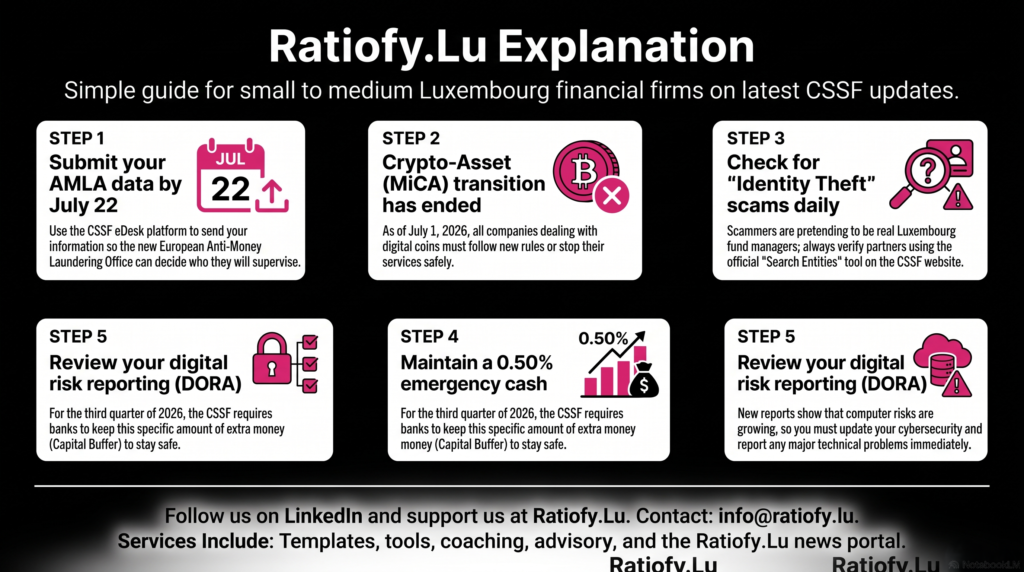
- Countercyclical Capital Buffer (CCyB): Regulation No 26-02 sets the rate for the third quarter of 2026 at 0.50%.
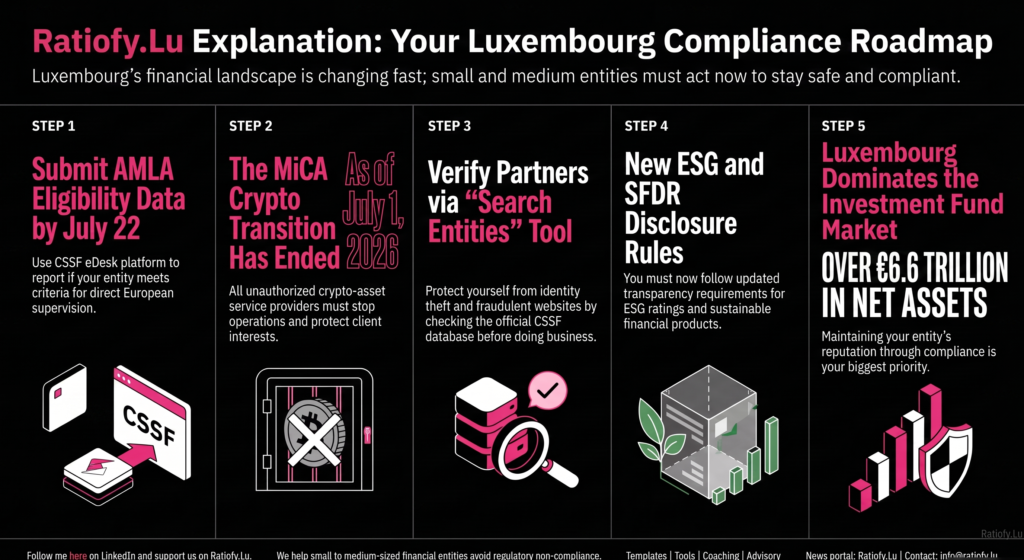
- AML/CFT (Circular 26/914): The European Anti-Money Laundering Authority (AMLA) is collecting data to identify entities for direct supervision starting in 2027. Relevant entities must submit data via the eDesk platform by July 22, 2026.
- Ancillary Services (Circular 26/913): Adoption of EBA Guidelines (EBA/GL/2026/01) to identify Ancillary Services Undertakings (ASUs), specifically covering operational leasing, property management, and data processing.
- High-Risk Jurisdictions: The list of jurisdictions subject to enhanced due diligence and FATF monitoring was updated on June 19, 2026.
Luxembourg Financial Centre Statistics under CSSF Newsletter No 306 – July 2026 in Luxembourg
Undertakings for Collective Investment (UCI) Profile
As of May 31, 2026, the Luxembourg fund market comprised 2,981 UCIs.
Breakdown by Legal Form and Status under CSSF Newsletter No 306 – July 2026 in Luxembourg:
| Legal Form | Percentage of UCIs | Percentage of Net Assets |
| SICAV | 57.87% | 82.29% |
| FCP | 35.86% | 16.10% |
| SICAR | 5.06% | 1.18% |
| Other UCI/SIF | 1.21% | 0.43% |
Breakdown by Law/Status under CSSF Newsletter No 306 – July 2026 in Luxembourg:
- Part I (2010 Law): 50.25% of UCIs; 84.20% of net assets.
- FIS/SIF: 34.22% of UCIs; 10.59% of net assets.
- Part II (2010 Law): 10.47% of UCIs; 4.03% of net assets.
- SICAR: 5.06% of UCIs; 1.18% of net assets.
Investment Policies and Asset Performance under CSSF Newsletter No 306 – July 2026 in Luxembourg
Total net assets reached €6,634.393 billion, with the following primary investment allocations:
- Variable-Yield Transferable Securities: €2,384.804 billion.
- Fixed-Income Transferable Securities: €1,535.501 billion.
- Mixed Transferable Securities: €1,184.883 billion.
- Money Market Instruments: €683.999 billion.
In June 2026, Part I funds saw net subscriptions of €14.433 billion, while SIFs experienced net redemptions of €2.542 billion.
Origin and Currency under CSSF Newsletter No 306 – July 2026 in Luxembourg
- Initiators: The United States remains the largest initiator of Luxembourg UCIs (19.5% of net assets), followed by Great Britain (16.4%) and Germany (14.2%).
- Currencies: The Euro (53.28%) and the US Dollar (40.39%) are the dominant reference currencies.
European and International News under CSSF Newsletter No 306 – July 2026 in Luxembourg
Digital Resilience and AI Adoption under CSSF Newsletter No 306 – July 2026 in Luxembourg
- DORA Implementation: The ESAs published the first annual report on major ICT-related incidents. The report emphasizes that ICT risks are increasingly borderless and warns that AI-driven tools necessitate stronger cybersecurity measures.
- AI Guidelines: The Financial Stability Board (FSB) released a consultation report on 12 sound practices for the responsible adoption of AI, focusing on financial stability and operational resilience.
- Product Governance: The European Banking Authority (EBA) updated guidelines to address “greenwashing” risks in ESG-related retail banking products.
Crypto-Assets and Stablecoins under CSSF Newsletter No 306 – July 2026 in Luxembourg
- MiCA Transition: The transitional period for virtual asset service providers ended on July 1, 2026. ESMA has instructed unauthorized providers to wind down operations orderly.
- International Cooperation: The EBA signed an MoU with the New York State Department of Financial Services (NYDFS) to coordinate the supervision of cross-border stablecoin activities.
Banking Supervision and Efficiency under CSSF Newsletter No 306 – July 2026 in Luxembourg
- 2027 Stress Tests: The EBA launched a consultation on a simplified stress test methodology for 2027. This exercise will cover 63 banks (75% of the EU banking sector) and integrate climate risks.
- Capital Framework Simplification: Proportionality and efficiency remain central to the EBA’s agenda, with proposals to reduce complexity in microprudential and macroprudential frameworks.
- Deposit Protection: EU deposit guarantee scheme (DGS) funds have reached €85 billion. The EBA is implementing the revised Deposit Guarantee Schemes Directive (DGSD3) to further strengthen depositor protection.
Macroeconomic Outlook and Monetary Policy under CSSF Newsletter No 306 – July 2026 in Luxembourg
European Central Bank (ECB) Actions under CSSF Newsletter No 306 – July 2026 in Luxembourg
In June 2026, the ECB raised key interest rates by 25 basis points. This decision was driven by:
- Energy Shocks: Inflationary pressure resulting from the conflict in the Middle East.
- Growth Projections: GDP growth is projected to remain weak at 0.8% in 2026, with a gradual recovery to 1.5% by 2028.
- Inflation Targets: Inflation is expected to peak at 3.0% in 2026 before returning to the 2% target by 2028.
Luxembourg Economic Situation under CSSF Newsletter No 306 – July 2026 in Luxembourg
The national economy is reported to be in a state of stagnation as of mid-2026. While external demand remains a driver, general uncertainty is limiting momentum across various sectors.
Institutional and Human Resources Updates under CSSF Newsletter No 306 – July 2026 in Luxembourg
- CSSF Staffing: As of June 2026, the CSSF employs 1,031 agents (573 men and 458 women). Recent hires were assigned to departments including Innovation, Public Oversight of Audit, and Information Systems.
- Audit Profession Oversight: There are currently 68 approved audit firms and 510 approved statutory auditors in Luxembourg.
- Transparency Law: As of June 30, 2026, 362 issuers are under CSSF supervision, with 88.12% of securities being debt instruments.
- Prospectus Approvals: The CSSF approved 87 documents in June 2026, primarily consisting of base prospectuses (47.13%) and supplements (33.33%).
This news related to CSSF Newsletter No 306 – July 2026 in Luxembourg can be considered beneficial under CSSF-Circulars, Central Securities Depositories (CSDs) News, Credit Institutions News, Crowdfunding service providers (CSPs) News, Crypto-Assets Service Providers (CASPs) and Virtual Asset Service Providers (VASPs) News, Data Reporting Service Providers (DRSPs) News, EU Regulations, Explanation, IFMs (AIFMs, ManCos) News, Investment Firms News, Issuers of Tokens (EMTs, ARTs) News, Multimedia, Must Read, Opinion, Payment Institutions (PIs) / Electronic Money Institutions (EMIs) /AISPs News, Pension funds News, PFS/PSF News, Undertakings for collective investment (UCIs).
At https://Ratiofy.Lu/, we defend your hard-earned money with our free daily news platform and expert-vetted templates. Need more help? Request access to our hands-on expert Advisory, Training and Coaching Services (very limited availability) related to CSSF Circulars and EU Regulations.
The pre-filled example templates for many CSSF Circulars should be available at https://ratiofy.lu/templates/ from the summer of 2026.
CSSF Newsletter No 306 – July 2026 in Luxembourg : 5 Essential Takeaways from the Future of Finance: Navigating the July 2026 Landscape
1. Introduction: The High-Stakes Shift under CSSF Newsletter No 306 – July 2026 in Luxembourg
The Luxembourg financial landscape in July 2026 is defined by a striking paradox of scale and fragility. As the latest data from the Commission de Surveillance du Secteur Financier (CSSF) makes clear, the industry is navigating a period of “competing forces.” On one hand, we see a massive fund sector reaching new heights of capital concentration; on the other, this growth is clashing with a darkening economic outlook—characterized by a baseline GDP growth projection of just 0.8%—and a surge in institutional-grade fraud. For the time-poor executive, the message is clear: innovation and asset growth are no longer sufficient metrics for success; the new premium is placed on the “infrastructure of trust.”
2. Identity Theft Goes Institutional: The New Face of Financial Fraud under CSSF Newsletter No 306 – July 2026 in Luxembourg
The July 2026 update reveals a sophisticated evolution in criminal tactics. We have moved beyond simple consumer phishing into the realm of “institutional identity theft,” where bad actors are systematically impersonating Luxembourg investment fund managers. This is not merely a technical breach but a forensic attack on the reputational bedrock of the fund industry.
A chilling level of detail is being employed to bypass traditional skepticism. Fraudsters are misusing specific professional email formats—notably firstname.lastname@pro-trx.net—and have gone as far as impersonating established firms such as 2 PM EUROPE S.A. to lend their schemes an air of legitimacy. The scale of this spoofing is significant, with the CSSF flagging a growing list of fraudulent entities, including:
- alinmcol.com
- tresorwacht.com
- hautfortpartners.com
The Actionable Takeaway: In an era of high-fidelity institutional spoofs, manual verification is mandatory. The CSSF strongly recommends that all market participants utilize the official “Search Entities” application to verify any counterparty before engaging in business.
3. The “Wild West” Era Ends: The MiCA Transition is Complete under CSSF Newsletter No 306 – July 2026 in Luxembourg
July 1, 2026, marks the definitive end of the Markets in Crypto-Assets (MiCA) transition period. This milestone signals that crypto-assets have officially shed their “alternative” status to become a fully regulated, mainstream pillar of the European financial system.
The European Securities and Markets Authority (ESMA) is overseeing this final wind-down with surgical precision, ensuring that the regulatory perimeter remains airtight.
“ESMA calls on unauthorised crypto-asset service providers to wind down orderly, while also safeguarding clients’ interests, as MiCA transitional period ends.”
This regulatory maturity is mirrored on the global stage through significant “Transatlantic regulatory alignment.” The European Banking Authority (EBA) and the New York State Department of Financial Services (NYDFS) have signed a Memorandum of Understanding (MoU) to foster cross-border cooperation in the supervision of stablecoins. For global managers, this signifies that the era of regulatory arbitrage in digital assets is effectively over.
4. AI is No Longer “Future Tech”—It’s a Core Operational Risk under CSSF Newsletter No 306 – July 2026 in Luxembourg
2026 has become the “year of first data” for the Digital Operational Resilience Act (DORA). The European Supervisory Authorities (ESAs) have published the first annual report on major ICT-related incidents, confirming that ICT risks are now “borderless and interconnected.”
The emergence of agentic AI – autonomous tools capable of independent action—has drastically increased the velocity and complexity of these risks. The Financial Stability Board (FSB) notes that while AI offers “evolving opportunities,” its agentic nature can exploit existing ICT vulnerabilities at a speed that traditional defensive postures cannot match.
Distilling the FSB’s 12 sound practices for AI adoption, firms should focus on three critical themes:
- Operational Resilience & Velocity: Strengthening cybersecurity to counter autonomous AI tools that can trigger interconnected ICT failures across borders.
- Systemic Stability: Actively monitoring how the mass adoption of generative and agentic AI increases the “interconnectedness” and potential contagion within the financial sector.
- Governance-Led Adoption: Moving beyond experimental AI to principled deployment, ensuring that autonomous actions do not create unforeseen legal or consumer liabilities.
5. The €6.6 Trillion Reality: Luxembourg’s Scale vs. Economic Stagnation under CSSF Newsletter No 306 – July 2026 in Luxembourg
Luxembourg continues to dominate as a global investment hub, with total net assets in Undertakings for Collective Investment (UCIs) standing at a staggering €6,634.393 billion as of May 31, 2026. However, this mountain of capital exists within an economy that the “Conjoncture Flash” report describes as “close to stagnation.”
The macro-economic picture is sobering: GDP growth is pinned at a baseline of 0.8% for 2026, while the European Central Bank (ECB) has implemented a 25 basis point interest rate hike to combat inflation (projected at 3.0%) driven by Middle East energy shocks. This environment suggests a “fragile, uneven recovery” where external demand is the only remaining driver.
The current legal structure of this €6.6 trillion industry is detailed below:
| UCI Form | Total Net Assets (Billion EUR) |
| SICAV | 5,459.791 |
| FCP | 1,068.266 |
| SICAR | 78.127 |
| Other UCIs/SIFs | 28.209 |
| Total | 6,634.393 |
6. Conclusion: Resilience as the New Competitive Advantage
The overarching theme of the July 2026 landscape is that resilience has replaced growth as the industry’s most valuable currency. Despite the convergence of geopolitical shocks and the disruptive arrival of agentic AI, the EBA’s Spring 2026 Risk Assessment confirms that the banking and fund sectors remain fundamentally “resilient.”
However, this resilience is not a legacy trait—it is an active operational requirement. As the MiCA transition closes and DORA reporting begins to yield its first forensic insights into ICT failures, the gap between the prepared and the vulnerable will only widen.
Final Question: In an era of agentic AI and trillion-euro fund shifts, is your firm’s definition of “resilience” still grounded in the reality of 2026, or is it a relic of a simpler time?