
Luxembourg Financial Regulatory Advisory, Tools, Templates:
The European Union’s AI Act in Luxembourg and in EU represents the first comprehensive legal framework designed to govern artificial intelligence by prioritizing safety, ethics, and transparency. As per the latest communication by European Council, most of the EU AI Act in Luxembourg and in EU is in force now. This legislation utilizes a risk-based hierarchy to categorize technologies, ranging from unregulated minimal-risk tools to strictly prohibited systems that threaten human rights or safety. While the law imposes heavy fines for non-compliance, it simultaneously seeks to foster technological innovation and investment within the European market. To ensure effective oversight, the act establishes a governance structure consisting of specialized offices and expert panels to manage enforcement. Ultimately, these documents highlight the EU’s ambition to set a global regulatory standard for trustworthy AI while protecting citizens from digital harms.
Summary of EU AI Act in Luxembourg and in EU applicability from August 2026
The European Union’s Artificial Intelligence (AI) Act represents the world’s first comprehensive legal framework dedicated to artificial intelligence. Its primary objective is to ensure that AI systems within the EU single market are safe, ethical, and trustworthy while simultaneously fostering innovation and investment. By addressing risks such as bias, discrimination, and accountability gaps, the Act seeks to establish a global standard for AI regulation, mirroring the impact of the General Data Protection Regulation (GDPR) on data privacy.
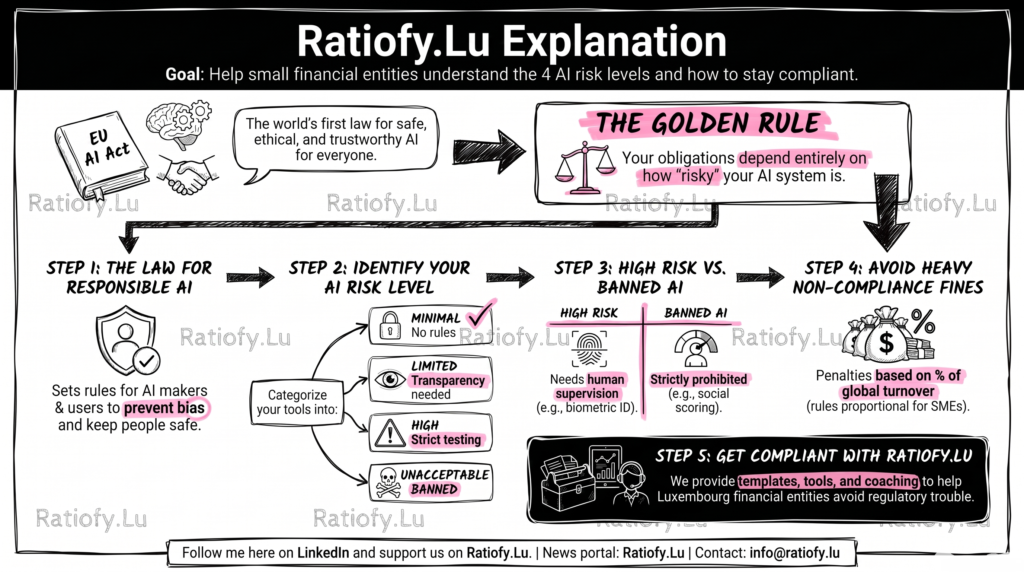
The legislation employs a tiered, risk-based approach, categorizing AI applications into four levels of risk – Minimal, Limited, High, and Unacceptable -with regulatory obligations increasing alongside the level of potential harm. Furthermore, the Act establishes a robust governance architecture, including a dedicated AI Office and various advisory bodies, to ensure consistent enforcement across member states. Subsequent updates, such as the 2026 “Omnibus VII” package, continue to refine these rules to address emerging concerns like non-consensual intimate content.
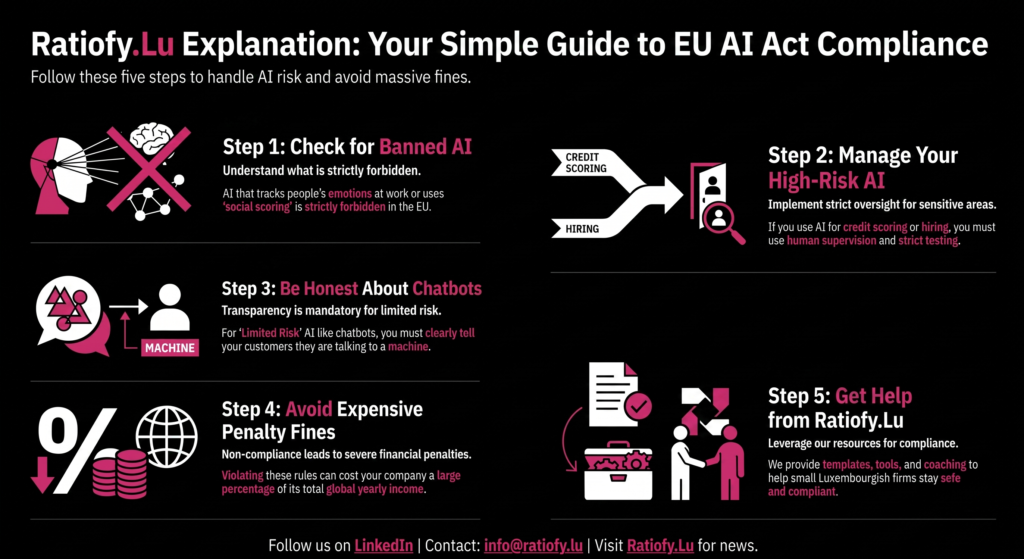
Core Objectives and Scope of EU AI Act in Luxembourg and in EU applicability from August 2026
The AI Act is designed to regulate the authorization, development, and deployment of AI technologies within the EU. Its mission is characterized by three central pillars:
- Responsibility and Safety: Ensuring AI systems are used ethically and do not compromise fundamental rights or safety.
- Risk Mitigation: Targeting specific harms such as systemic bias and lack of accountability.
- Market Innovation: Promoting the uptake of AI and facilitating a unified single market for AI applications to encourage European investment and research.
The Risk-Based Regulatory Framework of EU AI Act in Luxembourg and in EU applicability from August 2026
The Act categorizes AI systems based on the level of risk they pose to society. The stringency of the rules is directly proportional to these risk levels:
| Risk Level | Description and Examples | Regulatory Requirements |
| Unacceptable Risk | Systems seen as a threat to safety, rights, or livelihoods (e.g., social scoring, predictive policing, emotion recognition in schools/workplaces). | Prohibited. Banned from use in the EU with very limited exceptions for law enforcement. |
| High Risk | Systems used in critical sectors (e.g., disease diagnosis, autonomous driving, biometric identification for criminal investigations). | Strict Obligations. Must undergo rigorous testing and ensure transparency and human supervision for market access. |
| Limited Risk | Systems with lower potential for harm (e.g., chatbots, AI-generated content). | Transparency. Must inform users they are interacting with or viewing AI-generated content. |
| Minimal or No Risk | Common AI applications (e.g., AI-powered games, spam filters). | Unregulated. These systems are not affected by the AI Act and can be used freely. |
General-Purpose AI (GPAI) under EU AI Act in Luxembourg and in EU applicability from August 2026
General-purpose AI models, which can perform a wide range of tasks like image recognition and text generation, are handled according to their systemic impact:
- Non-systemic GPAI: Subject to limited transparency requirements.
- Systemic GPAI: Required to comply with stricter regulatory rules due to their broader potential impact.
Governance Architecture and Enforcement under EU AI Act in Luxembourg and in EU applicability from August 2026
To ensure the effective application of the AI Act, the EU has established a multi-layered governance structure:
- AI Office: Situated within the European Commission to enforce common rules across the EU.
- AI Board: Composed of representatives from member states to advise the Commission and assist in consistent application.
- Scientific Panel: A group of independent experts providing technical support for enforcement activities.
- Advisory Forum: A platform for stakeholders to provide technical expertise to the AI Board and the Commission.
Penalties for Non-Compliance under EU AI Act in Luxembourg and in EU applicability from August 2026
The law mandates fines for violations of its provisions. These penalties are calculated as either a percentage of the offending company’s global annual turnover from the previous year or a fixed set amount, whichever is higher. Small and Medium Enterprises (SMEs) and start-ups are subject to more proportional fine structures.
Support for Innovation
The AI Act is intended to work in tandem with the EU’s “coordinated plan on artificial intelligence.” This initiative aims to:
- Accelerate public and private investment in AI research and deployment.
- Strengthen synergies between European research centers of excellence.
- Provide clear, objective definitions for high-risk systems to give developers legal certainty.
Legislative Timeline and Evolution of EU AI Act in Luxembourg and in EU applicability from August 2026
The development of the AI Act followed a multi-year legislative process:
- October 2020: The European Council initiates discussions on the digital transition and AI investment.
- April 2021: The European Commission releases the initial proposal for the AI Act.
- December 2022: The Council adopts its position, emphasizing fundamental rights.
- December 2023: A provisional agreement is reached between the Council and the European Parliament after “marathon” negotiations.
- May 21, 2024: The Act is formally adopted by the Council.
- August 1, 2024: The AI Act officially enters into force.
- June 29, 2026: The Council approved the “Omnibus VII” legislative package. This regulation streamlines and simplifies existing rules while introducing a specific prohibition against AI practices that generate child sexual abuse material or non-consensual sexual and intimate content.
This news related to EU AI act in Luxembourg and in EU can be considered beneficial under CSSF-Circulars, Central Securities Depositories (CSDs) News, Credit Institutions News, Crowdfunding service providers (CSPs) News, Crypto-Assets Service Providers (CASPs) and Virtual Asset Service Providers (VASPs) News, Data Reporting Service Providers (DRSPs) News, EU Regulations, Explanation, IFMs (AIFMs, ManCos) News, Investment Firms News, Issuers of Tokens (EMTs, ARTs) News, Multimedia, Must Read, Opinion, Payment Institutions (PIs) / Electronic Money Institutions (EMIs) /AISPs News, Pension funds News, PFS/PSF News, Undertakings for collective investment (UCIs).
At https://Ratiofy.Lu/, we defend your hard-earned money with our free daily news platform and expert-vetted templates. Need more help? Request access to our hands-on expert Advisory, Training and Coaching Services (very limited availability) related to CSSF Circulars and EU Regulations.
The pre-filled example templates for many CSSF Circulars are available at https://ratiofy.lu/templates/ from the summer of 2026.
The Wild West is Over: 5 Ways the World’s First AI Law Changes Everything
For years, the development of artificial intelligence has felt like a digital frontier operating in a regulatory vacuum. Innovation moved at breakneck speed, often outpacing our understanding of its societal consequences as the industry mantra remained “move fast and break things.” From deepfakes to biased algorithms, the lack of a clear rulebook created a landscape where the primary directive was technical capability, not social responsibility.
That era is officially coming to a close. With the introduction of the EU AI Act—which entered into force on August 1, 2024—the law has finally caught up to the code. This is the world’s first comprehensive legal framework designed to tame the frontier, with the explicit goal of ensuring AI systems are “safe, ethical and trustworthy.” This isn’t just a technical adjustment; it’s a fundamental reimagining of algorithmic accountability.
As this landmark legislation takes hold, it marks a shift in how technology will be developed and deployed globally. The frontier is being fenced—here are the five pillars of the new digital order.
1. Setting the Global “GDPR” Standard under EU AI Act in Luxembourg and in EU applicability from August 2026
The EU AI Act is not merely a regional speed bump; it is designed to be the global blueprint for modern societies grappling with algorithmic power. By regulating the massive European single market, the EU is triggering the “Brussels Effect,” effectively dictating how global tech giants build their products for everyone, everywhere.
“As the world’s first law regulating AI, the EU’s rules could set a global standard in AI regulation, just as the general data protection regulation (GDPR) has done for data privacy, promoting ethical, safe, and trustworthy artificial intelligence worldwide.”
For tech companies outside the EU, the Act is now the de facto international baseline. Developers in Silicon Valley or Singapore must now align their global standards with European requirements if they wish to access one of the world’s most lucrative markets. In the age of borderless code, the EU has just become the world’s lead architect for AI safety.
2. The “Unacceptable” List – What’s Now Banned under EU AI Act in Luxembourg and in EU applicability from August 2026
One of the most striking aspects of the Act is its “Unacceptable Risk” category. While many frameworks offer suggestions for “best practices,” the EU has identified specific AI applications that are so harmful to human rights and safety that they are strictly prohibited within the Union.
Banned AI practices now include:
- Cognitive-behavioral manipulation: Systems designed to subvert an individual’s free will.
- Social scoring: Government or private systems that rank citizens based on behavior or personality traits.
- Predictive policing: AI used to assess the likelihood of an individual committing a future crime.
- Emotion recognition: Specifically prohibited when used in workplaces and educational institutions.
- Real-time remote biometric identification: The use of facial recognition by law enforcement in public spaces (subject to narrow exceptions).
The prohibition of emotion recognition in schools is a particularly vital human rights victory. By preventing the “data-fying” of a student’s internal mood, the law stops the reduction of complex human emotions into flawed data points. It ensures that classrooms remain spaces for learning rather than environments for intrusive psychological surveillance.
3. The Transparency Mandate for Your Favorite Chatbots under EU AI Act in Luxembourg and in EU applicability from August 2026
For AI systems that fall into the “Limited Risk” category—like the chatbots and image generators we interact with daily—the Act introduces a strict transparency mandate. This is the end of the “uncanny valley” of hidden AI; the technology must now identify itself.
Under these rules, providers have a legal obligation to disclose when a user is interacting with an AI system. This shift will transform the daily user experience, effectively creating a “Nutrition Label” for digital content. By making AI disclosure a legal requirement, the law allows users to make informed decisions about the information they consume and the bots they trust, moving us toward a more honest digital ecosystem.
4. Massive Penalties: Taxing Global Ambition under EU AI Act in Luxembourg and in EU applicability from August 2026
The EU AI Act isn’t just high-minded philosophy; it has teeth. To ensure compliance from the world’s most powerful entities, the law establishes an enforcement mechanism where fines are a “nuclear option” designed to make non-compliance a catastrophic financial risk.
Penalties are based on a percentage of a company’s global turnover from the previous year or a set amount, whichever is higher. By calculating fines based on total worldwide revenue rather than just EU-specific earnings, the law essentially “taxes” Big Tech’s global ambition. However, to ensure this doesn’t stifle the next generation of innovators, the Act provides a “proportional” approach for SMEs and start-ups. For the giants of the industry, however, compliance is now a fiduciary necessity.
5. Agile Governance: The 2026 “Regulatory Patch” under EU AI Act in Luxembourg and in EU applicability from August 2026
Demonstrating that modern law can be as agile as software, the EU is already preparing “patches” for the legislation. The June 29, 2026, “Omnibus VII” update is designed to streamline and simplify the framework while addressing emerging societal harms that have accelerated since the initial draft.
A critical provision of this 2026 update is the explicit prohibition of AI practices involving the generation of non-consensual sexual and intimate content, as well as child sexual abuse material. This proactive stance on “digital harms” proves the Act is a living document, capable of evolving to protect citizens from the most visceral forms of algorithmic abuse as technology becomes more sophisticated.
Conclusion: A New Chapter for Innovation under EU AI Act in Luxembourg and in EU applicability from August 2026
The EU AI Act is a dual-track strategy: it sets firm boundaries on what AI cannot do while simultaneously striving to “promote investment and innovation.” The goal is to create a robust single market where people adopt technology because they know it is safe and lawful.
As we step into this new era, the global tech community faces a provocative choice. We are moving from a world of chaotic, unchecked growth to one of defined safety and fundamental rights. But in a world where AI is safe, ethical, and entirely predictable, do we risk losing the chaotic sparks of innovation that defined the Wild West? Under the EU AI Act, we are about to find out.