
EU AI Act, NIS2, GDPR, PSD2, ISO, DORA Advisory, Templates, Trainings, Tools based in Luxembourg:
ICT Risk Management Framework Review Report in Luxembourg and EU is a must to be submitted on a yearly basis for the financial and insurance institutions under the Digital Operational Resilience Act (DORA). This document must be delivered in a searchable digital format and include an executive introduction detailing the organization’s operational scope, threat landscape, and risk profile. Furthermore, the submission requires a thorough account of the review’s timeline, methodologies, findings, and any weaknesses or vulnerabilities uncovered during the evaluation process. Entities must also outline specific remediation measures, timelines, resource allocations, and action plans for addressing identified security gaps. Finally, the report relies on multiple evidentiary sources, including internal audits, compliance evaluations, operational resilience testing, and past review outcomes to ensure complete regulatory transparency.
Summary of the requirements of ICT Risk Management Framework Review Report in Luxembourg and EU under DORA
The Digital Operational Resilience Act (DORA) – specifically Article 6(5) of Regulation (EU) 2022/2554 – mandates that financial entities submit a formal report on the review of their Information and Communication Technology (ICT) risk management framework to their designated competent authority upon request.
To operationalize this mandate, Chapter V (Article 27) of the DORA Regulatory Technical Standards (RTS) – Commission Delegated Regulation (EU) 2024/1774 – defines the exact structure, formatting, and content required for this report. Financial entities must submit this document in a searchable electronic format, incorporating management body sign-off, detailed gap assessments, resource allocation plans, root-cause analyses of triggering incidents, and evidence from internal controls, compliance reviews, and digital resilience testing.
This briefing document provides an exhaustive breakdown of the legal obligations, operational parameters, required disclosures, and structural components necessary for full compliance with the DORA ICT risk management review framework.
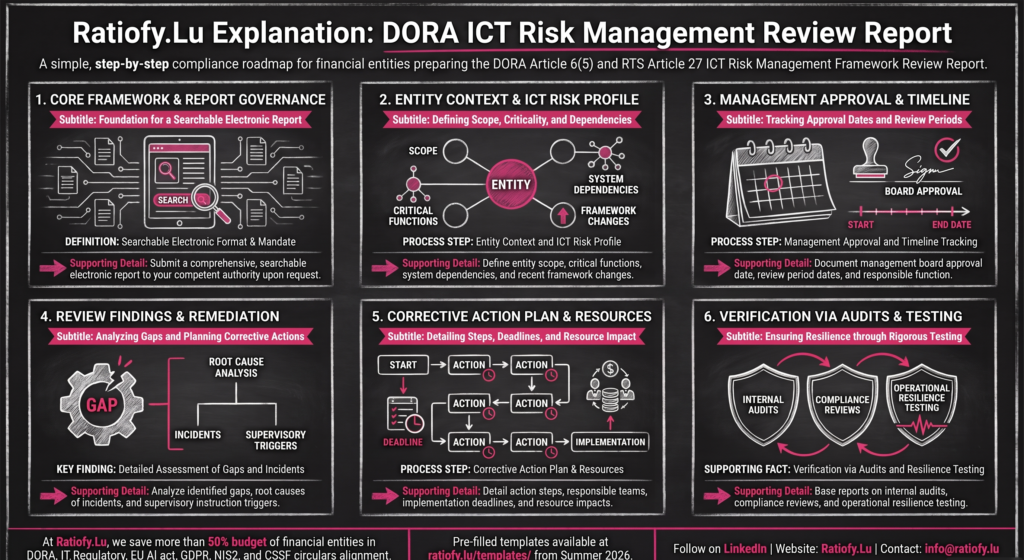
1. Regulatory Context and Core Legal Mandates under the requirements of ICT Risk Management Framework Review Report in Luxembourg and EU under DORA
1.1 DORA Article 6(5) Obligation under the requirements of ICT Risk Management Framework Review Report in Luxembourg and EU
Under Article 6, paragraph 5 of DORA (Regulation (EU) 2022/2554), financial entities are subject to regulatory oversight regarding their ICT operational resilience. Upon receiving a request from a competent authority, financial entities must produce and submit a comprehensive report detailing the review of their ICT risk management framework.
1.2 DORA RTS Article 27 Specifications under the requirements of ICT Risk Management Framework Review Report in Luxembourg and EU
Commission Delegated Regulation (EU) 2024/1774 specifies the ICT risk management tools, methods, processes, and policies for both standard and simplified frameworks. Chapter V, Article 27 lays out the format and precise mandatory contents of the review report:
- Format: The report must be provided in a searchable electronic format.
- Mandatory Scope: The report must comprehensively cover the organization’s governance, current threat landscape, identified gaps, remediation strategies, historical review performance, and supporting audit/testing data.
2. Structural Requirements of the Review Report under the requirements of ICT Risk Management Framework Review Report in Luxembourg and EU under DORA
Article 27(2) of the DORA RTS establishes a multi-part structure that financial entities must follow when assembling the report.
DORA ICT Risk Management Framework Review Report
│
┌─────────────────────────┼─────────────────────────┐
│ │ │
Introductory Context & Governance & Drivers Framework Changes &
Risk Profile (2a) (2b – 2e) Impact Analysis (2f)
│ │ │
├─────────────────────────┼─────────────────────────┤
│ │ │
Deficiency Assessment & Planned Developments & Information Sources &
Remediation Plans (2g-2h) Past Reviews (2i – 2k) Testing Data (2l)
2.1 Introductory Section and Context (Article 27(2)(a))
The introductory section sets the operational context of the entity. It must include:
- Entity Identification & Group Structure: Clear identification of the subject financial entity and an explicit description of its group structure, where applicable.
- Operational Context: Detail regarding the nature, scale, and complexity of the entity’s services, activities, and operations. This includes:
- Organizational layout and identified critical functions.
- Current strategy and major ongoing projects or activities.
- Relationships with and dependencies on both in-house and contracted ICT services and systems.
- The potential implications/impact that a total loss or severe degradation of these ICT systems would have on critical/important functions and broader market efficiency.
- Framework Evolution Summary: A summary highlighting major changes made to the ICT risk management framework since the submission of the previous report.
- Executive-Level Overview: High-level summary of the entity’s current and near-term ICT risk profile, the active threat landscape, assessed effectiveness of existing controls, and overall security posture.
2.2 Governance, Timing, and Initiation Drivers (Article 27(2)(b)–(e))
The report must capture administrative and governance accountability:
- Management Body Approval: The exact date the report was formally approved by the financial entity’s management body (Article 27(2)(b)).
- Review Period: The precise start and end dates covering the review window (Article 27(2)(d)).
- Responsible Unit: Indication of the specific internal function responsible for conducting the review (Article 27(2)(e)).
- Reason for Review (Article 27(2)(c)): A detailed explanation of why the review was initiated under Article 6(5).
Mandatory References Based on Review Triggers under the requirements of ICT Risk Management Framework Review Report in Luxembourg and EU:
- Supervisory/Audit Triggers: If initiated due to supervisory instructions or conclusions from digital operational resilience testing or audits, the report must contain explicit cross-references to those specific instructions or conclusions.
- Incident Triggers: If the review was prompted by ICT-related incidents, the report must include a complete list of all relevant ICT-related incidents accompanied by a full incident root-cause analysis.
2.3 Framework Changes and Strategic Impact (Article 27(2)(f))
Financial entities must detail all major changes and improvements made to the ICT risk management framework since the last review. This section requires a specific impact analysis explaining how these changes affect:
- The entity’s overall digital operational resilience strategy.
- The entity’s ICT internal control framework.
- The entity’s ICT risk management governance structure.
3. Findings, Remediation, and Risk Acceptance under the requirements of ICT Risk Management Framework Review Report in Luxembourg and EU under DORA
3.1 Gap and Severity Assessment (Article 27(2)(g))
The report must summarize all findings identified during the review period, providing a detailed analysis and assessment of the severity of all weaknesses, deficiencies, and gaps present in the ICT risk management framework.
3.2 Remediation Protocols (Article 27(2)(h))
To address the identified weaknesses, deficiencies, and gaps, financial entities must detail their corrective action plans across six distinct parameters:
| Remediation Element | Detailed Requirement |
| Action Summary | A summary of all corrective measures undertaken to remediate identified gaps (h)(i). |
| Timelines & Control | Expected implementation dates, key milestones for internal control of implementation, current progress status as of report drafting date, and explicit risk explanations if deadlines are in danger of being missed (h)(ii). |
| Tools & Responsibility | Specific tools deployed and identification of responsible functions (specifying whether internal or external) (h)(iii). |
| Resource Impact | Impact assessment of proposed changes on budgetary, human, and material resources, specifically accounting for dedicated corrective action resources (h)(iv). |
| Authority Notification | Description of the formal process established to inform competent authorities, where appropriate (h)(v). |
| Risk Acceptance Criteria | If identified gaps or weaknesses are not subject to corrective measures, a detailed explanation must be provided outlining criteria used to analyze impact, evaluate residual ICT risk, and accept that residual risk (h)(vi). |
4. Historical Analysis, Conclusions, and Data Sources under the requirements of ICT Risk Management Framework Review Report in Luxembourg and EU under DORA
4.1 Future Developments and Conclusions (Article 27(2)(i)–(j))
- Planned Developments: Overview of upcoming and planned enhancements to the ICT risk management framework.
- Conclusions: Formal conclusions derived directly from the outcomes of the framework review.
4.2 Historical Reviews Evaluation (Article 27(2)(k)) under the requirements of ICT Risk Management Framework Review Report in Luxembourg and EU
To demonstrate continuous monitoring, the report must incorporate past performance data:
- A complete list of past reviews conducted to date.
- The implementation status of corrective measures mandated by the previous report.
- Where past corrective measures proved ineffective or generated unexpected challenges, a description of how those measures will be improved or how the challenges will be mitigated.
4.3 Mandatory Information Sources (Article 27(2)(l)) under the requirements of ICT Risk Management Framework Review Report in Luxembourg and EU
The findings and conclusions in the report must be substantiated by empirical data and verified evaluation sources:
- Internal Audits: Results from internal audits (mandatory for all entities except microenterprises as defined under Article 6(6) of Regulation (EU) 2022/2554).
- Compliance Assessments: Results of internal and external regulatory compliance evaluations.
- Resilience Testing: Results of digital operational resilience testing, including advanced testing based on Threat-Led Penetration Testing (TLPT) of ICT tools, systems, and processes where applicable.
- External Sources: Relevant external threat intelligence, benchmarks, or third-party reports.
5. Summary Mapping of Report Components under the requirements of ICT Risk Management Framework Review Report in Luxembourg and EU under DORA
| Article 27 Reference | Report Section | Key Required Information |
| 2(a) | Introduction & Context | Entity ID, group structure, operational complexity, system dependencies/impacts, major changes, executive summary of risk profile. |
| 2(b)–(e) | Governance & Scope | Approval date, start/end dates, responsible unit, explicit review triggers (with incident root-cause analysis or audit references). |
| 2(f) | Impact of Changes | Impact analysis on resilience strategy, internal control framework, and governance. |
| 2(g)–(h) | Findings & Remediation | Gap severity, implementation schedules, dedicated resources, responsible internal/external tools, non-remediation risk acceptance justification. |
| 2(i)–(k) | Future Plans & History | Future roadmap, review conclusions, past review tracking, and analysis of ineffective past remedies. |
| 2(l) | Information Sources | Internal audits (non-microenterprises), compliance assessments, TLPT/resilience testing results, external data. |
6. Industry Implementation Context under the requirements of ICT Risk Management Framework Review Report in Luxembourg and EU under DORA
Financial entities aligning with DORA, EU AI Act, GDPR, NIS2, and CSSF circulars often utilize standardized tooling, templates, and specialized advisory services to streamline compliance workflows and reduce budgetary impacts.
Entities subject to these regulations may leverage pre-filled templates and regulatory resources (such as those being made available for CSSF Circulars starting in the summer of 2026 via platforms like Ratiofy.lu) to manage framework evaluations, track review periods, and prepare structured submissions required by competent authorities.
This news related tothe requirements of ICT Risk Management Framework Review Report in Luxembourg and EU under DORA can be considered beneficial under CSSF-Circulars, Central Securities Depositories (CSDs) News, Credit Institutions News, Crowdfunding service providers (CSPs) News, Crypto-Assets Service Providers (CASPs) and Virtual Asset Service Providers (VASPs) News, Data Reporting Service Providers (DRSPs) News, EU Regulations, Explanation, IFMs (AIFMs, ManCos) News, Investment Firms News, Issuers of Tokens (EMTs, ARTs) News, Multimedia, Must Read, Opinion, Payment Institutions (PIs) / Electronic Money Institutions (EMIs) /AISPs News, Pension funds News, PFS/PSF News, Undertakings for collective investment (UCIs).
At https://Ratiofy.Lu/, we defend your hard-earned money with our free daily news platform and expert-vetted templates. Need more help? Request access to our hands-on expert Advisory, Training and Coaching Services (very limited availability) related to CSSF Circulars and EU Regulations.
The pre-filled example templates for many CSSF Circulars are available at https://ratiofy.lu/templates/ from the summer of 2026.
Understanding EU DORA ICT Risk Management Framework Review Report: A Learner’s Blueprint
1. Introduction of the requirements of ICT Risk Management Framework Review Report in Luxembourg and EU under DORA: What is the DORA ICT Risk Management Review Report?
Under the European Union’s Digital Operational Resilience Act (DORA), financial entities must ensure they can withstand, respond to, and recover from all types of Information and Communication Technology (ICT) disruptions and threats. A cornerstone of this operational resilience framework is the mandatory periodic evaluation of an entity’s overarching ICT security setup.
The DORA ICT Risk Management Review Report is a comprehensive evaluation document designed to provide executive leadership and European supervisory authorities with complete transparency into an institution’s operational resilience posture.
> DORA Article 6(5) Core Mandate: “A report on the review of the ICT risk management framework shall be submitted to the competent authority upon its request.”
While Article 6(5) of DORA establishes the high-level legal obligation, the specific content, technical elements, and structural expectations are detailed in Article 27 of Commission Delegated Regulation (EU) 2024/1774, which sets the Regulatory Technical Standards (RTS) for ICT risk management.
To facilitate efficient supervisory analysis and automated data processing, financial entities are required to submit this report in a searchable electronic format.
| Legal Mandate (DORA Article 6(5)) | Technical Standard Details (RTS Article 27) |
| High-Level Requirement: Establishes the statutory obligation for financial entities to review their ICT risk management framework and present a formal report to competent authorities upon request. | Granular Execution: Defines the mandatory electronic format, reporting structure, and specific required narrative components (Points a through l). |
| Primary Focus: Establishing legal accountability, executive oversight, and regulatory reporting rights. | Primary Focus: Technical standardization, precise reporting metrics, and explicit incident root-cause traceability. |
Understanding how DORA’s statutory mandates map directly into a standardized reporting format provides the foundation for examining the four structural pillars that organize the report’s contents.
2. High-Level Anatomy: The Four Core Pillars of the Report under the requirements of ICT Risk Management Framework Review Report in Luxembourg and EU under DORA
To help learners process the twelve specific requirements outlined in Points (a) through (l) of RTS Article 27, the report can be grouped into four logical, thematic pillars:
- Entity Context & Current Security Posture (Points a, b) Establishes the operational identity of the financial entity, detailing its size, critical functions, ICT system dependencies, current threat landscape, and explicit management body approval.
- Review Scope & Initiation Triggers (Points c, d, e) Defines the operational context and timing of the evaluation, identifying the specific triggers that initiated the review, the review period dates, and the designated internal function held accountable for its execution.
- Findings, Weaknesses & Action Plans (Points f, g, h) Represents the diagnostic core of the report, detailing major framework changes, evaluating control gaps and their severity, and setting out resource-backed remediation plans or formal residual risk acceptance criteria.
- Evolution, Future Trajectory & Data Sources (Points i, j, k, l) Focuses on forward-looking resilience and historical verification, capturing planned ICT enhancements, review conclusions, past corrective measure performance, and the underlying audit or testing data sources used.
With these four broad pillars established, we can examine the specific regulatory requirements mandated across each section of the report.
3. Detailed Component Breakdown: Key Requirements & Explanations under the requirements of ICT Risk Management Framework Review Report in Luxembourg and EU under DORA
The following table breaks down every required component under Article 27 of the RTS, translating complex regulatory rules into accessible conceptual points.
| Report Section | Mandated Elements (Article 27) | Essential Purpose for the Learner |
| Introductory Context | Point (a): Entity identity and group structure; operational scale, nature, and complexity; critical functions; strategy; major ongoing projects; dependence on in-house or contracted ICT services and degradation/loss impacts; summary of major framework changes since previous report; executive summary of current/near-term ICT risk profile, threat landscape, control effectiveness, and overall security posture. | Establishes the entity’s operational baseline, identifying its critical functions, system dependencies, threat exposure, and macro security standing. |
| Governance & Dates | Point (b): Approval date by the management body. Point (d): Review period start and end dates. Point (e): Designated function responsible for the review. | Demonstrates governance oversight by confirming who conducted the review, the exact timeframe evaluated, and when senior management formally approved it. |
| Review Triggers | Point (c): Reason for initiating the review (e.g., supervisory instructions, internal audit findings, operational resilience testing, or major ICT incidents). | Explains the underlying operational or regulatory catalyst that prompted the review. |
| Framework Changes & Improvements | Point (f): Detailed description of major changes and improvements made to the ICT risk management framework since the previous review, combined with an analysis of their impact on digital operational resilience strategy, ICT internal controls, and risk governance. | Focuses on positive evolution, documenting structural upgrades to controls and governance while evaluating their strategic impact. |
| Deficiency & Weakness Analysis | Point (g): Summary of review findings, including a detailed analysis and severity assessment of identified weaknesses, deficiencies, and control gaps during the review period. | Serves as the diagnostic assessment, isolating vulnerability points and measuring the severity of control deficiencies across the framework. |
| Remediation Plans & Residual Risk | Point (h): Remediation measures, timelines, progress tracking, warning mechanisms for deadline risks, tools/functions used (internal or external), resource impacts (budgetary, human, material), regulatory notification protocols, and criteria for evaluating and accepting residual risk. | Outlines the concrete action plan to resolve security gaps, while establishing formal rules for accepting risk if immediate remediation is not possible. |
| Historical & Source Verification | Point (i): Information on planned framework developments. Point (j): Overall review conclusions. Point (k): Past reviews list, state of implementation of past corrective measures, and descriptions of how measures could be improved or unexpected challenges managed where past measures proved ineffective or created unexpected challenges. Point (l): Sources of information, including internal audit results (restricted to entities other than microenterprises), compliance assessments, digital operational resilience testing (including Threat-Led Penetration Testing [TLPT]), and external sources. | Ensures historical accountability and verifies the report’s findings by requiring evidence from audit trails, penetration testing, and past performance reviews. |
While every reporting element plays a key role in building a full picture of operational resilience, supervisory authorities place rigorous attention on how entities handle live operational incidents, execute remediation, and justify residual risks.
4. Special Focus: Incidents, Remediation, and Residual Risk under the requirements of ICT Risk Management Framework Review Report in Luxembourg and EU under DORA
Specific Review Triggers
Under Point (c), financial entities must explicitly document the specific catalyst that triggered the review process:
- Supervisory Instructions: If initiated due to regulatory orders, the report must contain explicit references to those supervisory instructions.
- Testing & Audits: If triggered by testing or audit findings, the report must contain explicit references to those specific testing conclusions or audit reports.
- ICT-Related Incidents: If initiated following operational disruptions or cyber attacks, the report must include a complete list of all ICT-related incidents alongside an incident root-cause analysis.
The 6 Required Elements of a Remediation Plan
When control gaps, weaknesses, or deficiencies are identified, Point (h) mandates that the entity’s corrective action plan explicitly contain the following six elements:
> Mandatory Elements of an Article 27(2)(h) Remediation Plan:
- Summary of Remediation Measures: A clear description of all specific actions taken or planned to resolve identified weaknesses, deficiencies, and gaps.
- Timelines & Progress Tracking: Expected implementation dates, internal control verification dates, current implementation status, and explicit explanations if there is a risk that deadlines may not be respected.
- Tools & Responsible Functions: Identification of the specific internal or external tools utilized and the exact internal or external function responsible for carrying out the measures.
- Resource Impact Analysis: A detailed description of how the corrective measures impact the entity’s budgetary, human, and material resources, including resources specifically dedicated to implementation.
- Regulatory Communication Process: Information on the formal process used for informing the competent supervisory authority, where appropriate.
- Residual Risk Acceptance Protocol: Detailed explanation of the criteria used to analyze operational impacts, evaluate remaining risk exposures, and accept residual ICT risk whenever identified weaknesses are not subject to corrective measures.
Accepting Residual Risk under the requirements of ICT Risk Management Framework Review Report in Luxembourg and EU
When an identified vulnerability cannot be fully remediated – such as when legacy infrastructure prevents an immediate control deployment – the entity cannot simply leave the risk unaddressed. Under Point (h)(vi), leadership must execute a documented residual risk protocol. The report must detail the specific qualitative and quantitative criteria used to analyze the potential operational impact, evaluate the unmitigated risk, and formally justify the management body’s decision to accept that residual risk exposure.
5. Key Concept Checklist & Learner Summary under the requirements of ICT Risk Management Framework Review Report in Luxembourg and EU under DORA
This quick-reference checklist outlines the essential takeaways regarding DORA ICT Risk Management Review Reports:
- [ ] Searchable Electronic Format: The report must be submitted in a searchable digital format to enable efficient review and data extraction by competent authorities.
- [ ] Management Body Approval: The report must contain the explicit date of approval by the management body, establishing executive accountability for the entity’s risk posture.
- [ ] Root-Cause Analysis for Incidents: Reviews triggered by ICT incidents must include a complete log of all operational incidents accompanied by root-cause analyses.
- [ ] Framework Change Impact: Major changes and improvements (Point f) must be documented alongside an impact analysis across three areas: digital operational resilience strategy, ICT internal controls, and risk governance.
- [ ] Resource Allocation Details: Remediation plans must account for real-world execution costs, detailing impacts on human personnel, material tools, and dedicated budgets.
- [ ] Proactive Deadline Warnings: Remediation tracking must explicitly alert management and supervisors if there is a risk that target completion dates will be missed.
- [ ] Formal Residual Risk Protocol: Unremediated security gaps require documented criteria for impact analysis, residual risk evaluation, and formal management risk acceptance.
- [ ] Evidence-Based Data Sources: Entities (excluding microenterprises regarding internal audits) must ground report conclusions in verified sources, including compliance assessments, external data, and Threat-Led Penetration Testing (TLPT) results.
Beyond the Compliance Checklist: 5 Impactful Realities of DORA’s ICT Risk Management Review Report under DORA
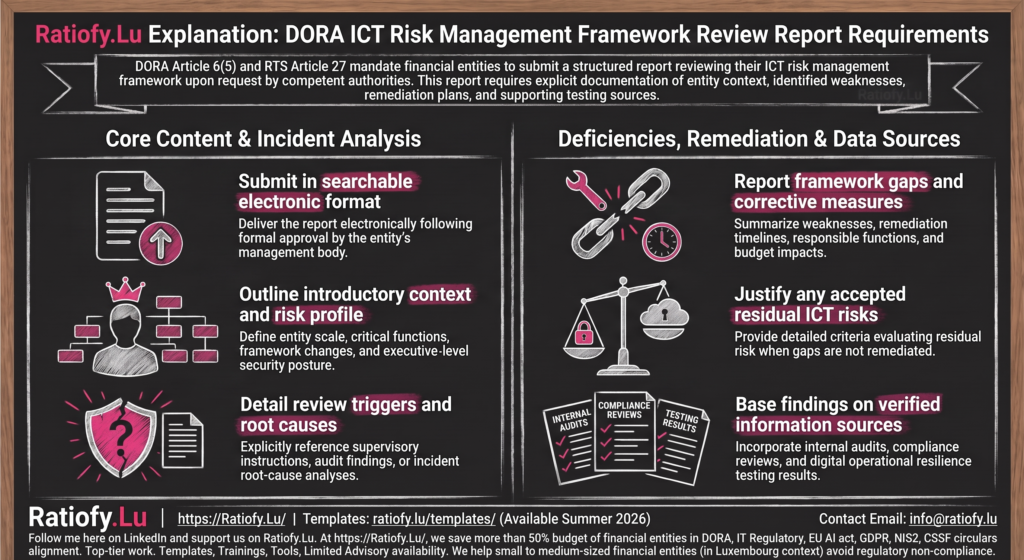
1. Introduction: Contextual Framing under the requirements of ICT Risk Management Framework Review Report in Luxembourg and EU under DORA
Navigating the evolving landscape of European financial regulation often feels like an endless exercise in administrative overhead. Under the Digital Operational Resilience Act (DORA), however, European supervisory authorities are signaling a fundamental shift away from superficial compliance. A primary example of this regulatory evolution sits embedded within Article 6(5) of Regulation (EU) 2022/2554, which mandates that financial entities must submit a comprehensive report on the review of their ICT risk management framework upon request by competent authorities.
Far from a routine paper-pushing exercise, the technical requirements codified in Commission Delegated Regulation (EU) 2024/1774 (RTS), Chapter V, Article 27 establish a deeply structured, transparent mandate that must be delivered in a searchable electronic format. Under Article 27(2)(a), the report must contextualize risk through a granular narrative: detailing group structures, organizational complexity, and identified critical functions. It requires entities to map their structural dependencies on both in-house and contracted third-party ICT services, explicitly outlining the operational and market efficiency impacts should those critical systems suffer severe degradation or total loss. Coupled with an executive summary of the current and near-term threat landscape, control effectiveness, and security posture, DORA elevates this review from a static IT audit into a core strategic asset.
For Chief Risk Officers, Chief Information Security Officers, and Board members, recognizing the true operational scope of this mandate is paramount. DORA transforms what was once an internal periodic check into a high-stakes instrument of regulatory transparency and corporate governance.
2. Takeaway 1: Incident-Triggered Reviews Require Exposing Every Root Cause under the requirements of ICT Risk Management Framework Review Report in Luxembourg and EU under DORA
When a financial entity undertakes a review of its ICT risk management framework, DORA requires an explicit accounting of the precise catalyst behind the review. Under Article 27, entities can no longer offer generalized assertions regarding why an assessment took place.
Specifically, where a review is initiated following supervisory instructions, or conclusions derived from audit processes or digital operational resilience testing, the final report must contain explicit, formal references to those instructions or testing conclusions. This allows regulators to immediately cross-reference the review’s scope with their own supervisory findings.
More critically, when operational failures drive the review, the regulation explicitly prohibits institutions from hiding behind sanitized post-mortems or high-level summaries.
> “Where the review was initiated following ICT-related incidents, the report shall contain the list of all ICT-related incidents with incident root-cause analysis.”
From a GRC practitioner’s perspective, this level of regulatory exposure is unprecedented. Financial entities must disclose an exhaustive catalog of all relevant ICT-related incidents alongside uncompromising root-cause analyses. Regulators are demanding direct visibility into systemic operational vulnerabilities, architectural flaws, and process breakdowns. For risk leaders, this shifts the paradigm: incident management is no longer an isolated operational ticket – it is a matter of direct regulatory accountability.
3. Takeaway 2: No Sweeping Gaps Under the Rug – Unremediated Risks Demand Explicit Criteria under the requirements of ICT Risk Management Framework Review Report in Luxembourg and EU under DORA
Justifying Residual Risk and Unaddressed Weaknesses
In complex enterprise IT environments, remediating every single technical debt item or architectural deficiency instantaneously is an operational impossibility. DORA acknowledges this reality, but it ensures that choosing not to fix an identified gap carries an extensive documented burden of proof.
Under Article 27(2)(h)(vi), if an entity identifies weaknesses, deficiencies, or gaps during its review that are not subject to immediate corrective measures, it cannot simply file them away on a risk register. The entity must articulate a detailed, formal explanation detailing:
- The specific criteria used to analyze the severity and potential operational impact of those unaddressed weaknesses, deficiencies, or gaps.
- The explicit methodology and criteria applied to evaluate the resulting residual ICT risk.
- The formal risk-acceptance criteria utilized by the organization to justify accepting that residual risk.
This requirement fundamentally alters executive risk governance. Accepting residual risk can no longer be an informal nod or an implicit operational compromise. By forcing leadership to publish the exact analytical criteria used to accept unmitigated risk, DORA places direct accountability on executive management and the C-suite for any future operational failures stemming from those accepted gaps.
4. Takeaway 3: Remediation Isn’t Just Action Items – It Requires Complete Resource Accounting under the requirements of ICT Risk Management Framework Review Report in Luxembourg and EU under DORA
When an entity commits to correcting identified gaps, DORA requires far more than a high-level roadmap or a list of Jira tickets. The RTS demands complete operational, procedural, and financial resource accounting for every planned corrective measure.
To satisfy Article 27(2)(h), remediation plans submitted within the review report must explicitly detail:
- A comprehensive summary of corrective measures taken to remediate identified weaknesses, deficiencies, and gaps.
- Targeted implementation dates alongside specific dates for internal control checkpoints designed to oversee execution progress – including mandatory risk warnings and explanations if implementation deadlines face potential delays.
- The precise tools to be deployed and the specific functional teams responsible for execution, explicitly distinguishing between internal resources and third-party external providers.
- A detailed description of how envisaged changes impact the entity’s budgetary, human, and material resources, including resources dedicated specifically to executing corrective measures.
- Information outlining the formal process for informing competent authorities regarding remediation progress and milestones, where appropriate.
From an enterprise risk management (ERM) perspective, this requirement bridges the historical divide between technical IT remediation and C-suite financial planning. By tracking internal versus external tool usage and detailing concrete budgetary, material, and human resource allocations, DORA ensures that technical IT remediation plans align directly with executive financial planning and carry board-backed operational resources.
5. Takeaway 4: Historical Self-Correction – Past Failures Must Be Documented under the requirements of ICT Risk Management Framework Review Report in Luxembourg and EU
DORA forces financial entities to establish historical continuity across their compliance reporting. A review report cannot be authored as a self-contained, forward-looking exercise; it must establish an auditable record of historical self-correction and past performance.
Under Article 27(2)(k), entities are legally mandated to incorporate detailed historical context into their reporting, including:
- A complete chronological record of all past framework reviews conducted to date.
- The current state of implementation for corrective measures identified in the preceding review report.
- An explicit analysis detailing where previously proposed corrective actions proved ineffective or encountered unexpected operational challenges, accompanied by concrete descriptions of how those measures will be improved or why those unexpected roadblocks occurred.
This retrospective requirement eliminates the common corporate habit of recycling unexecuted remediation plans year after year. If past corrective measures failed to resolve an architectural weakness or ran into deployment hurdles, executive leadership must openly document those failures, justify why previous attempts fell short, and demonstrate how updated strategies will overcome those historical barriers.
6. Takeaway 5: Board-Level Sign-Off and Multi-Layered Information Sourcing under the requirements of ICT Risk Management Framework Review Report in Luxembourg and EU under DORA
The governance structure established under DORA Article 27 directly links technical, multi-layered risk telemetry to board-level personal liability and strategic decision-making.
First and foremost, the report must state the explicit date on which the financial entity’s management body formally approved the document. This sign-off is not a passive endorsement; the report must incorporate a rigorous analysis of how identified gaps, remediation efforts, and structural changes impact the entity’s overall digital operational resilience strategy, its ICT internal control framework, and its overarching ICT risk management governance.
Furthermore, DORA mandates that the report’s conclusions must be grounded in multi-layered, objective data streams collected across both internal and external operational lines:
- Internal Audit & Compliance Telemetry: For entities other than microenterprises (as referred to in DORA Article 6(6)), the report must synthesize findings from independent internal audits alongside ongoing regulatory compliance assessments.
- Advanced Resilience & TLPT Testing: Findings must incorporate results from digital operational resilience testing. Where applicable under DORA, this includes advanced Threat-Led Penetration Testing (TLPT) targeting critical ICT tools, live production systems, and operational processes. Board sign-off on testing results derived from TLPT carries substantial legal and operational weight, placing direct responsibility on directors to ensure real-world threat simulations translate into verified technical resilience.
- External Threat Intelligence: Incorporating external threat feeds, supervisory insights, and third-party ecosystem telemetry to evaluate operational resilience against emerging sector-wide systemic risks.
7. Conclusion: The Paradigm Shift in ICT Governance & Closing Question under the requirements of ICT Risk Management Framework Review Report in Luxembourg and EU under DORA
DORA’s requirements for reviewing the ICT risk management framework represent a profound paradigm shift in digital financial regulation. What was once treated by many institutions as a periodic, box-ticking compliance exercise has been re-engineered into an active, transparent, and resource-heavy governance engine. By forcing institutions to expose incident root causes, justify residual risks with formal analytical criteria, allocate explicit budget and personnel to remediation, and mandate board sign-off on advanced testing like TLPT, European regulators are ensuring operational resilience is managed with the exact same rigor as financial capital.
Is your financial entity prepared to deliver this degree of operational transparency, resource tracking, and root-cause accountability when competent authorities request your ICT review report?
For financial entities seeking to maintain full alignment with DORA, CSSF circulars, and broader EU regulatory frameworks while optimizing operational overhead, expert-vetted compliance resources provide crucial efficiency. Institutions can save over 50% of their regulatory alignment budget across DORA, NIS2, GDPR, the EU AI Act, and CSSF requirements by utilizing pre-filled templates, targeted training, and specialized advisory solutions. Pre-filled example templates for major CSSF Circulars and EU regulations will be accessible directly at https://ratiofy.lu/templates/ starting in the summer of 2026, with current advisory solutions available via Ratiofy.lu.