
EU AI Act, NIS2, GDPR, PSD2, ISO, DORA Advisory, Templates, Trainings, Tools based in Luxembourg:
The CSSF communication here and circl.lu report here detail several critical security vulnerabilities discovered in Citrix NetScaler ADC and Gateway products in 2026. Experts emphasize that CVE-2026-88771 and CVE-2026-88772 are especially dangerous because they allow unauthenticated remote code execution and are already being actively exploited. The CSSF and CIRCL advise all impacted organizations to apply software updates immediately to mitigate risks like memory corruption and request smuggling. Beyond patching, administrators are urged to conduct forensic investigations on their systems to ensure no unauthorized persistence was established prior to the fix. Technical guidance is also provided to help teams identify vulnerable configurations and fulfil mandatory incident notification requirements.
Summary of Multiple Critical Vulnerabilities in Citrix NetScaler ADC and NetScaler Gateway such as CVE-2026-88771 and, CVE-2026-88772 – CSSF Communication in Luxembourg
On 28 September 2026, the Commission de Surveillance du Secteur Financier (CSSF) issued a formal communiqué regarding multiple critical security vulnerabilities affecting Citrix NetScaler ADC (formerly Citrix ADC) and Citrix NetScaler Gateway (formerly Citrix Gateway). Technical analysis and response recommendations were simultaneously published by the Computer Incident Center Luxembourg (CIRCL) under report TR-100 (https://www.circl.lu/pub/tr-100/).
A total of eight vulnerabilities have been disclosed: CVE-2026-88771 through CVE-2026-88778. These flaws encompass unauthenticated remote code execution (RCE), memory corruption, HTTP request smuggling, security-policy bypass, denial of service (DoS), and TCP Initial Sequence Number (ISN) prediction.
Key Takeaways
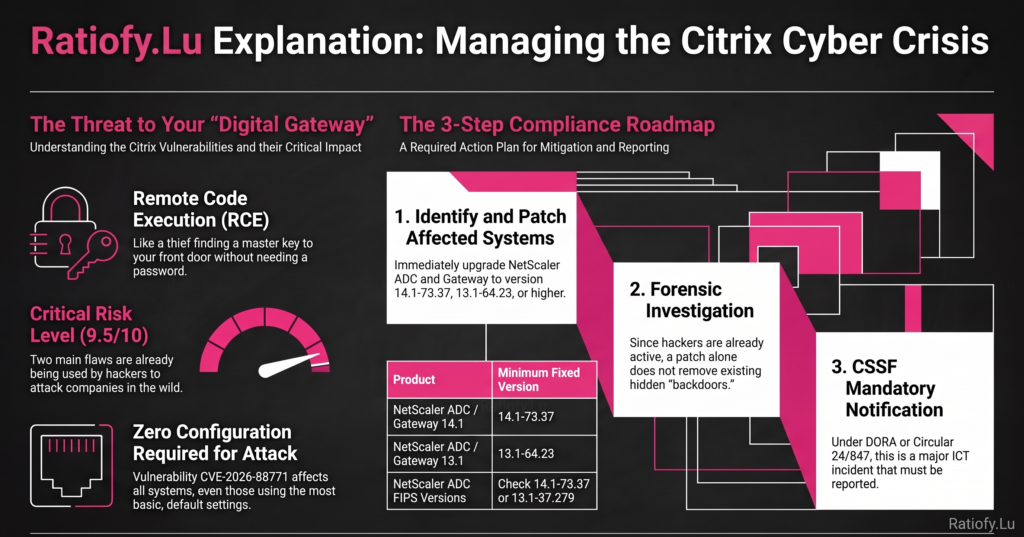
- Active Exploitation in the Wild: Two severe Remote Code Execution vulnerabilities—CVE-2026-88771 and CVE-2026-88772 (both carrying a CVSS v4.0 base score of 9.5)—are currently being actively exploited in the wild against unmitigated NetScaler deployments.
- Universal Default Risk: CVE-2026-88771 affects all vulnerable NetScaler ADC and Gateway instances in their default configuration. No optional features need to be enabled for an appliance to be exposed.
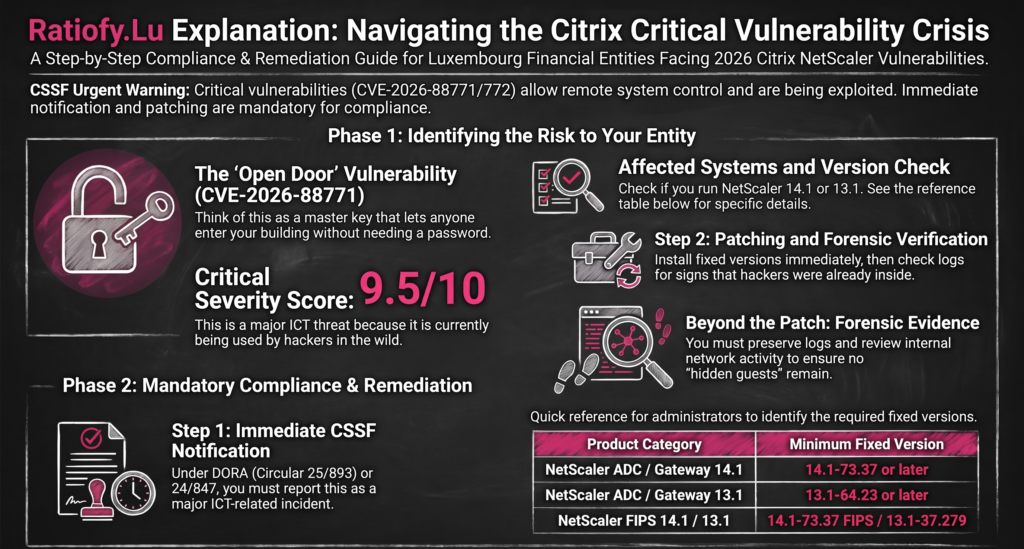
- Regulatory Compliance Mandate: The CSSF explicitly states that unauthenticated RCE constitutes unauthorized malicious access. Consequently, this scenario represents a major ICT-related incident requiring mandatory regulatory notification under either Circular CSSF 25/893 (DORA) or Circular CSSF 24/847, depending on the entity type.
- Insufficiency of Standalone Patching: Applying vendor patches prevents future exploitation but does not clear pre-existing threat actor persistence or compromise. Internet-facing appliances must undergo thorough compromise assessments and log analyses.
CVE-2026-88771, CVE-2026-88772, CVE-2026-88773, CVE-2026-88774, CVE-2026-88775, CVE-2026-88776, CVE-2026-88777, CVE-2026-88778 – CSSF Communication
Regulatory Framework and Reporting Mandates under Multiple Critical Vulnerabilities in Citrix NetScaler ADC and NetScaler Gateway such as CVE-2026-88771 and, CVE-2026-88772 – CSSF Communication in Luxembourg
The CSSF strongly directs all supervised entities operating affected infrastructure to review CIRCL report TR-100 and immediately institute remediation protocols.
| Directive / Requirement | Summary / Action Required |
| Incident Classification | Unauthenticated remote code execution constitutes unauthorized malicious access to critical financial systems. |
| Notification Mandate | Supervised entities experiencing a breach or exploitation must submit formal incident notifications pursuant to Circular CSSF 25/893 (DORA) or Circular CSSF 24/847. |
| Reference Material | Guidance and technical indicators published by CIRCL at https://www.circl.lu/pub/tr-100/. |
Affected Products and Fixed Versions under Multiple Critical Vulnerabilities in Citrix NetScaler ADC and NetScaler Gateway such as CVE-2026-88771 and, CVE-2026-88772 – CSSF Communication in Luxembourg
The disclosed vulnerabilities specifically impact customer-managed NetScaler ADC and NetScaler Gateway appliances.
Note: Citrix-managed cloud services and Citrix-managed Adaptive Authentication are updated directly by Cloud Software Group.
Version Compatibility Matrix
| Product Line | Vulnerable Versions | Fixed Version (or Later) |
| NetScaler ADC / Gateway 14.1 | Versions prior to 14.1-73.37 | 14.1-73.37 |
| NetScaler ADC / Gateway 13.1 | Versions prior to 13.1-64.23 | 13.1-64.23 |
| NetScaler ADC 14.1 FIPS | Versions prior to 14.1-73.37 FIPS | 14.1-73.37 FIPS |
| NetScaler ADC 13.1 FIPS & NDcPP | Versions prior to 13.1-37.279 | 13.1-37.279 |
| Secure Private Access Hybrid | Deployments utilizing NetScaler instances | Associated appliances must be upgraded |
Comprehensive Breakdown of Vulnerabilities under Multiple Critical Vulnerabilities in Citrix NetScaler ADC and NetScaler Gateway such as CVE-2026-88771 and, CVE-2026-88772 – CSSF Communication in Luxembourg
High-Priority & Actively Exploited Flaws
1. CVE-2026-88771 — Unauthenticated Remote Code Execution
- Description: An improper input validation bug allows an unauthenticated remote attacker to execute arbitrary commands on the target appliance.
- Priority Level: Highest Priority. Exposure does not depend on optional features.
- Precondition: None. Concerns all affected NetScaler ADC and Gateway deployments, including default configurations.
- CWE: CWE-20 (Improper Input Validation)
- CVSS v4.0 Score: 9.5
- CVSS Vector: CVSS:4.0/AV:N/AC:L/AT:P/PR:N/UI:N/VC:H/VI:H/VA:H/SC:H/SI:H/SA:H
- Exploitation Status: Observed in the wild
2. CVE-2026-88772 — Memory Overflow Leading to RCE or DoS
- Description: A memory overflow bug capable of causing arbitrary remote code execution or a complete denial-of-service state.
- Precondition: Datagram Transport Layer Security (DTLS) must be enabled. DTLS is enabled by default on VPN virtual servers unless explicitly turned off.
- CWE: CWE-119 (Improper Restriction of Operations within the Bounds of a Memory Buffer)
- CVSS v4.0 Score: 9.5
- CVSS Vector: CVSS:4.0/AV:N/AC:H/AT:N/PR:N/UI:N/VC:H/VI:H/VA:H/SC:H/SI:H/SA:H
- Exploitation Status: Observed in the wild
Additional Critical & High-Severity Flaws under Multiple Critical Vulnerabilities in Citrix NetScaler ADC and NetScaler Gateway such as CVE-2026-88771 and, CVE-2026-88772 – CSSF Communication in Luxembourg
3. CVE-2026-88773 — HTTP Request Smuggling
- Description: Inconsistent interpretation of HTTP requests allows attackers to perform HTTP request smuggling attacks.
- Precondition: HTTP functionality must be configured (Load Balancing, Content Switching, VPN, or Authentication virtual servers utilizing HTTP or SSL).
- CWE: CWE-444 (Inconsistent Interpretation of HTTP Requests)
- CVSS v4.0 Score: 9.3
- CVSS Vector: CVSS:4.0/AV:N/AC:L/AT:N/PR:N/UI:N/VC:N/VI:H/VA:N/SC:H/SI:H/SA:N
4. CVE-2026-88774 — HTTP URL Policy Bypass
- Description: Improper use or interpretation of HTTP URL-based expressions enables attackers to bypass configured security or feature policies.
- Precondition: An affected HTTP URL-based policy expression must be actively configured.
- CWE: CWE-16 (Configuration)
- CVSS v4.0 Score: 7.0
- CVSS Vector: CVSS:4.0/AV:N/AC:L/AT:P/PR:N/UI:N/VC:L/VI:L/VA:N/SC:H/SI:H/SA:N
5. CVE-2026-88775 — Memory Overflow in Gateway or AAA Configurations
- Description: A memory overflow issue causing unpredictable appliance behavior or denial of service.
- Precondition: NetScaler must be configured as AAA virtual server or Gateway (SSL VPN, ICA Proxy, CVPN, or RDP Proxy).
- CWE: CWE-119 (Improper Restriction of Operations within the Bounds of a Memory Buffer)
- CVSS v4.0 Score: 8.8
- CVSS Vector: CVSS:4.0/AV:N/AC:L/AT:N/PR:N/UI:N/VC:L/VI:L/VA:H/SC:N/SI:N/SA:N
6. CVE-2026-88776 — Memory Overflow in Oracle Load Balancing
- Description: A memory overflow bug resulting in unpredictable system behavior or denial of service.
- Precondition: NetScaler must be configured with a Load Balancing virtual server of type Oracle.
- CWE: CWE-119 (Improper Restriction of Operations within the Bounds of a Memory Buffer)
- CVSS v4.0 Score: 8.8
- CVSS Vector: CVSS:4.0/AV:N/AC:L/AT:N/PR:N/UI:N/VC:L/VI:L/VA:H/SC:N/SI:N/SA:N
7. CVE-2026-88777 — Memory Overflow in Non-HTTP L7 Services
- Description: Memory overflow vulnerability leading to service disruption or erratic execution.
- Precondition: Device configured as LB/CS or CGNAT-LSN/NAT64 with non-HTTP Layer 7 protocol features enabled (e.g., FTP, RTSP, DNS64, NAT64).
- CWE: CWE-119 (Improper Restriction of Operations within the Bounds of a Memory Buffer)
- CVSS v4.0 Score: 8.8
- CVSS Vector: CVSS:4.0/AV:N/AC:L/AT:N/PR:N/UI:N/VC:L/VI:L/VA:H/SC:N/SI:N/SA:N
8. CVE-2026-88778 — TCP Initial Sequence Number (ISN) Prediction
- Description: A weakness in the TCP Initial Sequence Number generation algorithm produces predictable sequence values, compromising TCP connection integrity.
- Precondition: TCP functionality is enabled and Enhanced ISN Generation is disabled.
- CWE: CWE-342 (Predictable Exact Value from Previous Values)
- CVSS v4.0 Score: 8.8
- CVSS Vector: CVSS:4.0/AV:N/AC:L/AT:N/PR:N/UI:N/VC:L/VI:H/VA:H/SC:L/SI:L/SA:L
Technical Audit & Configuration Check Reference under Multiple Critical Vulnerabilities in Citrix NetScaler ADC and NetScaler Gateway such as CVE-2026-88771 and, CVE-2026-88772 – CSSF Communication in Luxembourg
System administrators can inspect running configurations to evaluate exposure to precondition-dependent CVEs.
Vulnerability Verification Commands
- CVE-2026-88771: No check required. All installations meeting version criteria are vulnerable regardless of configuration.
- CVE-2026-88772 (DTLS Verification): Inspect VPN virtual server settings. Example default configuration (DTLS enabled): add vpn vserver vpn1 SSL 10.0.0.0 443 -Listenpolicy NONE DTLS is only disabled if explicitly declared via: -dtls OFF Review all explicitly configured DTLS virtual servers.
- CVE-2026-88773 (HTTP/SSL Services): Search configuration for HTTP or SSL virtual servers: `add lb vserver
This news related to Multiple Critical Vulnerabilities in Citrix NetScaler ADC and NetScaler Gateway such as CVE-2026-88771 and, CVE-2026-88772 – CSSF Communication in Luxembourg can be considered beneficial under CSSF-Circulars, Central Securities Depositories (CSDs) News, Credit Institutions News, Crowdfunding service providers (CSPs) News, Crypto-Assets Service Providers (CASPs) and Virtual Asset Service Providers (VASPs) News, Data Reporting Service Providers (DRSPs) News, EU Regulations, Explanation, IFMs (AIFMs, ManCos) News, Investment Firms News, Issuers of Tokens (EMTs, ARTs) News, Multimedia, Must Read, Opinion, Payment Institutions (PIs) / Electronic Money Institutions (EMIs) /AISPs News, Pension funds News, PFS/PSF News, Undertakings for collective investment (UCIs).
At https://Ratiofy.Lu/, we defend your hard-earned money with our free daily news platform and expert-vetted templates. Need more help? Request access to our hands-on expert Advisory, Training and Coaching Services (very limited availability) related to CSSF Circulars and EU Regulations.
The pre-filled example templates for many CSSF Circulars are available at https://ratiofy.lu/templates/ from the summer of 2026.
5 Critical Lessons from the NetScaler Zero-Day Wave under Multiple Critical Vulnerabilities in Citrix NetScaler ADC and NetScaler Gateway such as CVE-2026-88771 and, CVE-2026-88772 – CSSF Communication in Luxembourg
CVE-2026-88771, CVE-2026-88772, CVE-2026-88773, CVE-2026-88774, CVE-2026-88775, CVE-2026-88776, CVE-2026-88777, CVE-2026-88778 – CSSF Communication
For years, enterprise IT architectures have relied heavily on edge network appliances to serve as unbreakable gatekeepers. Sitting directly between untrusted public networks and sensitive internal systems, devices like Citrix NetScaler ADC and NetScaler Gateway are routinely entrusted with handling everything from load balancing to secure remote access. Yet, as recent security disclosures repeatedly demonstrate, positioning hardware at the network boundary does not inherently make it immune to exploitation.
On 28 September 2026, a major security wave highlighted the dangerous assumption of passive trust in perimeter hardware. The Computer Incident Center Luxembourg (CIRCL) and the Commission de Surveillance du Secteur Financier (CSSF) disclosed a suite of eight critical vulnerabilities—spanning CVE-2026-88771 through CVE-2026-88778—affecting customer-managed Citrix NetScaler ADC and NetScaler Gateway appliances. Beyond the immediate rush to apply vendor patches, this wave serves as a stark case study in the modern reality of edge security. It exposes uncomfortable truths about default exposure, post-exploitation persistence, and the shifting regulatory landscape governing enterprise breaches.
1. Default Configurations Offer Zero Shielding under Multiple Critical Vulnerabilities in Citrix NetScaler ADC and NetScaler Gateway such as CVE-2026-88771 and, CVE-2026-88772 – CSSF Communication in Luxembourg
The most alarming aspect of this disclosure wave centers on CVE-2026-88771, an unauthenticated Remote Code Execution (RCE) flaw caused by improper input validation (CWE-20). Carrying a near-maximum CVSS v4.0 base score of 9.5, this flaw allows an unauthenticated remote attacker to execute arbitrary commands on the target system.
What makes CVE-2026-88771 a security administrator’s worst nightmare is its complete lack of preconditions:
- Out-of-the-Box Vulnerability: The security flaw affects all vulnerable NetScaler ADC and Gateway deployments using default configurations.
- Zero Feature Dependency: An organization does not need to have any optional feature or specialized module turned on to be fully exposed.
This creates a sharp contrast with other vulnerabilities disclosed in the same advisory. For instance, CVE-2026-88772 (a CVSS 9.5 memory overflow leading to RCE or DoS) requires DTLS to be enabled (which is enabled by default on VPN virtual servers unless explicitly turned off via -dtls OFF), while CVE-2026-88776 (CVSS 8.8) specifically requires a Load Balancing virtual server of type Oracle.
Analysis: Security teams often operate under the assumption that keeping unused features or specialized services disabled limits an appliance’s attack surface. “Default-vulnerable” flaws like CVE-2026-88771 dismantle this safety net entirely. When an out-of-the-box installation with zero custom feature enablement is fully exploitable over the internet, passive defense strategies fail completely.
2. Patching Does Not Equal Remediation under Multiple Critical Vulnerabilities in Citrix NetScaler ADC and NetScaler Gateway such as CVE-2026-88771 and, CVE-2026-88772 – CSSF Communication in Luxembourg
Both CVE-2026-88771 and CVE-2026-88772 carry confirmation from Citrix and third-party observers of active exploitation in the wild against unmitigated deployments. In response, CIRCL released clear guidance advising immediate updates to fixed versions, including:
- NetScaler ADC / Gateway 14.1 (version 14.1-73.37 or later)
- NetScaler ADC / Gateway 13.1 (version 13.1-64.23 or later)
- NetScaler ADC 14.1 FIPS (version 14.1-73.37 FIPS or later)
- NetScaler ADC 13.1 FIPS / NDcPP (version 13.1-37.279 or later)
- Secure Private Access Hybrid deployments using NetScaler instances (which are equally affected and must have their associated appliances upgraded)
However, CIRCL paired these patch recommendations with an explicit warning regarding systems that were internet-facing while vulnerable: updating the software only resolves future vulnerability, not past intrusion.
> “In particular, successful patching prevents subsequent exploitation of the corrected vulnerabilities but does not remediate persistence or other changes potentially introduced before the update.”
Analysis: Organizations must shed the traditional “patch-and-forget” mentality when dealing with actively exploited edge appliances. If an adversary exploited an unauthenticated RCE flaw prior to the patch window, they may have established persistent backdoors, modified system files, or created unauthorized administrative accounts. Remediation requires moving to a forensic mindset: executing full compromise assessments, investigating unexpected processes or filesystem alterations, checking authentication activity, and inspecting outbound connections from the appliance into the internal network.
3. A Breach of the Edge Is Automatically a Major Regulatory Event under Multiple Critical Vulnerabilities in Citrix NetScaler ADC and NetScaler Gateway such as CVE-2026-88771 and, CVE-2026-88772 – CSSF Communication in Luxembourg
Technical vulnerabilities on perimeter appliances can no longer be contained within the boundary of the IT department. As highlighted by the CSSF communiqué, an unauthenticated remote code execution flaw on an edge device carries immediate, mandatory legal reporting requirements for supervised financial entities.
Because unauthenticated RCE grants unauthorized malicious access to core infrastructure, the CSSF explicitly reminds entities that exploitation constitutes a “major ICT-related incident.” Depending on the classification of the entity, supervised organizations are legally required to report the incident under specific regulatory frameworks:
- Circular CSSF 25/893 (implementing Digital Operational Resilience Act / DORA requirements)
- Circular CSSF 24/847
Analysis: Modern regulatory frameworks like DORA elevate technical perimeter flaws directly into boardroom liabilities. A compromised gateway is no longer viewed simply as an IT ticket or a routine maintenance issue; it is legally recognized as a major operational event. Automated threat detection and incident response workflows must be tightly linked with regulatory compliance reporting protocols to ensure strict notification deadlines are met.
4. Local Appliance Logs Cannot Be Trusted After an Attack under Multiple Critical Vulnerabilities in Citrix NetScaler ADC and NetScaler Gateway such as CVE-2026-88771 and, CVE-2026-88772 – CSSF Communication in Luxembourg
Meeting these rigorous regulatory mandates requires reliable forensic evidence to establish timeline accuracy and verify whether data was accessed. However, when investigating a potential compromise on an edge appliance, forensic teams encounter a fundamental weakness in local logging: if an attacker achieves execution rights on the host, the integrity of local logs is immediately compromised.
To address this challenge and ensure defensible reporting, CIRCL highlights two vital operational steps prior to and during incident handling:
- Preserve Forensic Evidence: Ensure relevant logs and system state evidence are safely backed up before applying major software updates or system reboots.
- External SIEM Forwarding: Continuously forward NetScaler logs off-device to an external SIEM or an independent central logging infrastructure.
Analysis: Relying solely on local log storage creates a single point of failure. If an adversary gains root privilege or arbitrary code execution capabilities on a NetScaler appliance, on-device audit logs can be easily wiped, altered, or disabled to hide lateral movement. Offloading log streams in real-time to an external, write-isolated SIEM ensures that an immutable trail of activity remains available for investigation even if the host appliance is entirely compromised.
5. Scope Extends Far Beyond Standard Web Servers under Multiple Critical Vulnerabilities in Citrix NetScaler ADC and NetScaler Gateway such as CVE-2026-88771 and, CVE-2026-88772 – CSSF Communication in Luxembourg
Enterprise infrastructure design frequently consolidates legacy protocols, specialized database routing, and legacy media streaming into multi-protocol edge gateways to streamline operations. While this approach simplifies network architecture, it drastically expands the underlying attack surface, as demonstrated by how deeply memory corruption and logic flaws permeate every layer of the NetScaler appliance stack:
Memory Overflows across Ecosystems
- Gateway & AAA Protocols (CVE-2026-88775, CVSS 8.8 / CWE-119): Affects specialized configurations including SSL VPN, ICA Proxy, CVPN, RDP Proxy, and AAA virtual servers.
- Database Load Balancing (CVE-2026-88776, CVSS 8.8 / CWE-119): Targets appliances configured specifically with Oracle Load Balancing virtual servers (add lb vserver .* ORACLE .*).
- Non-HTTP Layer 7 Services (CVE-2026-88777, CVSS 8.8 / CWE-119): Impacting non-HTTP Layer 7 processing modules, such as FTP, RTSP, DNS64, LSN/CGNAT, and NAT64 deployments (with particular emphasis on FTP Application Layer Gateway / ALG configurations).
Protocol & Logic Handling Flaws
- HTTP Request Smuggling (CVE-2026-88773, CVSS 9.3 / CWE-444): Caused by inconsistent interpretation of HTTP requests across Load Balancing, Content Switching, VPN, or Authentication virtual servers.
- HTTP URL Policy Bypass (CVE-2026-88774, CVSS 7.0 / CWE-16): Allows attackers to bypass configured security or feature policies due to improper evaluation of HTTP URL-based expressions.
- TCP ISN Prediction (CVE-2026-88778, CVSS 8.8 / CWE-342): Occurs when TCP functionality is enabled but “Enhanced ISN Generation” is explicitly set to DISABLED, generating predictable TCP Initial Sequence Numbers and weakening TCP connection integrity assumptions.
Analysis: Multifunction network appliances are complex, multi-protocol monoliths. Securing an enterprise edge requires reviewing niche protocol handlers—such as database load balancers, legacy FTP ALGs, and custom TCP parameters—rather than just monitoring standard web traffic.
Conclusion: The New Reality of Perimeter Defense under Multiple Critical Vulnerabilities in Citrix NetScaler ADC and NetScaler Gateway such as CVE-2026-88771 and, CVE-2026-88772 – CSSF Communication in Luxembourg
Managing edge appliances in 2026 demands far more than just standard patch management schedules. As demonstrated by the Citrix NetScaler disclosures, securing the enterprise boundary requires a synchronized effort: fast-tracked software updates, real-time external log aggregation, deep protocol review, and swift compliance reporting alongside continuous post-exploitation threat hunting.
Infrastructure Exposure & Risk Assessment Framework: 2026 Citrix NetScaler Vulnerabilities under Multiple Critical Vulnerabilities in Citrix NetScaler ADC and NetScaler Gateway such as CVE-2026-88771 and, CVE-2026-88772 – CSSF Communication in Luxembourg
CVE-2026-88771, CVE-2026-88772, CVE-2026-88773, CVE-2026-88774, CVE-2026-88775, CVE-2026-88776, CVE-2026-88777, CVE-2026-88778 – CSSF Communication
1. Executive Context & Regulatory Compliance Directives under Multiple Critical Vulnerabilities in Citrix NetScaler ADC and NetScaler Gateway such as CVE-2026-88771 and, CVE-2026-88772 – CSSF Communication in Luxembourg
On September 28, 2026, the Commission de Surveillance du Secteur Financier (CSSF) issued an official security communiqué in response to Technical Report TR-100 published by the Computer Incident Center Luxembourg (CIRCL). These disclosures detail eight significant security flaws in Citrix NetScaler ADC (formerly Citrix ADC) and NetScaler Gateway (formerly Citrix Gateway), spanning CVE-2026-88771 through CVE-2026-88778. Most critically, two of these vulnerabilities—CVE-2026-88771 and CVE-2026-88772—permit unauthenticated remote code execution (RCE) and are currently undergoing active exploitation in the wild against unmitigated appliances. Because NetScaler appliances sit at the network edge, providing gateway authentication and load balancing, unauthenticated RCE on these systems represents a systemic enterprise risk. A breach at the perimeter allows threat actors to establish an initial foothold, bypass boundary defense controls, terminate encrypted traffic, and pivot laterally into internal network segments or Active Directory domains. Consequently, establishing a formal risk assessment framework is vital to evaluating infrastructure exposure, accelerating patch management, and fulfilling binding statutory incident reporting mandates.
1.1 Regulatory Incident Notification Mandates
> CRITICAL COMPLIANCE DIRECTIVE: MAJOR ICT INCIDENT MANDATE Under regulatory frameworks enforced by the CSSF, any unauthenticated Remote Code Execution or unauthorized access event on perimeter infrastructure is classified as an unauthorized malicious access event. Confirmed exploitation or high-risk exposure triggers mandatory major ICT-related incident notification workflows.
Supervised entities must evaluate their operational risk and reporting obligations based on their institutional classification and regulatory framework:
- Classification as Unauthorized Malicious Access: Unauthenticated RCE vulnerabilities that expose enterprise infrastructure to arbitrary command execution constitute an unauthorized breach of perimeter integrity.
- Mandatory Reporting Obligations Under Circular CSSF 25/893 (DORA):
- Financial entities within the scope of the Digital Operational Resilience Act (DORA) must activate major ICT incident reporting immediately upon confirming unauthorized access, malicious exploitation, or high-risk infrastructure exposure.
- Operational Triage SLA (Initial Notification): An initial notification must be submitted to the CSSF within statutory DORA timelines following initial incident detection and triage confirmation.
- Follow-Up & Final Reporting SLA: Entities must provide periodic status updates followed by a comprehensive final forensic report detailing root cause analysis, total breach impact, matched Indicators of Compromise (IoCs), and full post-incident remediation status.
- Mandatory Reporting Obligations Under Circular CSSF 24/847:
- Entities supervised under Circular CSSF 24/847 must execute formal incident notification protocols aligned with their specific supervised entity classification upon detecting unauthorized system manipulation or compromise.
1.2 Scope of Managed Infrastructure & Cloud Governance
To ensure appropriate operational governance, organizations must delineate responsibility boundaries between customer-managed host appliances requiring immediate internal patching and service-provider-managed cloud environments:
| Deployment Responsibility Model | Required Remediation Action |
| Customer-Managed NetScaler ADC & Gateway | Customer Remediation Scope: Supervised entities maintain exclusive operational responsibility for inventory discovery, configuration auditing, firmware patching, log preservation, and forensic compromise assessments. |
| Citrix-Managed Cloud Services & Adaptive Authentication | Provider Remediation Scope: Infrastructure control planes and managed services are updated directly by Cloud Software Group. No customer host-level patching is required for provider-managed SaaS components. |
Note: Secure Private Access Hybrid deployments that leverage customer-managed NetScaler appliances fall strictly within the customer remediation scope; associated NetScaler host appliances must be updated immediately by internal security operations.
Having established the strategic compliance mandates and governance boundaries, this framework transitions to the technical vulnerability matrix and version evaluation baselines.
2. Comprehensive Vulnerability & Version Assessment Matrix under Multiple Critical Vulnerabilities in Citrix NetScaler ADC and NetScaler Gateway such as CVE-2026-88771 and, CVE-2026-88772 – CSSF Communication in Luxembourg
The September 2026 disclosures cover eight distinct Common Vulnerabilities and Exposures (CVE-2026-88771 through CVE-2026-88778). Engineering leadership and Security Operations Center (SOC) teams must prioritize mitigation efforts by evaluating CVSS v4.0 scores, Common Weakness Enumerations (CWEs), active exploitation status, and specific technical preconditions required to trigger each flaw.
2.1 Affected vs. Fixed Version Baseline
Organizations must immediately audit all active appliances against the official supported version baselines specified below:
| Product / Platform | Affected Supported Versions | Minimum Fixed Version Baseline |
| NetScaler ADC and Gateway 14.1 | Versions prior to 14.1-73.37 | 14.1-73.37 or later |
| NetScaler ADC and Gateway 13.1 | Versions prior to 13.1-64.23 | 13.1-64.23 or later |
| NetScaler ADC 14.1 FIPS | Versions prior to 14.1-73.37 FIPS | 14.1-73.37 FIPS or later |
| NetScaler ADC 13.1 FIPS and NDcPP | Versions prior to 13.1-37.279 | 13.1-37.279 or later |
2.2 Deep-Dive Vulnerability Analysis (CVE-2026-88771 to CVE-2026-88778)
> CRITICAL THREAT ADVISORY: ACTIVE IN-THE-WILD EXPLOITATION CVE-2026-88771 and CVE-2026-88772 are undergoing active threat-actor exploitation against exposed, unmitigated NetScaler appliances. Immediate emergency remediation and threat hunting are required.
CVE-2026-88771 — Unauthenticated Remote Code Execution
- CVSS v4.0 Score & Vector: 9.5 (CVSS:4.0/AV:N/AC:L/AT:P/PR:N/UI:N/VC:H/VI:H/VA:H/SC:H/SI:H/SA:H)
- Common Weakness Enumeration: CWE-20 (Improper Input Validation)
- Exploitation Status: Observed in the wild
- Core Technical Impact & Preconditions: Highest Emergency Priority. Precondition: None. All affected NetScaler ADC and Gateway deployments are vulnerable, including appliances operating on default configurations. An unauthenticated remote attacker can exploit improper input validation to execute arbitrary system commands at the operating system level.
CVE-2026-88772 — Memory Overflow Leading to RCE or DoS
- CVSS v4.0 Score & Vector: 9.5 (CVSS:4.0/AV:N/AC:H/AT:N/PR:N/UI:N/VC:H/VI:H/VA:H/SC:H/SI:H/SA:H)
- Common Weakness Enumeration: CWE-119 (Improper Restriction of Operations within the Bounds of a Memory Buffer)
- Exploitation Status: Observed in the wild
- Core Technical Impact & Preconditions: Precondition: DTLS must be enabled (DTLS is enabled by default on VPN virtual servers unless explicitly disabled). A memory buffer overflow allows an attacker to achieve unauthenticated remote code execution or crash the appliance, inducing a Denial of Service (DoS).
CVE-2026-88773 — HTTP Request Smuggling
- CVSS v4.0 Score & Vector: 9.3 (CVSS:4.0/AV:N/AC:L/AT:N/PR:N/UI:N/VC:N/VI:H/VA:N/SC:H/SI:H/SA:N)
- Common Weakness Enumeration: CWE-444 (Inconsistent Interpretation of HTTP Requests)
- Exploitation Status: Disclosed
- Core Technical Impact & Preconditions: Precondition: HTTP functionality must be configured on the appliance. This includes Load Balancing (LB), Content Switching (CS), VPN, or Authentication virtual servers utilizing HTTP or SSL protocols. Inconsistent request parsing enables HTTP request smuggling, bypassing security controls or poisoning caches.
CVE-2026-88774 — HTTP URL Policy Bypass
- CVSS v4.0 Score & Vector: 7.0 (CVSS:4.0/AV:N/AC:L/AT:P/PR:N/UI:N/VC:L/VI:L/VA:N/SC:H/SI:H/SA:N)
- Common Weakness Enumeration: CWE-16 (Configuration)
- Exploitation Status: Disclosed
- Core Technical Impact & Preconditions: Precondition: An affected HTTP URL-based policy expression must be configured. Improper interpretation of URL expressions allows attackers to circumvent access control and security policies.
CVE-2026-88775 — Memory Overflow in Gateway or AAA Configurations
- CVSS v4.0 Score & Vector: 8.8 (CVSS:4.0/AV:N/AC:L/AT:N/PR:N/UI:N/VC:L/VI:L/VA:H/SC:N/SI:N/SA:N)
- Common Weakness Enumeration: CWE-119 (Improper Restriction of Operations within the Bounds of a Memory Buffer)
- Exploitation Status: Disclosed
- Core Technical Impact & Preconditions: Precondition: Appliance must be configured as an AAA virtual server or Gateway deployment (SSL VPN, ICA Proxy, CVPN, or RDP Proxy). A memory buffer overflow causes unpredictable system behavior or denial of service.
CVE-2026-88776 — Memory Overflow in Oracle Load Balancing
- CVSS v4.0 Score & Vector: 8.8 (CVSS:4.0/AV:N/AC:L/AT:N/PR:N/UI:N/VC:L/VI:L/VA:H/SC:N/SI:N/SA:N)
- Common Weakness Enumeration: CWE-119 (Improper Restriction of Operations within the Bounds of a Memory Buffer)
- Exploitation Status: Disclosed
- Core Technical Impact & Preconditions: Precondition: Appliance must be configured with a Load Balancing virtual server of type Oracle. A memory overflow leads to service instability or denial of service.
CVE-2026-88777 — Memory Overflow in Non-HTTP L7 Services
- CVSS v4.0 Score & Vector: 8.8 (CVSS:4.0/AV:N/AC:L/AT:N/PR:N/UI:N/VC:L/VI:L/VA:H/SC:N/SI:N/SA:N)
- Common Weakness Enumeration: CWE-119 (Improper Restriction of Operations within the Bounds of a Memory Buffer)
- Exploitation Status: Disclosed
- Core Technical Impact & Preconditions: Precondition: Appliance must be configured as an LB/CS or CGNAT-LSN/NAT64 device with non-HTTP Layer 7 features enabled (FTP, RTSP, DNS64, or NAT64). Memory buffer overflow causes denial of service or unpredictable system failure.
CVE-2026-88778 — TCP Initial Sequence Number Prediction
- CVSS v4.0 Score & Vector: 8.8 (CVSS:4.0/AV:N/AC:L/AT:N/PR:N/UI:N/VC:L/VI:H/VA:H/SC:L/SI:L/SA:L)
- Common Weakness Enumeration: CWE-342 (Predictable Exact Value from Previous Values)
- Exploitation Status: Disclosed
- Core Technical Impact & Preconditions: Precondition: TCP functionality is active and Enhanced ISN Generation is disabled. Predictable TCP Initial Sequence Number generation weakens connection integrity guarantees. Action Required: Administrators must verify parameters AND apply Citrix-recommended TCP configuration changes beyond basic firmware updates.
Evaluating installed software versions against this baseline establishes primary exposure; however, verifying running feature configurations is required to map the exact enterprise attack surface.
3. Systematic Infrastructure Configuration Audit Protocol under Multiple Critical Vulnerabilities in Citrix NetScaler ADC and NetScaler Gateway such as CVE-2026-88771 and, CVE-2026-88772 – CSSF Communication in Luxembourg
Simple version inventory is insufficient to determine operational risk. Security engineering teams must perform CLI audits and configuration pattern matching to evaluate feature-specific exposure profiles across deployed units.
3.1 High-Priority Exposure Auditing (Zero-Precondition & Default Features)
CVE-2026-88771 (Universal Exposure)
No configuration audit check is required. All instances running vulnerable software versions meet the precondition automatically, regardless of active feature configurations or default settings.
CVE-2026-88772 (DTLS Configuration Inspection)
Inspect all VPN virtual server declarations for DTLS status. DTLS is enabled by default on VPN virtual servers created with standard syntax:
add vpn vserver vpn1 SSL 10.0.0.0 443 -Listenpolicy NONE
An explicit -dtls OFF flag indicates that DTLS has been disabled for that specific VPN virtual server:
set vpn vserver vpn1 -dtls OFF
Auditors must review all explicitly configured DTLS virtual servers and confirm whether any active VPN endpoints leave DTLS exposed.
3.2 Virtual Server & Feature-Specific Configuration Audits
Security personnel must execute configuration text pattern matching and Command Line Interface (CLI) verification commands to identify exposed services:
| CVE ID | Feature / Service Scope | Configuration Audit Target |
| CVE-2026-88773 | HTTP/SSL Virtual Servers | Search running configuration for HTTP/SSL Load Balancing, Content Switching, VPN, and AAA virtual servers. |
| CVE-2026-88774 | HTTP URL Policies | Search active policies for HTTP URL-based expressions. |
| CVE-2026-88775 | Gateway & AAA Virtual Servers | Audit configuration for active Gateway (SSL VPN, ICA Proxy, CVPN, RDP Proxy) and AAA virtual servers. |
| CVE-2026-88776 | Oracle Load Balancing | Audit configuration for Oracle-type Load Balancing virtual servers. |
| CVE-2026-88777 | Non-HTTP L7 Services | Search configuration for FTP, RTSP, DNS64, NAT64, and LSN/CGNAT FTP Application Layer Gateway (ALG) features. |
| CVE-2026-88778 | TCP Parameter Verification | Verify TCP parameter state via shell command and check for disabled Enhanced ISN Generation. |
Operational CLI Terminal Commands & Regex Audit Strings
To facilitate copy-paste execution for network operations and SOC personnel, use the following terminal syntax blocks:
# === CVE-2026-88773: HTTP/SSL Virtual Server Search ===
grep -E “add (lb|cs|vpn|authentication) vserver .* (HTTP|SSL)” /nsconfig/ns.conf
# === CVE-2026-88774: HTTP URL Policy Expression Audit ===
grep -E “add (rewrite|responder|appfw) policy” /nsconfig/ns.conf | grep -i “HTTP.REQ.URL”
# === CVE-2026-88775: Gateway & AAA Virtual Server Audit ===
grep -E “add vpn vserver .*” /nsconfig/ns.conf
grep -E “add authentication vserver .*” /nsconfig/ns.conf
# === CVE-2026-88776: Oracle Load Balancing Audit ===
grep -E “add lb vserver .* ORACLE” /nsconfig/ns.conf
# === CVE-2026-88777: Non-HTTP L7 Protocols & FTP ALG Audit ===
grep -E “add (lb|cs) vserver .* FTP” /nsconfig/ns.conf
grep -E “add service .* FTP” /nsconfig/ns.conf
grep -E “add lb monitor .* (FTP|FTP-EXTENDED)” /nsconfig/ns.conf
grep -E “set lsn group .* -rtspalg ENABLED” /nsconfig/ns.conf
grep -E “add lb vserver .* DNS .* -dns64 ENABLED” /nsconfig/ns.conf
grep -E “add dns policy64” /nsconfig/ns.conf
grep -E “add nat64” /nsconfig/ns.conf
# === CVE-2026-88778: TCP Parameter Shell Check & Remediation Mandate ===
# Run via NetScaler CLI shell:
shell show ns tcpparam | grep “Enhanced ISN Generation”
# FLAG TRIGGER: If the output displays “Enhanced ISN Generation: DISABLED”,
# the vulnerability precondition is met on active TCP virtual servers.
# ACTION REQUIRED: Update TCP parameters to enable Enhanced ISN Generation
# AND apply the full set of TCP configuration changes recommended by Citrix.
Identifying feature exposure directs immediate patch prioritizations. However, due to observed in-the-wild exploitation, technical teams must perform post-patch forensic compromise assessments alongside firmware updates.
4. Post-Patch Forensic Verification & Compromise Assessment Protocol under Multiple Critical Vulnerabilities in Citrix NetScaler ADC and NetScaler Gateway such as CVE-2026-88771 and, CVE-2026-88772 – CSSF Communication in Luxembourg
Applying official security updates replaces vulnerable executable binaries but does not eliminate malicious persistence established prior to patch execution. Because CVE-2026-88771 and CVE-2026-88772 are undergoing active exploitation, treating Internet-facing appliances as clean based solely on successful firmware upgrading introduces unacceptable enterprise operational risk.
4.1 Limitations of Patching & Threat Persistence
Upgrading appliance firmware updates the underlying kernel and system binaries to block future exploit vectors. However, security updates do not:
- Remove pre-existing web shells, reverse shells, or modified system binaries introduced during prior exploitation.
- Revert unauthorized administrative account creation, SSH key additions, or rogue configuration changes made prior to patching.
- Terminate persistent malicious network tunnels, lateral movement sessions, or backdoor connections actively maintained by threat actors.
4.2 Forensic Preservation & Investigation Workflow
Incident Response (IR) and SOC teams must execute a structured forensic investigation across all Internet-exposed appliances that ran vulnerable software:
- Evidence Preservation: Prior to rebooting, applying firmware updates, or modifying configurations, capture volatile memory state and preserve raw appliance logs where operationally feasible.
- External Log Integration: Enforce real-time off-appliance log forwarding from NetScaler devices to a SIEM or independent log repository (e.g., remote syslog). External log preservation ensures that audit records remain intact even if an adversary wipes local log files during a compromise.
- Telemetry & Deep File System Artifact Inspection:
- System & Access Log Audit: Inspect local syslog records in /var/log/notice.log, web access logs in /var/log/httpaccess.log, and process history in /var/log/bash.log or /var/log/ns.log.
- Shell Activity Verification: Review shell command history files, specifically checking /root/.bash_history and home directories for anomalous command execution.
- File System Integrity Checks: Inspect critical system directories for unauthorized files, rogue scripts, or modified binaries. Audit /nsconfig/, /tmp/, /var/tmp/, /netscaler/portal/, and web server root directories for dropped web shells or unauthorized cron jobs.
- Process Tree Analysis: Examine active running processes for anomalous spawned shells (/bin/sh, /bin/bash) originating from core NetScaler daemons such as nsppe or httpd.
- Internal Pivoting & Lateral Movement Review:
- Outbound Network Telemetry: Audit outbound traffic originating from the NetScaler NSIP (NetScaler IP), SNIP (Subnet IP), or VIPs directed toward internal network zones. Pay explicit attention to anomalous connections targeting Active Directory Domain Controllers, internal web services, or database servers.
- Authentication Telemetry: Review administrative login logs and AAA session records for unauthorized authentication events, privilege escalations, or unusual geographic sources.
- Vendor Indicators & Mandatory Incident Escalation:
- Cross-reference appliance state and network logs against Citrix-published Indicators of Compromise (IoCs) and official detection utilities.
- If evidence of unauthorized access or exploitation is detected, immediately trigger the organizational Incident Response Plan, isolate the affected appliance, and execute mandatory regulatory reporting to the CSSF under Circular CSSF 25/893 (DORA) or Circular CSSF 24/847.
Achieving complete infrastructure resilience requires a comprehensive defense strategy combining rapid patch deployment, rigorous configuration auditing, off-appliance log preservation, and proactive forensic compromise assessments.