
Luxembourg Financial Regulatory Advisory, Tools, Templates:
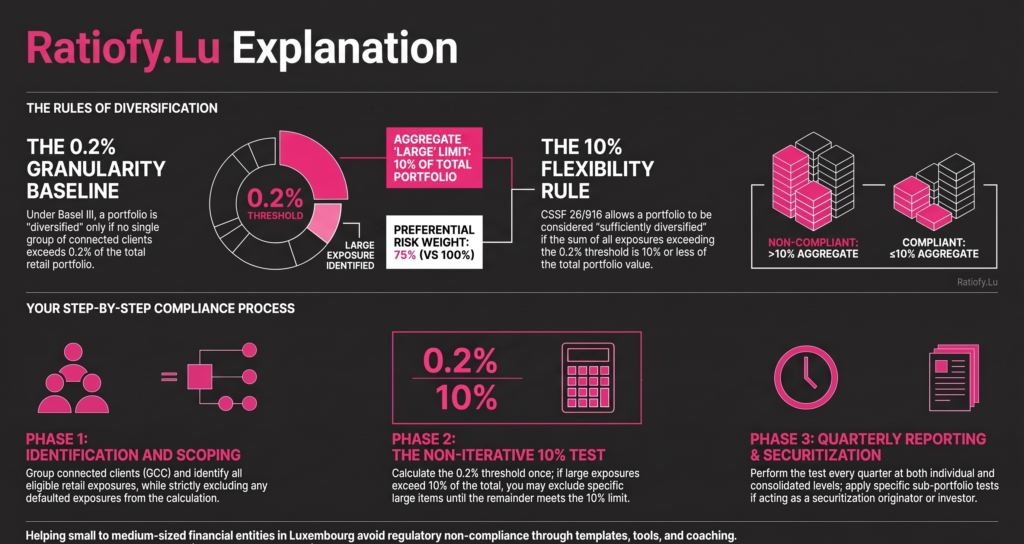
This article explains Circular CSSF 26/916, which formally adopts the European Banking Authority’s (EBA) guidelines regarding retail diversification methods for Luxembourgish financial institutions. The primary objective is to define when a portfolio of retail exposures is sufficiently granular to qualify for a preferential 75% risk weight under the Standardised Approach for credit risk. While the standard Basel III framework sets a 0.2% concentration limit per counterparty, these guidelines offer a more flexible 10% allowance for portfolios that exceed this threshold. Specifically, a portfolio remains eligible for the lower risk weight if the sum of all exposures exceeding the 0.2% limit does not surpass 10% of the total retail pool. The text further clarifies how securitised exposures should be handled by originators and investors to ensure consistent regulatory compliance. These rules aim to support smaller institutions with concentrated portfolios while promoting supervisory convergence across the European Union.
Summary of Circular CSSF 26/916: Application of the Guidelines of the European Banking Authority on proportionate retail diversification methods under Regulation (EU) 575/2013 (EBA/GL/2026/02) in Luxembourg
This briefing outlines the regulatory framework and specific methodologies established by the European Banking Authority (EBA) and adopted by the Commission de Surveillance du Secteur Financier (CSSF) regarding retail portfolio diversification. Under Article 123(1) of Regulation (EU) No 575/2013 (the Capital Requirements Regulation or CRR), retail exposures must represent “one of a significant number of similar exposures” to qualify for a preferential 75% risk weight.
The core of the Guidelines (EBA/GL/2026/02) is the introduction of a “one-step” diversification test. While the Basel III framework generally requires that no single exposure exceed 0.2% of the total retail portfolio, these guidelines provide flexibility for less granular portfolios—particularly those held by smaller institutions. A portfolio is now considered sufficiently diversified if no more than 10% of its total exposure value consists of individual exposures that exceed the 0.2% threshold. This approach ensures supervisory convergence and proportionality while maintaining prudential standards across the European Union.
Regulatory Context and Mandate under Circular CSSF 26/916: Application of the Guidelines of the European Banking Authority on proportionate retail diversification methods under Regulation (EU) 575/2013 (EBA/GL/2026/02) in Luxembourg
The EBA was mandated under the CRR to specify proportionate diversification methods to identify retail exposures where risks are substantially reduced due to a high number of similar exposures.
Core Objectives under Circular CSSF 26/916: Application of the Guidelines of the European Banking Authority on proportionate retail diversification methods under Regulation (EU) 575/2013 (EBA/GL/2026/02) in Luxembourg
- Supervisory Convergence: To harmonize how competent authorities assess retail diversification across the EU.
- Proportionality: To ensure that smaller institutions, which naturally possess more concentrated portfolios, can still access preferential risk weights if their portfolios meet objective diversification metrics.
- Risk Mitigation: To verify that the risks associated with retail exposures are substantially reduced through granularity.
Applicable Risk Weights under Circular CSSF 26/916: Application of the Guidelines of the European Banking Authority on proportionate retail diversification methods under Regulation (EU) 575/2013 (EBA/GL/2026/02) in Luxembourg
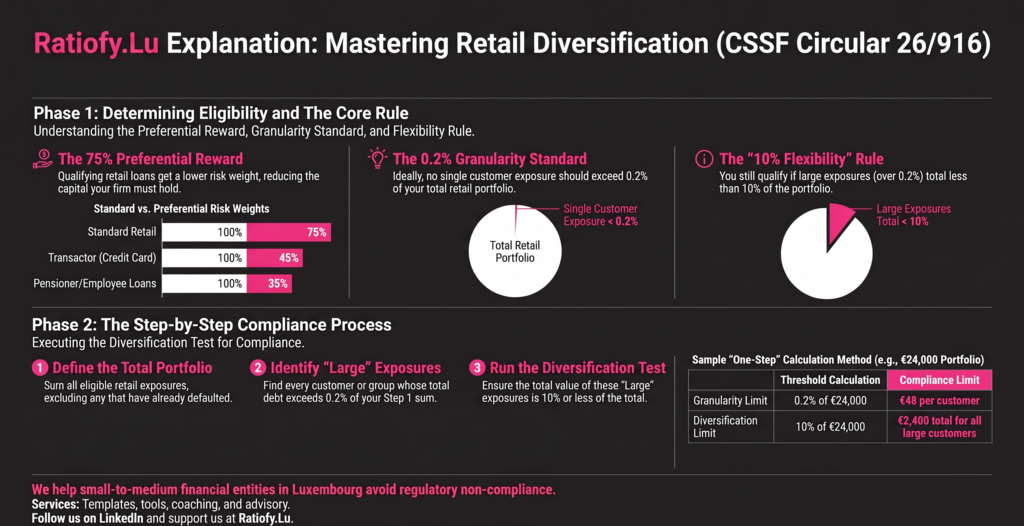
Exposures meeting the diversification criteria generally receive a 75% risk weight. However, specific subsets may receive different treatments:
- Transactor exposures: 45% risk weight.
- Pensioner/Employee loans: 35% risk weight (subject to Article 123(4) conditions regarding the unconditional transfer of salary or pension).
The Proportionate Diversification Method under Circular CSSF 26/916: Application of the Guidelines of the European Banking Authority on proportionate retail diversification methods under Regulation (EU) 575/2013 (EBA/GL/2026/02) in Luxembourg
The Guidelines utilize a quantitative “one-step” (non-iterative) approach to assess diversification. This method was selected over an iterative process to minimize operational complexity for smaller and medium-sized institutions.
The Granularity Thresholds
The assessment relies on two distinct percentages:
- The 0.2% Granularity Criterion: Based on Basel III standards, an individual exposure is “large” if it exceeds 0.2% of the overall regulatory retail portfolio.
- The 10% Diversification Limit: A portfolio remains “sufficiently diversified” even if it contains large exposures, provided the aggregate value of these large exposures does not exceed 10% of the total portfolio value.
Calculation Process
The institution must perform the following steps for each reference date:
- Identify Eligible Exposures: Include all retail exposures meeting CRR criteria, excluding defaulted exposures.
- Aggregate Group Exposures: Treat exposures to a single client or a Group of Connected Clients (GCC) as a single exposure.
- Calculate the Denominator: Sum the exposure values (EAD) of all eligible retail exposures.
- Identify “Large” Exposures: Determine which GCC exposures exceed 0.2% of the denominator.
- Apply the 10% Test: Sum the values of all “large” exposures and compare this to the total portfolio. If the ratio is ≤ 10%, the portfolio is diversified.
Scope of Application and Reporting under Circular CSSF 26/916: Application of the Guidelines of the European Banking Authority on proportionate retail diversification methods under Regulation (EU) 575/2013 (EBA/GL/2026/02) in Luxembourg
Entities and Jurisdictions
In Luxembourg, Circular CSSF 26/916 applies to:
- Less Significant Institutions (LSIs) under the Single Supervisory Mechanism.
- CRR Investment Firms incorporated under Luxembourg law.
Level and Frequency of Application under Circular CSSF 26/916: Application of the Guidelines of the European Banking Authority on proportionate retail diversification methods under Regulation (EU) 575/2013 (EBA/GL/2026/02) in Luxembourg
- Calculation Level: The test must be performed at the same level as minimum own funds requirements (individual and/or consolidated).
- Frequency: Assessment is required for each reference date (quarterly) to account for fluctuations in portfolio composition.
- Basis: The calculation is based on Exposure at Default (EAD).
Treatment of Securitized Exposures under Circular CSSF 26/916: Application of the Guidelines of the European Banking Authority on proportionate retail diversification methods under Regulation (EU) 575/2013 (EBA/GL/2026/02) in Luxembourg
The Guidelines require institutions to segment their retail portfolios into three sub-portfolios for diversification testing:
- Non-securitized Exposures: The test is performed solely on the institution’s own retail portfolio, excluding securitized positions.
- Originator Positions: Institutions acting as originators must assess a combined sub-portfolio including both the underlying securitized exposures and all other non-securitized retail exposures.
- Investor Positions: Institutions acting as investors assess diversification exclusively at the level of the underlying securitized exposures.
Investor Derogation under Circular CSSF 26/916: Application of the Guidelines of the European Banking Authority on proportionate retail diversification methods under Regulation (EU) 575/2013 (EBA/GL/2026/02) in Luxembourg
To reduce operational burden, the diversification condition is automatically deemed fulfilled for investors if the disclosure templates required under Regulation (EU) 2017/2402 do not currently provide information on the obligor or exposure size.
Policy Rationale and Consultation Feedback under Circular CSSF 26/916: Application of the Guidelines of the European Banking Authority on proportionate retail diversification methods under Regulation (EU) 575/2013 (EBA/GL/2026/02) in Luxembourg
The EBA conducted a qualitative impact assessment and public consultation (ending February 2025) to refine these methods.
Comparison of Methodological Options
- Non-Iterative (One-Step) Approach: This was the preferred option due to its operational simplicity. It avoids “circular calculations” by always using the original portfolio as the denominator.
- Iterative Approach: While theoretically more precise in reflecting the final portfolio’s granularity, it was rejected as too burdensome for smaller institutions.
Key Amendments Post-Consultation
- Methodology Shift: The EBA moved from an iterative approach to the one-step approach.
- Threshold Increase: The diversification threshold was increased from 5% to 10% specifically to alleviate the capital impact on small and medium-sized institutions and preserve their lending capacity.
Implementation Timeline
- CSSF Circular 26/916 Issue Date: 15 September 2026.
- CSSF Application Date: Immediate effect upon issuance.
- EBA Guidelines Application Date: 19 May 2026.
- Compliance Notification Deadline: Competent authorities must notify the EBA of their compliance status by 19 May 2026.
This news related to Circular CSSF 26/916: Application of the Guidelines of the European Banking Authority on proportionate retail diversification methods under Article 123(1) of Regulation (EU) 575/2013 (EBA/GL/2026/02) in Luxembourg can be considered beneficial under CSSF-Circulars, Central Securities Depositories (CSDs) News, Credit Institutions News, Crowdfunding service providers (CSPs) News, Crypto-Assets Service Providers (CASPs) and Virtual Asset Service Providers (VASPs) News, Data Reporting Service Providers (DRSPs) News, EU Regulations, Explanation, IFMs (AIFMs, ManCos) News, Investment Firms News, Issuers of Tokens (EMTs, ARTs) News, Multimedia, Must Read, Opinion, Payment Institutions (PIs) / Electronic Money Institutions (EMIs) /AISPs News, Pension funds News, PFS/PSF News, Undertakings for collective investment (UCIs).
At https://Ratiofy.Lu/, we defend your hard-earned money with our free daily news platform and expert-vetted templates. Need more help? Request access to our hands-on expert Advisory, Training and Coaching Services (very limited availability) related to CSSF Circulars and EU Regulations.
The pre-filled example templates for many CSSF Circulars are available at https://ratiofy.lu/templates/ from the summer of 2026.
Strategic Framework for Proportionate Retail Diversification Compliance (CSSF 26/916)
1. Regulatory Context and Strategic Mandate under Circular CSSF 26/916: Application of the Guidelines of the European Banking Authority on proportionate retail diversification methods under Regulation (EU) 575/2013 (EBA/GL/2026/02) in Luxembourg
The issuance of Circular CSSF 26/916, transposing the EBA/GL/2026/02 guidelines, marks a pivotal shift in the prudential management of retail credit risk within the Luxembourgish financial center. This framework is a direct response to the mandates of the Banking Package (CRR III / Regulation (EU) 2024/1623), specifically refining the application of Basel 3.1 standards for the European market. By moving beyond rigid, historical constraints, this methodology offers critical flexibility for Less Significant Institutions (LSIs) and CRR investment firms. It acknowledges that while smaller institutions are vital to the local economy, their portfolios often lack the inherent granularity of global systemically important banks.
The primary strategic objective is the preservation of the 75% preferential risk weight for retail exposures. Under Article 123(1)(c) of the CRR, institutions must demonstrate “satisfactory diversification” to qualify for this rate. This framework provides the objective metrics required to prove that retail exposures belong to a “significant number of similar exposures,” thereby ensuring idiosyncratic risks are substantially mitigated.
Scope of Application This mandate applies to the following Luxembourg-based entities:
- Less Significant Institutions (LSIs): As designated under the Single Supervisory Mechanism (SSM).
- CRR Investment Firms: Incorporated under Luxembourg law.
Adherence to these metrics is essential for Supervisory Convergence. For LSIs, this is not merely a box-ticking exercise but a strategic alignment with the European System of Financial Supervision. By adopting harmonized, quantitative benchmarks, institutions safeguard their regulatory standing while ensuring capital efficiency across both individual and consolidated levels.
As we transition to the technical execution, the focus shifts to the “One-Step” methodology— a streamlined approach designed to balance prudential rigor with operational efficiency.
2. The Proportionate Diversification Methodology: The “One-Step” Test under Circular CSSF 26/916: Application of the Guidelines of the European Banking Authority on proportionate retail diversification methods under Regulation (EU) 575/2013 (EBA/GL/2026/02) in Luxembourg
A core strategic “win” for Risk Managers in this framework is the shift to the “One-Step” approach. Unlike iterative models that require multiple recalculation cycles, the One-Step test utilizes a stable denominator. By referencing the original eligible retail portfolio throughout the calculation, the framework eliminates circularity and reduces the operational burden on IT and risk departments.
The methodology is governed by a two-tier quantitative threshold system:
- The Granularity Criterion: An individual exposure (or Group of Connected Clients) is considered “large” if its value exceeds 0.2% of the total eligible retail portfolio.
- The Diversification Threshold: The portfolio is deemed “sufficiently diversified” if the aggregate exposure value of these “large” clients does not exceed 10% of the total portfolio.
Mathematical Formulation The institution must calculate the following ratio and ensure it remains ≤ 10%:
- Numerator: The sum of the Exposure at Default (EAD) of all eligible retail exposures (or GCCs) that individually exceed 0.2% of the total portfolio.
- Denominator: The total EAD of all eligible retail exposures in the original portfolio (prior to any exclusions and excluding securitizations risk-weighted under Chapter 5).
Strategic Oversight and “Regulatory Arbitrage” While the stable denominator simplifies reporting, it introduces a requirement for senior oversight. Institutions are cautioned against “artificial inflation” of the denominator to game the 10% limit. Specifically, the use of unconditionally cancellable commitments with low conversion factors to pad the portfolio size may be viewed by the CSSF as a breach of prudential intent.
The 10% threshold acts as a vital safety valve for Luxembourg’s LSI sector. It allows institutions to maintain the 75% risk weight even if localized market conditions lead to a subset of exposures exceeding the 0.2% granularity bar.
3. Procedural Requirements for Exposure Identification and Aggregation under Circular CSSF 26/916: Application of the Guidelines of the European Banking Authority on proportionate retail diversification methods under Regulation (EU) 575/2013 (EBA/GL/2026/02) in Luxembourg
Data integrity at the Group of Connected Clients (GCC) level is the non-negotiable foundation of this framework. Failure to accurately aggregate connected exposures leads to an underestimation of concentration, which could result in the retroactive loss of preferential risk weighting and a corresponding capital shortfall.
Risk Manager’s Operational Checklist
To identify and aggregate eligible exposures, the following steps must be integrated into the quarterly reporting workflow:
- Filter by Core CRR Criteria: Include only exposures meeting Article 123(1) points (a), (b), and (d). Critically, under point (b), the total amount owed by the obligor (or GCC) to the institution and its subsidiaries must not exceed EUR 1 million.
- Mandatory Default Exclusion: Remove all defaulted retail exposures from the diversification assessment.
- Establish Valuation Basis: All metrics must be calculated using Exposure at Default (EAD), reflecting facility-level values.
- Aggregate GCCs: Treat all exposures to a single client or connected group as a single aggregate exposure for the 0.2% test.
- Strategic Exclusion (Paragraph 14): If the portfolio fails the 10% test, an institution may strategically exclude its largest exposures. Strategic Note: Excluded exposures must be risk-weighted at 100% (or the applicable non-retail rate), but their removal allows the remaining “diversified” portfolio to retain the 75% rate.
This procedural rigor ensures that even exposures secured by immovable property, when risk-weighted as retail, meet the necessary diversification standards to justify the capital discount.
4. Specialized Treatment of Securitized Exposures under Circular CSSF 26/916: Application of the Guidelines of the European Banking Authority on proportionate retail diversification methods under Regulation (EU) 575/2013 (EBA/GL/2026/02) in Luxembourg
When retail exposures are securitized, Article 255(6) of the CRR mandates a “look-through” assessment. Diversification must be evaluated as if the underlying exposures had not been securitized. This requires the segmentation of the portfolio into three sub-portfolios to prevent “cherry-picking” and ensure transparency.
Diversification Assessment by Securitization Role
| Sub-Portfolio Type | Included Exposures (Numerator/Denominator) | Strategic Rationale |
| Non-securitised | Only non-securitised eligible retail exposures. | Assesses the core balance sheet’s idiosyncratic risk. |
| Institution as Originator | Combined set: Securitised exposures PLUS all non-securitised exposures. | Prevents manipulation by ensuring originators assess the entire pool for which they possess full data. |
| Institution as Investor | Only the underlying securitised exposures of that specific position. | Isolates risk within the specific investment pool where the bank is exposed. |
The Investor Derogation and Monitoring The framework provides a “compliance shortcut” for investors. Diversification is automatically fulfilled if the mandatory transparency templates (Article 7 of Regulation (EU) 2017/2402) do not require specific obligor-level information. However, this creates a monitoring obligation: the legal and compliance teams must verify quarterly that Article 7 templates have not been updated to include such data, as any change would immediately trigger a requirement for a full “look-through” assessment.
5. Implementation Roadmap and Reporting Obligations under Circular CSSF 26/916: Application of the Guidelines of the European Banking Authority on proportionate retail diversification methods under Regulation (EU) 575/2013 (EBA/GL/2026/02) in Luxembourg
The transition to CSSF 26/916 requires immediate IT and workflow integration to meet the rigid 2026 deadlines. Automated RWA reporting must be calibrated to handle these quarterly calculations without manual intervention.
Critical Compliance Dates
- 19 May 2026: Official EBA Application Date; deadline for competent authorities to confirm compliance.
- 15 September 2026: CSSF Circular application date with immediate effect for Luxembourg entities.
Application and Frequency
- Level of Application: Assessments must be performed at every level where own funds are calculated—both Individual and Consolidated.
- Frequency: Calculations are mandatory on a Quarterly basis to ensure granularity is maintained despite intra-year portfolio fluctuations.
Reporting Requirements The CSSF will monitor compliance via standardized EBA notifications. For the institution, the diversification test must be embedded in the quarterly RWA reporting suite. This ensures that the justification for the 75% risk weight is documented and available for supervisory review at every reference date.
Strategic Summary
For senior management, the business case for this framework is centered on capital preservation. The 25% RWA saving (the delta between 100% and 75% risk weights) provides a massive capital buffer that far outweighs the operational costs of implementing the One-Step calculation. By utilizing this objective methodology, Luxembourgish institutions can secure their capital base while maintaining a robust and compliant retail lending strategy.
This institution remains committed to the highest standards of risk management and supervisory convergence, ensuring our retail portfolio remains a resilient pillar of our balance sheet.
The 10% Solution: How the EBA’s New Retail Rules Give Smaller Banks a Capital Breathing Roomunder Circular CSSF 26/916: Application of the Guidelines of the European Banking Authority on proportionate retail diversification methods under Regulation (EU) 575/2013 (EBA/GL/2026/02) in Luxembourg
The Hidden Cost of Being “Small” under Circular CSSF 26/916: Application of the Guidelines of the European Banking Authority on proportionate retail diversification methods under Regulation (EU) 575/2013 (EBA/GL/2026/02) in Luxembourg
For Less Significant Institutions (LSIs), the path to capital efficiency has historically been obstructed by the rigid granularity requirements of the Basel III framework. While the 75% preferential risk weight for retail exposures is a vital tool for capital optimization, many smaller banks struggle to meet the strict 0.2% granularity threshold due to their limited portfolio size. This regulatory rigidity often creates an inadvertent penalty for smaller players, forcing them to hold higher capital against portfolios that are qualitatively “retail” but technically “concentrated” by a fraction of a percentage point.
The release of Circular CSSF 26/916, implementing the European Banking Authority (EBA) guidelines EBA/GL/2026/02, marks a significant shift toward genuine proportionality. These new rules provide a practical “fix” for institutions that lack the scale to meet traditional granularity metrics, ensuring that size does not dictate capital disadvantage.
Breaking the 0.2% Barrier: The New “10% Buffer” under Circular CSSF 26/916: Application of the Guidelines of the European Banking Authority on proportionate retail diversification methods under Regulation (EU) 575/2013 (EBA/GL/2026/02) in Luxembourg
The standard Basel III framework mandates that for a retail portfolio to qualify for the 75% risk weight, no single aggregate exposure to a counterparty (or group of connected clients) may exceed 0.2% of the overall regulatory retail portfolio. The new EBA guidelines introduce a “leakage” provision that changes this calculus entirely.
Under the new method, institutions can still qualify their retail portfolios for preferential treatment even if they contain exposures exceeding the 0.2% threshold. This is permitted as long as the cumulative sum of these “large” exposures does not exceed 10% of the total eligible retail portfolio. However, any exposure beyond this 10% buffer is excluded from the preferential treatment and must be risk-weighted in accordance with Article 123(4) of the CRR.
The rationale for this shift is rooted in the fundamental definition of the retail asset class:
> “The reason for this requirement is that the capital requirements set out for the retail exposure class require that exposures eligible for the preferential 75% risk weight represent one of a significant number of exposures with similar characteristics, such that the risks associated with such exposure are substantially reduced as a result of diversification.”
Strategists should also note that the 10% buffer applies to the broader retail class, which includes even lower-weighted categories. This includes “transactor” exposures (45% risk weight) and specific loans to pensioners or employees (35% risk weight) under Article 123(4). Optimizing the 10% “leakage” allows these preferential sub-categories to remain protected from broader portfolio disqualification.
The Triumph of Simplicity: Choosing the “One-Step” Method under Circular CSSF 26/916: Application of the Guidelines of the European Banking Authority on proportionate retail diversification methods under Regulation (EU) 575/2013 (EBA/GL/2026/02) in Luxembourg
In developing these guidelines, the EBA evaluated an “iterative” process versus a “non-iterative” (one-step) approach. While the iterative process offered higher theoretical granularity, the EBA ultimately chose the one-step method to prioritize operational feasibility for IT and risk departments.
The benefits of the one-step method include:
- Lower operational burden: Avoids the need for complex, multi-round exclusion systems.
- Avoidance of circularity: By using the original portfolio EAD as the constant denominator, institutions avoid recalculating the 0.2% threshold every time a large exposure is removed.
- Ready data availability: The calculation relies on the sum of exposure values, data points already present in standard reporting.
Notably, the EBA increased the diversification threshold from 5% in the consultation phase to a final 10%. While this was a deliberate move to “alleviate the impact on small and medium-sized institutions,” the EBA has signaled a warning regarding regulatory arbitrage. Strategists must ensure that portfolios are not “artificially inflated” with non-granular retail exposures simply to increase the denominator and expand the 10% buffer—a practice the EBA will monitor closely.
A Practical Illustration: The Math of Subset D under Circular CSSF 26/916: Application of the Guidelines of the European Banking Authority on proportionate retail diversification methods under Regulation (EU) 575/2013 (EBA/GL/2026/02) in Luxembourg
To see the RWA impact, consider a stylized portfolio with a total exposure value of €24,000.
- The 0.2% Threshold: €24,000 * 0.002 = €48. Any exposure above €48 is “large.”
- The 10% Buffer: €24,000 * 0.10 = €2,400. This is the maximum “leakage” allowed.
- The Impact: If the bank has 50 exposures of €200 each (Subset D), the total value of large exposures is €10,000. Under the new rules, the bank can keep 12 of these exposures (€2,400 / €200) within the 75% risk weight. The remaining 38 exposures must be moved to the higher fallback risk weights. Under previous rigid rules, the entire €10,000—or potentially the entire portfolio—might have been disqualified.
A Win for Proportionality: Why LSIs Should Care under Circular CSSF 26/916: Application of the Guidelines of the European Banking Authority on proportionate retail diversification methods under Regulation (EU) 575/2013 (EBA/GL/2026/02) in Luxembourg
The CSSF circular specifically targets Less Significant Institutions (LSIs) and CRR investment firms in Luxembourg. Crucially, this diversification test must be performed at every level where minimum own funds requirements are calculated—both at the individual and consolidated levels.
By using objective metrics to define proportionality, the guidelines prevent a “capital penalty” for institutions that are “not granular enough” under old standards. This increases lending capacity for SMEs and consumers, as smaller banks are no longer forced to hold disproportionate capital against qualitatively sound retail books.
Decoding the Securitization Safety Net
The treatment of securitized exposures follows a three-part assessment logic:
- Non-securitized exposures: Tested as a standalone sub-portfolio.
- Originator positions: Tested on a combined sub-portfolio (securitized + non-securitized), treating underlying assets with full transparency as if not securitized.
- Investor positions: Tested exclusively at the level of the underlying securitized portfolio.
A major strategic “win” for investors is the automatic fulfillment derogation. If obligor and exposure data are unavailable in the standard Article 7 transparency templates (Regulation (EU) 2017/2402), the diversification condition is deemed automatically fulfilled. This removes a significant data-gathering hurdle for banks investing in third-party retail securitizations.
Strategic Roadmap: Optimizing for 2026 under Circular CSSF 26/916: Application of the Guidelines of the European Banking Authority on proportionate retail diversification methods under Regulation (EU) 575/2013 (EBA/GL/2026/02) in Luxembourg
While Circular CSSF 26/916 is effective immediately, the broader EBA application date is 19 May 2026. To capitalize on this “breathing room,” senior management should adopt the following roadmap:
- Step 1: Data Audit. Identify all groups of connected clients (GCCs) currently exceeding the 0.2% threshold.
- Step 2: RWA Impact Modeling. Run parallel calculations comparing the 0.2% strict limit against the 10% buffer to identify “hidden” capital currently locked in Subset D-style exposures.
- Step 3: Dual-Level Validation. Ensure reporting systems can handle the diversification test at both individual and consolidated levels as required by the CSSF.
With the 10% buffer now in play, how much capital can your retail portfolio unlock before the next reporting cycle?