
EU AI Act, NIS2, GDPR, PSD2, ISO, DORA Advisory, Templates, Trainings, Tools based in Luxembourg:
Several major cybersecurity institutions in Luxembourg have collaborated to release a series of operational rulebooks designed to assist organizations in managing digital crises. These resources were developed to fulfill requirements under the NIS2 Act, offering practical, step-by-step instructions for mitigating significant security incidents. While specifically aimed at regulated public and private entities, the guides serve as a universal technical reference for containment, investigation, and recovery. The rulebooks help streamline communication between affected organizations and national authorities by providing standardized response frameworks for various attack scenarios. Hosted on GitHub, these documents are intended to be evolving assets that benefit from ongoing community feedback and expert updates. Although they provide critical technical support, these guides do not replace an organization’s legal notification obligations or internal security policies.
Summary of Operational guidance for incident handling under NIS2, HCPN, ANSSI, CSIRT, CIRCL, CSSF, ILR, GOVCERT.LU in Luxembourg
On 28 September 2026, Luxembourg’s leading national cybersecurity and regulatory authorities—the High Commission for National Protection (HCPN), acting as the ANSSI (Agence Nationale de la Sécurité des Systèmes d’Information) and GOVCERT.LU; the Computer Incident Response Center Luxembourg (CIRCL); the Commission de Surveillance du Secteur Financier (CSSF); and the Institut Luxembourgeois de Régulation (ILR)—jointly released a standardized framework of operational rulebooks for cybersecurity incident handling (Traffic Light Protocol: TLP:CLEAR, Version 1.0 stable).
Developed under Article 14(5) of the NIS2 Act (Loi du 5 mai 2026), these rulebooks translate regulatory reporting mandates into actionable, step-by-step procedures for technical teams, cybersecurity officers, and incident responders. The framework provides structured incident response across eight threat-specific scenarios, prefaced by a master triage protocol.
Key Takeaways
- Target Audience & Scope: Designed primarily for public and private entities subject to the NIS2 Act, but applicable to any organization seeking structured incident response. The guidance strictly focuses on malicious cyber-attacks; human errors and pure system failures are out of scope.
- Operational Flow: Each threat scenario follows a standardized eight-phase lifecycle: Detection, Containment, Investigation, Remediation, Evidence Keeping, Post-Incident Activity, Communication, and Key Watchpoints.
- Community-Driven & Evolving: To maintain quality and adapt to evolving threat landscapes, the framework is hosted open-source on GitHub, welcoming continuous contributions from cybersecurity professionals.
- Regulatory & Legal Boundaries: The rulebooks provide operational guidance upon request following an initial incident notification under NIS2. They do not substitute internal organizational policies, do not discharge legal reporting obligations (such as filing formal complaints or notifying the CNPD, CSSF, or ILR), and carry no liability for the authoring institutions in the event of damages or system malfunctions.
Operational Framework & Governance under Operational guidance for incident handling under NIS2, HCPN, ANSSI, CSIRT, CIRCL, CSSF, ILR, GOVCERT.LU in Luxembourg
Regulatory Context & Legal Authority
The rulebooks fulfill the statutory mandate established by Article 14(5) of the NIS2 Act (Loi du 5 mai 2026 concernant des mesures destinées à assurer un niveau élevé de cybersécurité). Under this provision, once a competent authority receives an initial notification of a significant incident, it provides the entity with initial feedback and operational guidance regarding mitigation measures, coordinated alongside the relevant Computer Security Incident Response Team (CSIRT).
The authority of the HCPN/ANSSI is derived from Article 3, paragraph 1ter, of the modified law of 23 July 2016 (Loi modifiée du 23 juillet 2016 portant création du Haut-Commissariat à la Protection nationale).
[Significant Incident Occurs]
│
▼
[Initial Notification to Authority (NIS2 Clock)]
│
▼
┌─────────────────────────────────────────────────────────┐
│ Competent Authority Response │
│ (Coordinated via ANSSI, GOVCERT.LU, CIRCL, CSSF, ILR) │
└────────────────────────────┬────────────────────────────┘
│
▼
┌─────────────────────────────────────────────────────────┐
│ Operational Guidance Delivered │
│ • Triage & Routing (Rulebook 0) │
│ • Threat-Specific Action (Rulebooks 1–8) │
│ • Technical CSIRT Support │
└─────────────────────────────────────────────────────────┘
Core Purpose and Disclaimers
- Practical Assistance: Translates operational guidance into ready-to-use steps during acute cybersecurity events.
- Non-Substitution: Entities must continue to maintain and execute internal policies and disaster response frameworks.
- Legal Disclaimers: Guidance does not address statutory reporting processes (e.g., General Data Protection Regulation / CNPD breach notifications). The authoring agencies accept no legal liability for unforeseen disruptions or damages arising from the implementation of these rulebooks.
Rulebook 0: Triage, First Actions, and Routing Principles under Operational guidance for incident handling under NIS2, HCPN, ANSSI, CSIRT, CIRCL, CSSF, ILR, GOVCERT.LU in Luxembourg
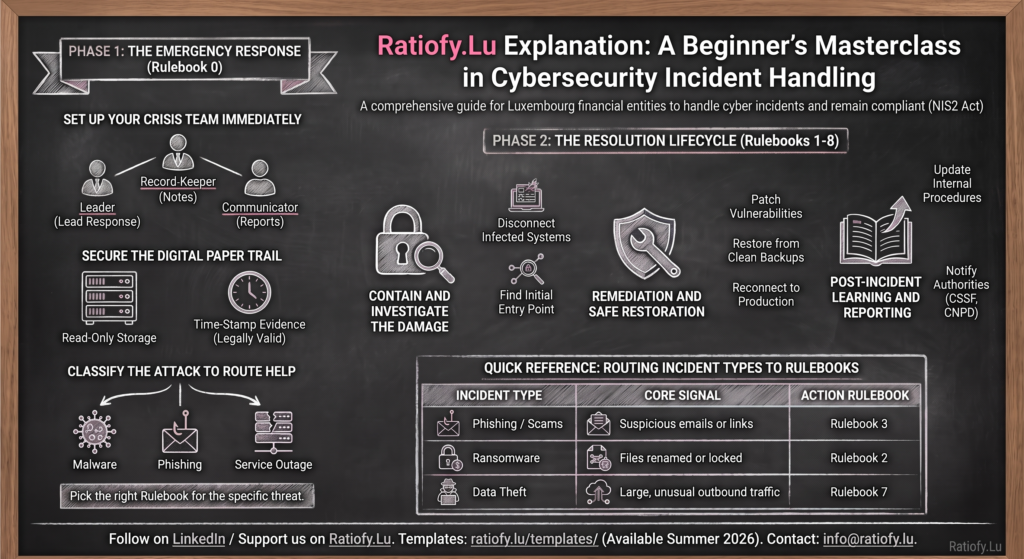
Rulebook 0 functions as the operational entry point to stabilize operations, secure evidence, satisfy regulatory clocks immediately, and route response teams to the appropriate specialized playbook(s).
Immediate First Actions
1. Assign Roles & Segregate Responsibilities
- Incident Leadership: Appoint an Incident Leader, a Secretary (dedicated to meeting minutes and evidence logs), Security Analysts, and a Communicator.
- Segregation of Functions: Communication and regulatory reporting roles must be strictly segregated from technical resolution teams (IT and security staff).
- War-Room & Business Continuity: In crisis scenarios, establish a secure physical or virtual war-room. Log all decisions and attendees. Immediately engage the Business Continuity Management (BCM) lead to evaluate business-critical disruptions.
2. Staff Wellbeing & Operational Sustainability
- Implement mandatory shift rotations for sustained incidents.
- Provide breaks and psychological support where necessary.
- Enforce factual, calm internal communications to control operational stress.
3. Chain of Custody & Evidence Logging
- Establish an incident case log using standardized templates or incident management software.
- Artifact Hashing: For every collected artifact, document who, what, when, and how, compute a SHA-256 cryptographic hash, and store the original file in a read-only, access-controlled repository.
- Infrastructure Compromise Assumption: Responders must operate under the assumption that primary organizational infrastructure is compromised, utilizing out-of-band communication and dedicated out-of-band storage.
Master Triage & Threat Classification under Operational guidance for incident handling under NIS2, HCPN, ANSSI, CSIRT, CIRCL, CSSF, ILR, GOVCERT.LU in Luxembourg
Responders must assess collected Indicators of Compromise (IoCs) to invoke the relevant rulebook(s). Attacks may involve multiple vectors simultaneously, requiring the concurrent execution of multiple rulebooks.
| Rulebook | Attack Type | Key Indicators of Compromise (IoCs) |
| Rulebook 1 | DoS & DDoS | Service unavailability/severe latency; saturated network traffic; WAF origin timeouts; spikes in 4xx/5xx errors; DNS/VPN/Email drops; CPU spikes on backend servers. |
| Rulebook 2 | Malware | File extension changes (.locked, .crypt); AV/EDR alerts; suspicious process execution; C2 beaconing; persistence artifacts (WMI, tasks); ransom notes; screen locks. |
| Rulebook 3 | Communication Channel Exploitation | Suspicious emails/SMS reported; anomalous auto-forwarding; credential reuse alerts; fake login portals/phishing sites; CERT/Threat Intel warnings. |
| Rulebook 4 | Credential Theft & Account Compromise | Impossible travel/geographic login anomalies; MFA bypass; privilege escalation alerts; mailbox permission changes/downloads; external compromised domain alerts. |
| Rulebook 5 | Vulnerability Exploitation | Application crashes/defacement; anomalous API calls; web/reverse shell execution; spikes in WAF 4xx/5xx logs; abnormal web page volumetry. |
| Rulebook 6 | Insider Threat | Unauthorized access to sensitive data; large outbound transfers outside working hours; HR complaints/warnings; unauthorized admin tool/privilege escalation usage. |
| Rulebook 7 | Data Exfiltration | Obfuscated outbound traffic; DLP/proxy alerts; sudden large file transfers; long dwell times; organizational data found on external channels (Telegram, dark web, media). |
| Rulebook 8 | Supply Chain & Package Compromise | Post-update alerts; failed package hash/signature validations; EDR alerts on side-loaded DLLs/installers; unexpected OAuth permissions; SBOM drift. |
Detailed Examination of Incident-Specific Rulebooks
Rulebook 1: Denial of Service (DoS) & Distributed Denial of Service (DDoS) under Operational guidance for incident handling under NIS2, HCPN, ANSSI, CSIRT, CIRCL, CSSF, ILR, GOVCERT.LU in Luxembourg
Covers network-layer and application-layer overflow or crash attacks.
- Immediate Response (Containment):
- Notify BCM and affected business owners immediately.
- Classify attack as volumetric or non-volumetric.
- Contact Internet Service Providers (ISPs) to enable traffic filtering or activate subscribed anti-DDoS services.
- Implement rate-limiting, geo-blocking, or IP range blocking. Cap connections and lower timeouts to preserve backend components.
- Divert web traffic through Content Delivery Networks (CDNs) and activate crisis communications.
- Investigation Steps: Perform traffic analysis to isolate geographic and logical origins (accounting for reflection attack limitations). Capture PCAP files, edge logs, User-Agent strings, URIs, and source ASNs. Evaluate if the DoS is a distraction vector for concurrent exfiltration or intrusion.
- Remediation: Update WAF rules; apply challenge-response mechanisms (CAPTCHAs); deploy temporary caching rules; apply IP reputation deny-lists; gradually remove temporary blocks once traffic stabilizes.
- Evidence Keeping: Retain NetFlow/PCAP samples, WAF/load-balancer/firewall/application logs, and detailed timeline records.
- Key Watchpoints: Application-layer (L7) DoS frequently evades volumetric controls. Attackers alter techniques dynamically. Responders must confirm no persistent backdoors or web shells were planted during the disruption.
Rulebook 2: Malware (Ransomware, Infostealers, RATs, Wipers, Botnets) under Operational guidance for incident handling under NIS2, HCPN, ANSSI, CSIRT, CIRCL, CSSF, ILR, GOVCERT.LU in Luxembourg
Covers all malicious software types, including destruction, extortion, remote access, surveillance, and resource mining.
[Malware Detection Alert]
│
▼
┌───────────────────────────────────────┐
│ Immediate System Isolation │
│ (Switch/NAC/Hypervisor/Network Cable) │
└───────────────────┬───────────────────┘
│
┌──────────────┴──────────────┐
▼ ▼
[System Strategy: OFF] [System Strategy: ON]
• Limits spread • Preserves RAM forensics
• Prevents lateral movement • Enables ransomware key
extraction opportunity
- Containment Strategy:
- Power On vs. Power Off Decision: Leaving systems powered on preserves volatile RAM memory for forensic analysis and potential cryptographic key extraction. Powering off stops immediate lateral spread and data destruction.
- Isolate devices at network, switch, NAC, or hypervisor levels.
- If ransomware is identified, immediately disconnect backup infrastructure and suspend automated backup jobs to avoid encryption or wiping of backups. Check integrity of offline backups.
- Disable administrative shares (SMB), RDP, and tools commonly abused for lateral movement (e.g., PsExec).
- Investigation:
- Create forensic disk images using tools such as dd on entry points, domain controllers, and attacker pivots. Utilize EDR for rapid artifact extraction.
- Identify initial access vectors (phishing, exposed RDP, software flaw).
- Analyze ransomware strains utilizing external resources (e.g., pandora.circl.lu).
- Remediation:
- Do not pay the ransom (does not guarantee recovery and may violate sanctions laws).
- Rebuild systems from clean, gold-image baselines. Invalidate cached tokens on infected hosts.
- If rebuilding is impossible, manually purge persistence artifacts (registry keys, WMI tasks).
- Patch vulnerabilities, update endpoint AV/EDR signatures, and gradually restore network access under heightened monitoring.
- Key Watchpoints: Watch for double-extortion tactics (data exfiltration paired with encryption) and dormant second-stage droppers. Cloud synchronization services must be sanitized to prevent re-infecting restored files.
Rulebook 3: Exploitation of Communication Channels under Operational guidance for incident handling under NIS2, HCPN, ANSSI, CSIRT, CIRCL, CSSF, ILR, GOVCERT.LU in Luxembourg
Covers social engineering tactics: Phishing, Smishing, Vishing, Quishing (QR Code), Pretexting (CEO Fraud), and Business Email Compromise (BEC).
- Immediate Response (Containment):
- Block malicious URLs and domains across proxy, email gateway, and firewall controls.
- Execute administrative search-and-purge operations across all mailbox stores.
- Revoke active user sessions and reset compromised credentials/OAuth tokens.
- Scan user endpoints for credential stealers or secondary malware using EDR.
- Remove unauthorized mailbox auto-forwarding rules. Block external delivery of spoofed internal domain addresses.
- Investigation Steps:
- Inspect raw email headers for SPF/DKIM/DMARC anomalies and routing paths.
- Do not click links/payloads directly. Sandbox suspicious URLs/files to determine intent. Utilize tools like Lookyloo (lookyloo.circl.lu) to inspect redirect chains and credential-harvesting kits.
- Remediation: Align email protection protocols (SPF, DKIM, DMARC) with industry best practices. Force credential/token rotations. Monitor compromised accounts for a minimum of 72 hours post-incident.
- Key Watchpoints: Attackers increasingly use phishing to harvest OAuth tokens to bypass password resets. Mobile vector exploitation (SMS/messaging apps) is rising.
Rulebook 4: Credential Theft & Account Compromise under Operational guidance for incident handling under NIS2, HCPN, ANSSI, CSIRT, CIRCL, CSSF, ILR, GOVCERT.LU in Luxembourg
Covers session hijacking, pass-the-hash, pass-the-ticket, brute-forcing, password spraying, Kerberoasting, and LSASS credential dumping.
- Immediate Response (Containment):
- Terminate active user sessions, invalidate refresh/session tokens, and force immediate password resets.
- Alert SOC and Identity and Access Management (IAM) teams to monitor for authentication retry attempts or password spraying across other accounts.
- Investigation Steps:
- Determine entry vector and review Active Directory (AD), Identity Provider (IdP), and VPN authentication logs.
- Investigate MFA bypass mechanisms (e.g., adversary-in-the-middle phishing relays or push fatigue).
- Audit identity directories for persistence mechanisms: newly created admin/app accounts, unauthorized OAuth consents, long-lived API tokens, or newly registered MFA devices.
- Remediation: Enforce conditional access (MFA, geo-fencing). Remove unauthorized privileges from identity directories. Purge malicious mail-filtering and forwarding rules.
- Key Watchpoints: Password resets do not invalidate compromised OAuth/session tokens; active session revoking must be explicitly triggered.
Rulebook 5: Vulnerability Exploitation under Operational guidance for incident handling under NIS2, HCPN, ANSSI, CSIRT, CIRCL, CSSF, ILR, GOVCERT.LU in Luxembourg
Covers exploitation of web applications, APIs, Known Exploited Vulnerabilities (KEV), configuration flaws, and memory/binary flaws.
- Immediate Response (Containment): Isolate affected systems; kill-switch vulnerable code paths or disable exposed API endpoints. Update WAF signatures to block observed exploit payloads. Save system snapshots and memory logs prior to patching or rebooting.
- Investigation Steps:
- Review web, API, reverse-proxy, and application error logs.
- Execute code comparison commands (e.g., diff) between current production releases and baseline repositories to spot injected vulnerabilities or backdoors.
- Search for web shells (e.g., unexpected .php, .py, .asp, .js files).
- Check process trees and active network sockets for reverse shell connections.
- Remediation: Patch vulnerable software or remove exposed features. Rotate all secrets, API keys, and database credentials accessible to the application. Rebuild compromised web stacks from clean source repositories. Perform code reviews, API rate-limiting, and vulnerability scans prior to returning to service.
- Key Watchpoints: Exploitation frequently serves as a bridge to data exfiltration; assume data loss until forensic investigation proves otherwise.
Rulebook 6: Insider Threat under Operational guidance for incident handling under NIS2, HCPN, ANSSI, CSIRT, CIRCL, CSSF, ILR, GOVCERT.LU in Luxembourg
Covers malicious actions executed by internal staff, contractors, or consultants leveraging valid system permissions.
- Immediate Response (Containment):
- Restrict user access using need-to-know and least-privilege principles.
- Suspend user accounts immediately if active sabotage or data theft is suspected.
- Notify HR, Legal, and affected business units.
- Investigation & Evidence Handling:
- Collect file access histories, administrative action logs, and recent role change records.
- Perform intent analysis by reviewing HR records, disciplinary history, or resignation notices.
- Legal Compliance: All employee log collection and monitoring activities must strictly comply with national privacy laws and internal policies.
- Remediation: Revoke access; rotate shared administrative passwords and API keys the insider had access to; implement User Behaviour Analytics (UBA); refine Data Loss Prevention (DLP) boundaries.
- Key Watchpoints: Ensure operational teams carefully differentiate intentional malicious activity from genuine operational negligence or human error.
Rulebook 7: Data Exfiltration under Operational guidance for incident handling under NIS2, HCPN, ANSSI, CSIRT, CIRCL, CSSF, ILR, GOVCERT.LU in Luxembourg
Covers unauthorized extraction or leakage of confidential organizational data.
- Immediate Response (Containment):
- Choose containment strategy: Block vs. Monitor (monitoring may be selected briefly to map adversary C2 channels, provided leakage impact allows).
- Restrict outbound exfiltration paths (e.g., block HTTPS/SFTP connections to unusual ASNs or unapproved cloud services).
- Terminate remote access connections (VPN/SSH) for implicated accounts.
- Execute full-disk image captures (dd) on staging devices.
- Investigation Steps:
- Search for data staging areas (e.g., temporary folders, compressed archive files in cloud sync or local temp directories).
- Measure exfiltrated file volumes, trace dwell times, and analyze “Living Off the Land” (LOTL) tool usage.
- Audit collaboration tools, web proxies, and DLP/CASB alerts.
- Remediation: Clean persistence artifacts; reset all organizational credentials (including service accounts and tiered administrative credentials); applyZero-Trust segmentation.
- Legal Coordination: Coordinate immediately with the Data Protection Officer (DPO) if personal data is implicated, ensuring compliance with GDPR notification deadlines.
- Key Watchpoints: Advanced threat actors obscure exfiltration by splitting data into small encrypted chunks transferred over common public cloud services.
Rulebook 8: Package Compromise & Supply Chain Attacks under Operational guidance for incident handling under NIS2, HCPN, ANSSI, CSIRT, CIRCL, CSSF, ILR, GOVCERT.LU in Luxembourg
Covers compromises involving third-party software dependencies, libraries, open-source code, firmware, or build pipelines.
[Supply Chain / Package Alert]
│
▼
┌──────────────────────────────────────────────────┐
│ Immediate Freeze Actions │
│ • Freeze software deployments & auto-updates │
│ • Quarantine CI/CD worker agents/build hosts │
│ • Restrict outbound access to allowlisted update│
│ endpoints only │
└────────────────────────┬─────────────────────────┘
│
▼
┌──────────────────────────────────────────────────┐
│ Investigation & Purge │
│ • Inspect CI/CD logs & SBOM drift │
│ • Verify digital signatures & hash digests │
│ • Blacklist compromised packages in registries │
│ • Rebuild environment from clean baselines │
└──────────────────────────────────────────────────┘
- Immediate Response (Containment):
- Freeze Deployments: Halt all software deployment pipelines and disable automated update mechanisms across the organization.
- CI/CD Quarantine: Move build agents, runner environments, containers, and updated host systems to isolated network quarantine zones.
- Restrict outbound software update traffic strictly to allowlisted endpoints.
- Revoke suspected signing keys, API tokens, and SSO/OAuth integrations. Require step-up authentication for administrators.
- Investigation Steps:
- Identify compromised component versions, installation dates, and downstream dependent assets.
- Validate certificate chains, revocation status, and package hash digests against trusted vendor baselines.
- Audit CI/CD execution logs, Software Bill of Materials (SBOM) records, and artifact repositories for unauthorized modifications.
- Examine full process descendant chains originating from updated software installers.
- Remediation:
- Add malicious packages to registry blocklists and clear affected package caches.
- Roll back to last known good versions or install clean vendor patches.
- Rebuild infected systems and CI/CD worker environments from trusted baselines.
- Invalidate exposed signing keys, SSH keys, and service tokens.
- Key Watchpoints: Stolen code-signing certificates are routinely utilized by adversaries; code signatures alone do not guarantee safety. Automatically updated software components present severe latent risk.
Technical Tooling Reference Map under Operational guidance for incident handling under NIS2, HCPN, ANSSI, CSIRT, CIRCL, CSSF, ILR, GOVCERT.LU in Luxembourg
The framework explicitly leverages several public tools, standard utilities, and specialized repositories throughout the incident response steps:
| Tool / Resource | Type / Provider | Primary Application in Incident Handling |
| dd | Command-line Utility | Low-level full disk forensic acquisition on compromised workstations, Domain Controllers, and pivots. |
| Pandora (pandora.circl.lu) | Analysis Platform (CIRCL) | Static and dynamic analysis of suspicious files, ransomware strains, and persistence artifacts. |
| Lookyloo (lookyloo.circl.lu) | Web Analysis Tool (CIRCL) | Safe scraping, sandboxing, and redirection mapping of phishing sites and malicious URLs. |
| CIRCL Ransomware FAQ (tr-73) | Operational Guidance | Specialized supplementary playbook for managing ransomware, decryption assessment, and recovery. |
| CIRCL Standard Operational Procedures (tr-39) | SOP Reference | Standards for forensic evidence collection and formal incident handling procedures. |
| Sysmon / Windows Event Viewer | Endpoint Telemetry | Logging process creation, WMI persistence, network sockets, and lateral movement artifacts. |
| EDR / WAF / CASB / DLP | Defensive Security Stack | Real-time endpoint isolation, web payload blocking, cloud broker monitoring, and exfiltration alerts. |
Cross-Cutting Best Practices & Post-Incident Improvement
Across all threat categories, the authoring agencies emphasize general operational watchpoints to maximize organizational resilience:
[Detection & Triage] ──► [Containment] ──► [Remediation & Recovery] ──► [Post-Incident Improvements]
│
┌────────────────────────────────────────────────────────────────────────────┘
▼
• Patch entry vectors & update GPOs
• Enforce Tiered Credential Rotation & MFA
• Harden CI/CD pipelines & verify SBOMs
• Conduct user awareness exercises
• Update internal procedures & legal reviews
1. Evidence and Timeline Preservation
- Maintain a continuous, real-time log of events, decisions, and technical actions throughout the incident life cycle.
- Validate that backup stores are completely isolated and verified clean prior to executing system recovery operations.
2. Post-Incident Review (“Lessons Learnt”)
- Following system restoration, conduct formal post-incident reviews to patch identified entry vectors.
- Review Active Directory Group Policy Objects (GPOs), enforce zero-trust network segmentation, and implement tiered credential rotation.
- Strengthen deployment pipelines by enforcing signed Software Bill of Materials (SBOM) attestations, deploying private update proxies, and utilizing “canary” deployment strategies.
3. Communications Security
- Keep all internal and external communications clear, factual, and minimal.
- Ensure public disclosures or user notifications undergo prior legal and compliance review.
- Secure alternative, out-of-band communication platforms if primary corporate channels (e.g., cloud email or internal chat) are compromised.
Core Acronyms Reference under Operational guidance for incident handling under NIS2, HCPN, ANSSI, CSIRT, CIRCL, CSSF, ILR, GOVCERT.LU in Luxembourg
- ANSSI: Agence Nationale de la Sécurité des Systèmes d’Information
- API: Application Programming Interface
- ASN: Autonomous System Number
- BEC: Business Email Compromise
- CASB: Cloud Access Security Broker
- CDN: Content Delivery Network
- CI/CD: Continuous Integration / Continuous Delivery
- CIRCL: Computer Incident Response Center Luxembourg
- CSSF: Commission de Surveillance du Secteur Financier
- DLP: Data Loss Prevention
- EDR: Endpoint Detection and Response
- GOVCERT.LU: Governmental Computer Security Incident Response Team
- HCPN: Haut-Commissariat à la Protection Nationale
- ILR: Institut Luxembourgeois de Régulation
- IoC: Indicator of Compromise
- KEV: Known Exploited Vulnerabilities
- LOTL: Living Off the Land
- MFA: Multi-Factor Authentication
- NIS2: Directive (EU) 2022/2555 / Luxembourg NIS2 Act (Loi du 5 mai 2026)
- SBOM: Software Bill of Materials
- WAF: Web Application Firewall
- WMI: Windows Management Instrumentation
This news related to Operational guidance for incident handling under NIS2, HCPN, ANSSI, CSIRT, CIRCL, CSSF, ILR, GOVCERT.LU in Luxembourg can be considered beneficial under CSSF-Circulars, Central Securities Depositories (CSDs) News, Credit Institutions News, Crowdfunding service providers (CSPs) News, Crypto-Assets Service Providers (CASPs) and Virtual Asset Service Providers (VASPs) News, Data Reporting Service Providers (DRSPs) News, EU Regulations, Explanation, IFMs (AIFMs, ManCos) News, Investment Firms News, Issuers of Tokens (EMTs, ARTs) News, Multimedia, Must Read, Opinion, Payment Institutions (PIs) / Electronic Money Institutions (EMIs) /AISPs News, Pension funds News, PFS/PSF News, Undertakings for collective investment (UCIs).
At https://Ratiofy.Lu/, we defend your hard-earned money with our free daily news platform and expert-vetted templates. Need more help? Request access to our hands-on expert Advisory, Training and Coaching Services (very limited availability) related to CSSF Circulars and EU Regulations.
The pre-filled example templates for many CSSF Circulars are available at https://ratiofy.lu/templates/ from the summer of 2026.
Mastering the Incident Response Lifecycle: An Educational Guide for Aspiring Responders under Operational guidance for incident handling under NIS2, HCPN, ANSSI, CSIRT, CIRCL, CSSF, ILR, GOVCERT.LU in Luxembourg
1. Introduction to Operational Incident Handling under Operational guidance for incident handling under NIS2, HCPN, ANSSI, CSIRT, CIRCL, CSSF, ILR, GOVCERT.LU in Luxembourg
When a cybersecurity breach strikes an organization, technical environment stability can crumble within minutes. In critical moments, technical teams face intense cognitive stress, conflicting system telemetry, and urgent pressure from corporate executives and external stakeholders. To navigate this operational fog of war, cyber security experts from the High Commission for National Protection (HCPN/ANSSI/GOVCERT.LU), the Computer Incident Response Center Luxembourg (CIRCL), the Commission de Surveillance du Secteur Financier (CSSF), and the Institut Luxembourgeois de Régulation (ILR) jointly established standardized operational rulebooks on September 28, 2026. Published under Article 14(5) of the NIS2 Act (and aligned with frameworks like DORA), these rulebooks establish standard operational procedures for public and private sector entities facing significant cyber incidents.
Structured operational guidance provides technical teams and cybersecurity officers with a repeatable roadmap. During an active breach, responders cannot afford to design containment procedures on the fly or debate administrative protocols while adversaries move laterally across internal networks.
Central Objective: The core purpose of operational incident handling is to transform chaotic security breaches into a controlled, repeatable, and mathematically verifiable mitigation process.
Learner Synthesis (“So What?”)
Standard operational rulebooks do not replace an organization’s existing internal policies, nor do they fulfill all statutory legal obligations (such as filing formal regulatory notifications with the CSSF, ILR, or CNPD, or lodging criminal complaints). Instead, they serve as immediate, battle-tested operational cheat-sheets. When a critical breach occurs, these rulebooks give responders immediate, actionable steps to stabilize systems, preserve forensic evidence, and limit organizational impact when every second counts.
Before any technical remediation or deep system recovery can occur, responders must first establish immediate organizational command and triage.
2. Triage & First Actions: Establishing Command and Control under Operational guidance for incident handling under NIS2, HCPN, ANSSI, CSIRT, CIRCL, CSSF, ILR, GOVCERT.LU in Luxembourg
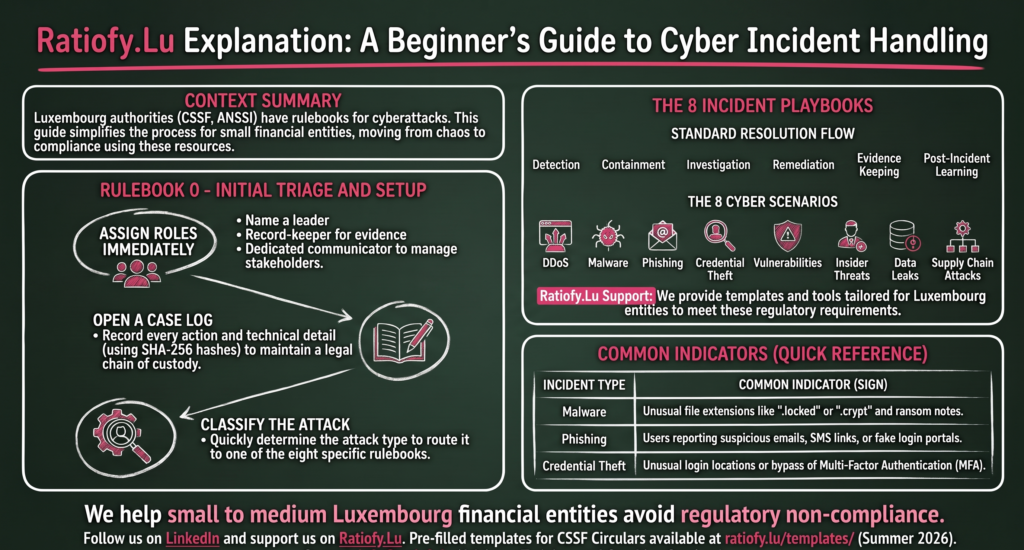
When an incident is first declared, establishing operational order takes priority over deep technical probing. Without clean command structures, incident response efforts risk falling into chaotic miscommunication, overwritten forensic evidence, and technical team burnout.
2.1 Key Incident Handling Roles
Immediately upon declaring an incident, specific operational roles must be assigned to ensure clear decision-making, strict accountability, and uncompromised command hierarchy.
| Incident Role | Primary Function & Operational Description |
| Incident Leader | Directs the overall response strategy, coordinates technical resources, makes key operational decisions, and maintains ultimate command over the response lifecycle. |
| Secretary | Maintains the official incident case log, records precise timestamps and decision rationales, tracks war-room participation, and manages evidence chain-of-custody logs. |
| Technical Analysts | Conducts technical triage, investigates system logs, isolates compromised assets, extracts volatile technical artifacts, and executes remediation tasks. |
| Communicator | Manages all internal and external messaging (to executive leadership, staff, customers, and regulatory bodies). Must be strictly segregated from technical resolution teams. |
| BCM Lead | Represents Business Continuity Management; evaluates business-critical operational impacts, assists in crisis escalation, and aligns recovery priorities with core business operations. |
2.2 Critical Immediate Steps
Once team roles are assigned, responders must immediately execute four foundational triage steps:
- Segregating Communication Roles: Strictly isolate the communicator role from technical IT and security analysts. Technical responders must maintain absolute focus on containment and threat hunting without being interrupted by executive status inquiries or press demands.
- Opening a Case Log & Securing Evidence: Establish an official incident log using dedicated software or standardized templates. For every captured artifact, log who collected it, what it is, when it was acquired, and how it was retrieved. Calculate cryptographic SHA-256 hashes for all evidence files and store original copies in a dedicated, read-only repository.
- Utilizing Out-of-Band Channels: Assume that the entity’s underlying network infrastructure, internal email servers, and primary file stores may be fully monitored or compromised by the adversary. Responders must rely on out-of-band communication lines and secondary external storage platforms for technical coordination and evidence management.
- Managing Staff Wellbeing: Sustained incidents generate severe mental fatigue. Incident leaders must schedule mandatory shift rotations, enforce rest breaks, provide psychological support, and maintain clear, calm, factual communication to prevent cognitive overload and catastrophic human errors.
Learner Synthesis (“So What?”)
Separating communication duties from technical teams is critical to surviving a cyber crisis. If lead engineers are forced to answer executive phone calls or draft external press releases, their focus is pulled away from hunting the adversary, allowing the threat actor more time to escalate privileges, destroy offline backups, or exfiltrate sensitive data.
With team roles defined and initial command established, responders transition from immediate crisis management to the structured chronological phases used to systematically resolve the threat.
3. The 5 Chronological Phases of Incident Resolution under Operational guidance for incident handling under NIS2, HCPN, ANSSI, CSIRT, CIRCL, CSSF, ILR, GOVCERT.LU in Luxembourg
Standard incident handling follows a structured 5-phase chronological workflow designed to systematically isolate, analyze, and eliminate cyber threats.
+———————————————————————————–+
| INCIDENT RESOLUTION LIFECYCLE |
| |
| [ Phase 1 ] —> [ Phase 2 ] —> [ Phase 3 ] —> [ Phase 4 ] —> [ Phase 5 ] |
| Detection & Immediate Investigation & Remediation & Post-Incident |
| Identification Containment Forensics Safe Recovery & Evidence |
+———————————————————————————–+
3.1 Phase 1: Detection & Indicator Identification under Operational guidance for incident handling under NIS2, HCPN, ANSSI, CSIRT, CIRCL, CSSF, ILR, GOVCERT.LU in Luxembourg
The incident lifecycle begins when monitoring systems or users register an operational anomaly. Responders evaluate initial triggers—known as Indicators of Compromise (IOCs)—to identify the nature of the attack.
Indicators typically fall into common attack vector groups:
- Network & Traffic Anomalies: Saturated network interfaces, connection timeouts, handshake failures, unexpected spikes in HTTP 4xx/5xx error rates, Web Application Firewall (WAF) origin timeouts, or outbound connections to suspicious Autonomous System Numbers (ASNs) and Command & Control (C2) infrastructure.
- Endpoint & System Anomalies: Endpoint Detection and Response (EDR) or Antivirus (AV) alerts, unusual process executions, altered or appended file extensions (such as .locked or .crypt), unexpected file renaming, reverse shells, or sudden high CPU utilization on backend database servers.
- User & Access Anomalies: Suspicious user emails or SMS messages, automated mailbox forwarding rules, unusual geographic logins (“impossible travel”), unexpected Multi-Factor Authentication (MFA) bypasses, or privilege escalation alerts.
- Supply Chain Anomalies: Software Bill of Materials (SBOM) drift, hash validation failures on software updates, unexpected code-signing certificates, or alerts triggered on newly updated Dynamic-Link Libraries (DLLs).
Operational Note: Indicators are indicative, non-exhaustive triggers. Responders do not need to encounter every listed indicator to launch a specific playbook, and complex breaches frequently trigger multiple playbooks simultaneously.
Once an anomaly is detected and verified, responders must immediately move to freeze the attack’s progress.
3.2 Phase 2: Immediate Response & Containment under Operational guidance for incident handling under NIS2, HCPN, ANSSI, CSIRT, CIRCL, CSSF, ILR, GOVCERT.LU in Luxembourg
Containment focuses on stopping the spread of an attack (“preventing contagion”) to minimize overall operational damage. Responders implement immediate technical blocks, isolate compromised network segments, and disable risky remote access points (such as SMB or RDP shares).
Executing containment requires balancing critical technical trade-offs regarding system power states:
POWER-STATE CONTAINMENT DECISION TREE
│
▼
Is Ransomware or Volatile Memory Active?
│
┌─────────────────────────┴─────────────────────────┐
▼ ▼
[ KEEP POWER ON ] [ POWER SYSTEM OFF ]
Preserves Volatile RAM Halts Active Encryption
Enables Memory Dumps & Key Extraction Stops Network Contagion
│ │
▼ ▼
Check Decryptors ( Pandora / TR-73 ) Permanently Destroys RAM
│ Eliminates Key Recovery Options
▼
Proceed to Safe System Isolation
Operational Containment Trade-Off: Deciding whether to leave an infected system powered on or to power it off immediately is a critical decision during a breach:
- Keeping Power ON: Preserves volatile memory (RAM) critical for deep forensic analysis, memory dumps, and potential extraction of ransomware decryption keys. Responders must check for publicly or specialized available decryptors (such as CIRCL Pandora or TR-73 guidance tools) before making destructive system-wiping decisions. However, keeping power on carries the risk of ongoing file encryption or active lateral network propagation.
- Powering Power OFF: Immediately stops active malware execution, halts lateral movement, and stops ongoing file destruction. However, it permanently destroys volatile RAM evidence and eliminates any chance of extracting memory-resident decryption keys.
If ransomware or severe network contagion is identified, responders must immediately disconnect backup systems from the network, temporarily suspend automated backup synchronization to prevent corrupted or encrypted files from overwriting clean backups, and verify the offline integrity of uninfected storage.
Once the spread of an attack is halted, responders must pivot to understanding the root cause and overall reach.
3.3 Phase 3: Investigation & Forensic Analysis under Operational guidance for incident handling under NIS2, HCPN, ANSSI, CSIRT, CIRCL, CSSF, ILR, GOVCERT.LU in Luxembourg
During the investigation phase, technical analysts collect artifacts to uncover the root cause, determine attacker dwell time, inspect process execution hierarchies, and assess the full extent of the intrusion.
FORENSIC ANALYSIS STEPS
1. Acquire EDR Artifacts & Full Disk Images (e.g., `dd`)
│
▼
2. Inspect Logs (Event Viewer, Sysmon, Firewalls)
│
▼
3. Map Attacker Dwell Time & Entry Vector
│
▼
4. Inspect Process Descendant Chains & Persistence
(Parent ──► Child ──► Grandchild Execution)
│
▼
5. Evaluate Data Exfiltration Scope & Staging
- Acquire EDR & Forensic Images: Use EDR tools to collect volatile host artifacts. For critical workstations (such as entry points, domain controllers, or attacker pivot hosts), perform full-disk bitstream acquisitions using forensic tools like dd.
- Inspect System Logs: Analyze Windows Event Viewer, Sysmon, proxy, and firewall logs to trace lateral movement, account creation, and the use of administrative utilities (e.g., PsExec or credential dumping tools targeting LSASS).
- Map Attacker Dwell Time & Entry Vector: Determine how long the adversary remained undetected inside the network and identify the exact entry mechanism (e.g., a phishing link, exploited web vulnerability, or compromised third-party package).
- Inspect Process Descendant Chains & Persistence: Execute deep process execution analysis by tracing full process descendant chains (parent $\rightarrow$ child $\rightarrow$ grandchild processes) originating from compromised installers, CI/CD build runners, or web servers. Search infected stacks for server-side web shells, unauthorized scheduled tasks, rogue Windows Management Instrumentation (WMI) event consumers, altered registry keys, or newly assigned OAuth application permissions.
- Assess Exfiltration Scope: Inspect network flow records (NetFlow/PCAP) and proxy logs to verify if sensitive data was staged in temporary directories and transferred out to external Autonomous System Numbers (ASNs) or public cloud platforms.
Once the scope and origin are fully mapped, the organization can safely move toward rebuilding and restoring systems.
3.4 Phase 4: Remediation & Safe Recovery under Operational guidance for incident handling under NIS2, HCPN, ANSSI, CSIRT, CIRCL, CSSF, ILR, GOVCERT.LU in Luxembourg
Remediation focuses on eliminating technical vulnerabilities, removing adversary access, and safely restoring operations to a secure baseline state.
- Patching Entry Vectors: Apply software updates, patch exposed web vulnerabilities, close unauthorized open ports, and reconfigure Web Application Firewalls (WAF) to eliminate the initial entry vector before reconnecting systems.
- Stack Rebuilding & Cleaning: Remove all persistence artifacts (web shells, tasks, registry keys). Where feasible, completely rebuild host stacks, containers, and virtual machines from clean gold images rather than attempting to manually clean infected operating systems.
- Credential & Secret Rotation: Invalidate cached session tokens, execute mandatory password resets across affected accounts (utilizing tiered credential rotation for privileged/administrative accounts), and rotate exposed API keys, SSH keys, and OAuth refresh tokens.
- Pausing & Sanitizing Cloud Synchronization Services: Explicitly pause and audit all automated cloud storage and folder synchronization services prior to restoring files. Unsanitized cloud sync services can passively re-propagate encrypted or infected files back into clean, restored environments, causing immediate re-infection.
- Restoring from Trusted Backups: Restore database records and application files strictly from verified, uninfected offline copies. Reconnect restored systems to the network gradually under heightened monitoring.
- Email Security Technical Stack Hardening: Audit and enforce email validation protocols across the enterprise, specifically verifying Sender Policy Framework (SPF), DKIM, and DMARC configurations to prevent domain spoofing.
- Strict Policy Mandate on Ransoms: Entities facing extortion should not pay ransoms. Ransom payments offer no technical guarantee of data recovery, do not prevent secondary leaks, and risk breaching legal sanctions laws.
Resolving the immediate breach is incomplete without long-term learning and evidence retention.
3.5 Phase 5: Post-Incident Activity & Evidence Preservation under Operational guidance for incident handling under NIS2, HCPN, ANSSI, CSIRT, CIRCL, CSSF, ILR, GOVCERT.LU in Luxembourg
The final phase ensures legal readiness and translates technical failures into strategic defensive improvements.
Evidence Keeping & Chain of Custody
- Read-Only Original Retention: Store initial forensic disk images, memory dumps, and network packet captures (PCAP) in secure access-controlled repositories. Maintain chain-of-custody logs tracking who collected each artifact, when it was retrieved, and its cryptographic SHA-256 hash.
- Artifact Samples: Retain copies of original malicious communications (including full raw email headers), samples of malware binaries/installers, ransom notes, and a representative subset of encrypted files.
- Comprehensive Log Preservation: Store full HTTP access/error logs, EDR telemetry, firewall records, and the finalized incident case log documenting all decisions and rationales.
Lessons Learnt & System Hardening under Operational guidance for incident handling under NIS2, HCPN, ANSSI, CSIRT, CIRCL, CSSF, ILR, GOVCERT.LU in Luxembourg
- Architecture Review: Update internal network architecture by enforcing strict network segmentation, zero-trust access, and endpoint hardening (e.g., applying restricted Group Policy Objects – GPOs).
- Authentication & Proxy Hardening: Expand Multi-Factor Authentication (MFA) across all administrative accounts, remote access points, and cloud service portals. Ensure web proxies execute SSL/TLS termination with explicit HTTP POST request logging enabled to capture credential harvesting and data exfiltration attempts.
- BCP/DRP Plan Updates: Incorporate technical findings into Business Continuity Plans (BCP) and Disaster Recovery Plans (DRP). Re-evaluate alert thresholds on Security Information and Event Management (SIEM) dashboards for earlier detection.
Learner Synthesis (“So What?”)
Post-incident activity turns a crisis into a long-term operational advantage. By rigorously auditing technical failures, updating defensive baselines, and hardening identity access, responders ensure that a single vulnerability cannot be exploited by the same threat actor twice.
Understanding this generic 5-phase framework provides the structure needed to examine its practical application across specific real-world attack scenarios.
4. Scenario Blueprint: Threat Classification & Response Matrix under Operational guidance for incident handling under NIS2, HCPN, ANSSI, CSIRT, CIRCL, CSSF, ILR, GOVCERT.LU in Luxembourg
Incident responders must adapt their procedures to match specific threat vectors. The matrix below synthesizes operational rulebooks across eight distinct incident categories, highlighting dual-path decision forks and critical technical watchpoints.
| Incident Category | Primary Detection Indicator | Immediate Containment Action (with Decision Forks) | Key Watchpoint / Risk |
| 1. DoS & DDoS (Rulebook 1) | Saturated network interfaces, connection timeouts, spikes in HTTP 4xx/5xx errors, severe backend CPU load. | Triage Fork: Distinguish Volumetric vs Non-Volumetric.<br>• Volumetric Path: Activate ISP traffic scrubbing and external anti-DDoS services.<br>• Non-Volumetric Path: Apply connection caps, lower HTTP timeouts, rate limits, geo-blocking, and CDN traffic diversion. | Application-layer (L7) DoS can evade volumetric network defenses; attack vectors shift rapidly across L3/L4/L7 layers; campaigns frequently re-emerge within days. |
| 2. Malware & Ransomware (Rulebook 2) | Files appended with .locked/.crypt extensions; ransom notes; EDR alerts; suspicious C2 beaconing. | Power State Fork: Evaluate RAM preservation vs immediate shutdown.<br>• Preserve RAM: Keep power ON if checking decryptors (CIRCL Pandora/TR-73) or dumping memory.<br>• Power OFF: If active spread threatens core infrastructure.<br>• Mandatory Action: Isolate hosts, disconnect offline backups, and pause cloud folder sync services to prevent re-infection. | Double extortion risks (data exfiltration prior to encryption); hidden dropper payloads pre-positioned for future access; re-infection triggered by unsanitized cloud sync folders. |
| 3. Communication Exploitation (Phishing/BEC) (Rulebook 3) | User reports of suspicious links/SMS; unexpected auto-forwarding mail rules; reported fake login portals. | Block malicious domains/URLs on proxies/gateways; purge emails via administrative search-and-remove; reset credentials and revoke active session/OAuth tokens; audit SPF, DKIM, DMARC settings. | OAuth token harvesting bypasses traditional password resets; mobile users targeted via smishing/vishing; attackers collecting access for delayed reuse. |
| 4. Credential Theft & Account Compromise (Rulebook 4) | Impossible travel login alerts; unintended MFA bypasses; privilege escalation alerts; suspicious OAuth/API token usage outside corporate IP range. | Force user logoff; enforce password resets using tiered credential rotation; terminate active application sessions; revoke OAuth/API tokens; notify IAM team. | Token-based attacks remain active after password resets; automated persistence mechanisms (scheduled tasks, rogue delegate access). |
| 5. Vulnerability Exploitation (Rulebook 5) | Reverse or web shells; unusual API calls; spikes in WAF/SIEM error alerts; abnormal rendered page volumes. | Isolate affected host/application; kill-switch the vulnerable path; deploy blocking WAF rules; disable exposed API endpoints; take system snapshots before rebooting. | Exploits often lead to data theft (always assume exfiltration until disproven); attacks may target business logic flaws rather than technical software bugs alone. |
| 6. Insider Threat (Rulebook 6) | Unauthorized access to sensitive data; massive outbound transfers outside business hours; HR warnings; admin tool abuse. | Restrict access using least-privilege principles; monitor activity via approved tools; perform intent analysis (differentiate malicious intent from employee negligence); provide psychological support during disputes; suspend access if sabotage/theft is confirmed. | Do not confuse employee negligence with intentional malice; strictly adhere to local labor laws and privacy regulations during investigations. |
| 7. Data Exfiltration (Rulebook 7) | Unusually large outbound traffic; Data Loss Prevention (DLP) alerts; suspicious obfuscated outbound transfers; internal data spotted on public forums/Telegram. | Strategy Fork: Choose Block vs Monitor based on data sensitivity.<br>• Block Path: Sever SFTP/HTTPS connections to unknown ASNs, disable VPN/SSH remote access.<br>• Monitor Path: Quietly observe C2 pathways to map full exfiltration scope without tipping off adversary. | Exfiltration can be stealthy, chunked into small encrypted packets; advanced actors obscure activity using fileless “Living Off the Land” (LOTL) tools. |
| 8. Package Compromise & Supply Chain (Rulebook 8) | Software Bill of Materials (SBOM) drift; package signature hash failures; EDR alerts on newly updated binaries; unexpected third-party API requests. | Freeze software deployments and disable auto-updates; quarantine affected build agents/runners; block observed IOCs; revoke build secrets/tokens; perform full process descendant chain inspection (parent $\rightarrow$ child $\rightarrow$ grandchild). | Stolen code-signing certificates render signature checks insufficient; third-party software often holds excessive system access rights; long attacker dwell times. |
Learner Synthesis (“So What?”)
During a high-stress crisis, security teams cannot afford to re-invent response protocols. Classification tables allow incident responders to quickly match observed technical artifacts against pre-planned containment procedures and dual-path decision forks, enabling fast, decisive action across complex, multi-vector attacks.
Having reviewed specific attack scenarios, aspiring responders must internalize the core mindsets that govern effective incident response.
5. Key Incident Handling Principles for New Learners under Operational guidance for incident handling under NIS2, HCPN, ANSSI, CSIRT, CIRCL, CSSF, ILR, GOVCERT.LU in Luxembourg
To build a career in cybersecurity incident response, developing the right operational mindset is just as important as mastering technical commands. Successful incident responders operate according to four foundational principles:
- Continuous Re-assessment: Initial assumptions in a breach are frequently incomplete or wrong. Responders must continuously gather new logs, update technical hypotheses, and re-classify the incident vector as new evidence emerges.
- Assume Data Exfiltration: Whenever an adversary achieves interactive system compromise or code execution (such as exploiting a web vulnerability), responders must assume that sensitive data was accessed or exfiltrated until forensic analysis proves otherwise.
- Out-of-Band Communication: Never rely on potentially compromised internal infrastructure during an active breach. Always utilize isolated out-of-band communication platforms and dedicated external storage repositories to prevent the attacker from monitoring response efforts.
- Strict Factuality: Keep all written case logs, internal briefings, and external communications short, clear, and objective. Avoid speculation or unverified assumptions, and ensure communications pass legal review when appropriate.
Building expertise in incident handling is a continuous journey. By approaching complex security incidents with strict technical discipline, calm analytical thinking, and a commitment to methodical containment, aspiring responders can successfully protect critical digital systems and lead organizations through their most challenging operational crises.
5 Unexpected Insights from Luxembourg’s National Cybersecurity Incident Handling Rulebooks under Operational guidance for incident handling under NIS2, HCPN, ANSSI, CSIRT, CIRCL, CSSF, ILR, GOVCERT.LU in Luxembourg
When a major cyber crisis hits an organization, what actually happens behind closed doors? As critical systems go dark, telemetry alarms flash, and unauthorized execution streams across the environment, executive leadership and technical teams face an overwhelming sequence of high-stakes choices. Under intense pressure, standard IT operating procedures quickly fall apart.
On September 28, 2026, Luxembourg’s national cybersecurity and regulatory apparatus released a landmark joint framework. Authored collaboratively by the High Commission for National Protection (HCPN) in its capacities as ANSSI and GOVCERT.LU, alongside the Computer Incident Response Center Luxembourg (CIRCL), the financial regulator (CSSF), and the telecom regulator (ILR), this release establishes standardized operational incident handling rulebooks under Article 14(5) of Luxembourg’s NIS2 Act.
While these nine guides (ranging from Rulebook 0 through Rulebook 8) serve as granular technical reference tools for CSIRTs, they contain surprisingly counter-intuitive strategies and mandatory operational directives. Below are five unexpected insights from Luxembourg’s national guidelines that redefine modern enterprise incident response.
Takeaway #1: Human Errors and IT Glitches Are Out—These Rules Are Purely for Cyber Warfare under Operational guidance for incident handling under NIS2, HCPN, ANSSI, CSIRT, CIRCL, CSSF, ILR, GOVCERT.LU in Luxembourg
A striking foundational element of Rulebook 0 (Triage & Routing) is its unyielding restriction of operational scope. In enterprise IT, the overwhelming majority of network outages and system failures stem from mundane operational blunders: unannounced routine changes, botched firmware updates, or internal network misconfigurations. However, Luxembourg’s national rulebooks explicitly throw these operational issues out of their purview.
> “Enable support for malicious cyber-attacks (human errors and system failures are out of scope of these rulebooks).”
This strict boundary is a direct response to modern regulatory realities. When a major incident unfolds, statutory reporting clocks under directives like NIS2 and the Digital Operational Resilience Act (DORA) begin ticking immediately. Security Operations Centers (SOCs) and response teams cannot afford to burn twelve hours investigating a self-inflicted BGP misconfiguration or an accidental database drop when statutory early-warning notification windows are shrinking. By strictly filtering out internal operational noise during initial classification, responders maintain absolute focus on detecting, isolating, and eradicating active malicious threat actors before regulatory deadlines expire.
Takeaway #2: The Power-Button Paradox—Shutting Down an Infected Machine Might Destroy Your Only Decryption Key under Operational guidance for incident handling under NIS2, HCPN, ANSSI, CSIRT, CIRCL, CSSF, ILR, GOVCERT.LU in Luxembourg
When ransomware or destructive wipers are detected executing on a endpoint, the immediate human reaction is to pull the power cable or force a hard shutdown to stop network propagation. Rulebook 2 (Malware) explicitly warns incident responders that this instinctual reaction introduces a severe tactical compromise.
The guidance requires teams to deliberately evaluate a critical forensic trade-off before altering an endpoint’s power state:
- Preserving power keeps volatile system memory (RAM) intact. This enables responders to capture volatile artifacts, reconstruct running processes, and potentially extract encryption keys directly from memory—offering a path to decrypt system data without yielding to extortion.
- Powering off the system immediately halts local disk destruction and network propagation, but permanently wipes volatile RAM artifacts, eliminating any chance of memory-based key recovery.
Beyond the power paradox, Rulebook 2 details aggressive containment actions that must happen simultaneously: responders must immediately sever all physical and logical connections to backup systems and temporarily suspend automated cloud synchronization pipelines to prevent encrypted files or secondary payloads from re-infecting clean storage. Furthermore, teams must immediately disable administrative lateral movement tools—specifically halting Server Message Block (SMB) shares, Remote Desktop Protocol (RDP) access, and execution utilities like PsExec.
Throughout this crisis management, the directive maintains an unyielding stance on extortion: organizations must not pay ransoms. Payment provides no technical guarantee of data recovery and exposes enterprise leadership to severe legal liabilities under international sanctions regimes.
Takeaway #3: Password Resets Don’t Stop Modern Attackers (Beware the OAuth & Token Hijack) under Operational guidance for incident handling under NIS2, HCPN, ANSSI, CSIRT, CIRCL, CSSF, ILR, GOVCERT.LU in Luxembourg
Standard incident response playbooks have historically relied on immediate, sweeping password resets as a primary containment mechanism. However, cross-synthesizing Rulebook 3 (Exploitation of Communication Channels) and Rulebook 4 (Credential Theft & Account Compromise) exposes why credential rotation alone routinely fails against modern threat actors.
Modern adversaries increasingly execute “Living off the Land” (LOTL) tactics. By leveraging adversary-in-the-middle (AiTM) phishing kits, session hijacking, and unauthorized OAuth application consent grants, attackers bypass Multi-Factor Authentication (MFA) entirely. Once inside, they operate using legitimate session tokens, valid API keys, and authorized application permissions, blending into standard corporate traffic.
Relying solely on password changes creates a dangerous, false sense of security while the attacker retains persistence. The national rulebooks mandate that effective containment must instead execute the following:
- Session and Token Invalidation: Immediately force global user logoffs and purge all active session cookies, OAuth refresh tokens, and long-lived API keys.
- Application & Mailbox Auditing: Audit cloud environments for newly registered third-party OAuth applications, excessive consent scopes, newly added MFA devices, and automated mailbox forwarding rules or delegates.
- Safe Sandbox Inspection: When investigating phishing vectors, analysts are strictly forbidden from clicking links or executing payloads directly; all suspicious lures and communications must be safely inspected within isolated sandbox environments (utilizing specialized analytical frameworks such as CIRCL’s Lookyloo or Pandora).
Takeaway #4: Signed Code Isn’t Safe—Your Auto-Update Engine May Be the Trojan Horse under Operational guidance for incident handling under NIS2, HCPN, ANSSI, CSIRT, CIRCL, CSSF, ILR, GOVCERT.LU in Luxembourg
Enterprise security architectures often place explicit trust in software binaries that exhibit valid digital signatures or originate from trusted vendor update nodes. Rulebook 8 (Package Compromission & Supply Chain Attack) details how sophisticated threat actors exploit this blind trust to subvert enterprise perimeters.
By compromising upstream CI/CD deployment pipelines, stealing software-signing certificates, or poisoning open-source dependency repositories, threat actors inject malicious code directly into legitimate update channels. Because the resulting payloads carry valid digital signatures, standard Endpoint Detection and Response (EDR) platforms frequently allow them to execute unimpeded.
To defend against supply chain compromises, the framework mandates immediate containment along with long-term architectural controls:
- Immediate Containment Actions:
- Freeze Deployment Pipelines: Immediately suspend all automated software updates, patch management schedules, and CI/CD deployment jobs across the infrastructure.
- Quarantine Build Infrastructure: Network-isolate all worker nodes, build agents, and CI/CD runners to prevent tainted artifacts from deploying into production.
- SBOM Drift Monitoring: Continuously compare running software behaviors against established Software Bill of Materials (SBOM) baselines to identify unexpected binary modifications or unexpected child process spawning.
- Strategic Architectural Protections: To permanently mitigate supply chain exposures, organizations must establish private internal package registries and update proxies rather than fetching dependencies directly from the open internet. Furthermore, organizations should enforce canary releases (staged rollouts) and explicitly negotiate contractual “kill-switch” provisions with third-party software vendors, granting the enterprise legal and technical authority to immediately sever vendor data flows during an upstream breach.
Takeaway #5: Crisis Team Burnout and Bad Comms Will Ruin You Faster Than the Malware under Operational guidance for incident handling under NIS2, HCPN, ANSSI, CSIRT, CIRCL, CSSF, ILR, GOVCERT.LU in Luxembourg
While technical eradication dominates incident management discussions, Rulebook 0 (First Actions) emphasizes that human endurance and operational governance are equally pivotal to surviving an enterprise compromise.
During a severe incident, two operational mandates are required:
- Strict Operational Segregation: The leadership roles managing crisis communications, executive updates, legal compliance, and regulatory reporting must be completely separated from technical resolution teams (IT and SOC analysts). Technical responders must be shielded from managerial interruptions so they can maintain focus on containment and eradication.
- Immediate Business Continuity & Out-of-Band Ops: The Business Continuity Management (BCM) lead must be engaged during initial triage to evaluate operational impacts alongside technical response efforts. Because internal enterprise communications and infrastructure must be presumed compromised, incident leads must immediately transition to pre-established, secure out-of-band communication channels and storage repositories.
- Forensic Evidence Logging Standards: Evidence collection under crisis conditions requires strict technical controls. Responders must maintain a detailed case log for every collected artifact, computing cryptographic SHA-256 hashes immediately upon acquisition and storing original files read-only in isolated, access-controlled repositories to preserve the evidentiary chain of custody.
- Mandatory Staff Wellbeing Protections: High-stress cyber crises rapidly degrade human decision-making. The framework explicitly mandates that crisis leadership enforce mandatory shift rotations, require periodic rest breaks, provide psychological support, and maintain factual, low-stress internal communications to prevent cognitive burnout among response personnel.
Navigating the Future of Incident Management under Operational guidance for incident handling under NIS2, HCPN, ANSSI, CSIRT, CIRCL, CSSF, ILR, GOVCERT.LU in Luxembourg
Luxembourg’s national cybersecurity rulebooks illustrate a fundamental shift in technical defense: under regulatory frameworks like NIS2, incident handling is no longer a localized IT repair task. It has transformed into a highly disciplined, multidisciplinary crisis management operational framework requiring exact coordination across technical forensics, supply chain architecture, regulatory compliance, and human risk management.
As threat actors continue to weaponize valid credentials, automated updates, and organizational fatigue, enterprise leaders must ask whether their internal incident response plans reflect these modern operational realities.
An Executive Self-Assessment:
Does your organization’s current incident response playbook explicitly account for session token revocation, automated backup isolation, build-agent quarantine, and mandatory responder rotation—or is your playbook relying on outdated assumptions?