
Luxembourg Financial Regulatory Advisory, Tools, Templates:
An active exploitation of a vulnerability, CVE-2026-76461, on Cisco Secure Email Gateway has been highlighted by CSSF Communication. Several international cybersecurity agencies have issued urgent warnings regarding a critical SQL injection vulnerability, identified as CVE-2026-76461, which affects the Cisco Secure Email Gateway. This security flaw stems from poor email parsing validation within the AsyncOS, permitting remote, unauthenticated attackers to gain root-level privileges by sending specially crafted messages. Because this exploit is currently being actively utilized by hackers, organizations are being instructed to immediately apply software updates and search their system logs for signs of unauthorized access. Regulatory bodies emphasize that any successful breach must be reported as a major ICT incident due to the total technical impact on affected systems. Administrators can mitigate risks by restricting external network access and monitoring for suspicious commands that indicate arbitrary code execution. In addition to patching, the CISA (Cybersecurity and Infrastructure Security Agency: America’s Cyber Defense Agency) has set a strict deadline for remediation to prevent further compromise of infrastructure.
Summary of Active exploitation of a vulnerability on Cisco Secure Email Gateway – CSSF Communication in Luxembourg
As of September 2026, a critical vulnerability identified as CVE-2026-76461 is being actively exploited in the wild. This vulnerability resides in the email parsing logic of the Cisco AsyncOS Software, which powers the Cisco Secure Email Gateway (SEG). It is a SQL injection flaw (CWE-89) that allows unauthenticated, remote attackers to execute arbitrary commands with root privileges on the underlying operating system.
The severity is rated as 9.8 (Critical). Major international cybersecurity bodies, including CISA, CSSF, and CERTFR, have issued urgent alerts. Immediate action is required: organizations must apply vendor-provided software updates or implement specific mitigations, including log analysis for indicators of compromise (IoC) and network-level access restrictions. For supervised financial entities in Luxembourg, this is classified as a major ICT-related incident requiring formal notification.
Vulnerability Technical Profileunder Active exploitation of a vulnerability, CVE-2026-76461, on Cisco Secure Email Gateway – CSSF Communication in Luxembourg
The vulnerability stems from insufficient validation of inputs during the email parsing process within Cisco AsyncOS.
Key Identifiers and Severity
| Attribute | Detail |
| CVE Identifier | CVE-2026-76461 |
| Common Weakness Enumeration | CWE-89 (SQL Injection) |
| CVSS 3.1 Score | 9.8 (Critical) |
| CVSS Vector | CVSS:3.1/AV:N/AC:L/PR:N/UI:N/S:U/C:H/I:H/A:H |
| SSVC Ratings | Exploitation: Active; Automatable: Yes; Technical Impact: Total |
| Exploitation Status | Confirmed Active (CISA KEV Entry ID: 9ac436c8-102a-4823-ba5c-e8df968c9d63) |
Attack Mechanism
An attacker exploits the flaw by sending a specifically crafted email message containing malicious SQL statements through an affected Cisco SEG device. Because the system fails to neutralize these special elements, the malicious SQL is executed, leading to a full compromise of the device with root-level access.
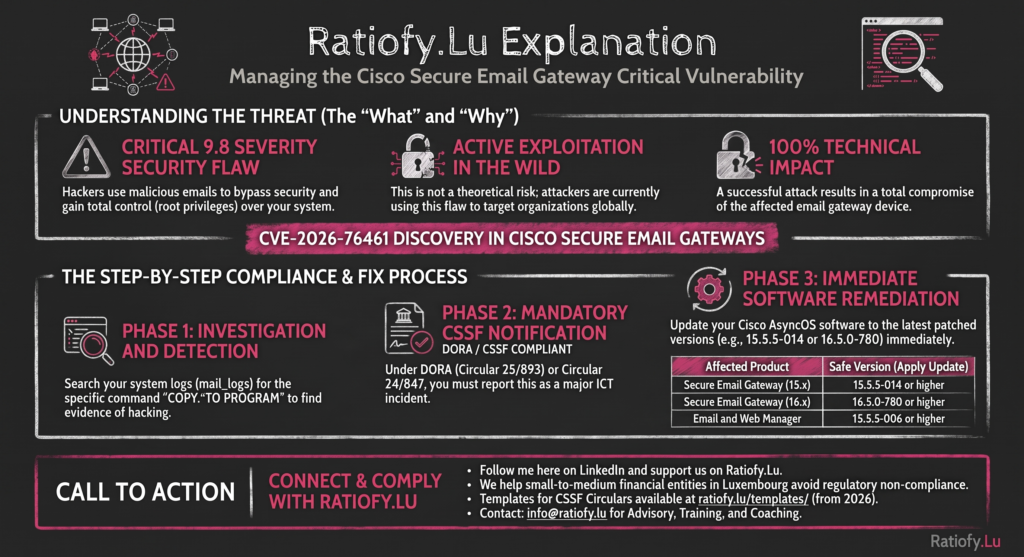
Scope of Impacted Products under Active exploitation of a vulnerability, CVE-2026-76461, on Cisco Secure Email Gateway – CSSF Communication in Luxembourg
The vulnerability affects a broad range of Cisco email and management products.
Affected Software Versions
- AsyncOS for Secure Email Gateway:
- Versions prior to 15.5.5-014
- Versions 16.0.x prior to 16.0.4-3021
- Versions 16.5.x prior to 16.5.0-780
- Secure Email and Web Manager:
- Versions prior to 15.5.5-006
- Versions 16.x prior to 16.5.0-429
Impacted Hardware and Virtual Appliances
- Cisco Secure Email Gateway (C195, C395, C695)
- Cisco Secure Email Gateway Virtual Appliance (C100V, C300V, C600V)
Exploitation Evidence and Indicators under Active exploitation of a vulnerability, CVE-2026-76461, on Cisco Secure Email Gateway – CSSF Communication in Luxembourg
National security agencies and incident centers have recorded significant evidence of unauthorized malicious access.
- Sighting Data: Reports indicate at least 136 sightings of this vulnerability.
- Exploitation Confidence: Vendor reports and CISA provide an 80% confidence level regarding successful exploitation in the wild.
- Detection Method (IoC): Cisco and CERTFR recommend searching the mail_logs for suspicious SQL queries. Specifically, administrators should search for the COPY command being used to trigger program execution.
Recommended Detection Command: cisco-esa> grep -i “COPY.*TO PROGRAM” [mail_logs]
Required Remediation and Mitigations under Active exploitation of a vulnerability on Cisco Secure Email Gateway – CSSF Communication in Luxembourg
The primary recommendation is the immediate application of software updates as directed by the vendor.
Mandatory Actions
- Apply Patches: Update to the non-vulnerable versions listed in the “Affected Products” section.
- Compliance: For US-based entities, follow CISA’s BOD 26-04 patching guidelines. The assigned due date for remediation in some jurisdictions was September 17, 2026.
- Forensics: Perform forensics triage according to CISA guidelines to ensure no prior compromise has occurred.
Compensating Mitigations (If Patching is Delayed)
- Network Segmentation: Use firewalls to limit remote access to the vulnerable software.
- Access Restriction: Strictly limit or disable access to the device from external networks (Internet).
- Intrusion Prevention: Deploy Intrusion Detection/Prevention Systems (IDS/IPS) specifically configured to detect SQL injection patterns in email traffic.
- Source Validation: Block the transmission of SQL queries originating from untrusted sources.
Regulatory Reporting Requirements under Active exploitation of a vulnerability, CVE-2026-76461, on Cisco Secure Email Gateway – CSSF Communication in Luxembourg
The CSSF (Luxembourg) has issued a communiqué emphasizing that exploitation of this vulnerability constitutes a major ICT-related incident.
- DORA Compliance: Regulated entities must notify the CSSF under Circular CSSF 25/893 (DORA).
- General Reporting: Other entities may be required to notify under CSSF 24/847.
- Attribution: Any unauthenticated remote code execution is to be treated as unauthorized malicious access.
This news related to Active exploitation of a vulnerability on Cisco Secure Email Gateway – CSSF Communication in Luxembourg can be considered beneficial under CSSF-Circulars, Central Securities Depositories (CSDs) News, Credit Institutions News, Crowdfunding service providers (CSPs) News, Crypto-Assets Service Providers (CASPs) and Virtual Asset Service Providers (VASPs) News, Data Reporting Service Providers (DRSPs) News, EU Regulations, Explanation, IFMs (AIFMs, ManCos) News, Investment Firms News, Issuers of Tokens (EMTs, ARTs) News, Multimedia, Must Read, Opinion, Payment Institutions (PIs) / Electronic Money Institutions (EMIs) /AISPs News, Pension funds News, PFS/PSF News, Undertakings for collective investment (UCIs).
At https://Ratiofy.Lu/, we defend your hard-earned money with our free daily news platform and expert-vetted templates. Need more help? Request access to our hands-on expert Advisory, Training and Coaching Services (very limited availability) related to CSSF Circulars and EU Regulations.
The pre-filled example templates for many CSSF Circulars are available at https://ratiofy.lu/templates/ from the summer of 2026.
Case Study: How a Crafted Email Grabs the Keys to the Kingdom (CVE-2026-76461) under Active exploitation of a vulnerability on Cisco Secure Email Gateway – CSSF Communication in Luxembourg

1. The “Big Picture” of CVE-2026-76461 under Active exploitation of a vulnerability, CVE-2026-76461, on Cisco Secure Email Gateway – CSSF Communication in Luxembourg
In the high-stakes environment of edge defense, some vulnerabilities are theoretical risks, while others are “keys to the kingdom.” CVE-2026-76461 represents a catastrophic failure in the Cisco Secure Email Gateway (SEG). By exploiting a critical SQL injection flaw within the email parsing logic, a remote, unauthenticated attacker can bypass all security layers to execute commands with root-level privileges. This is the ultimate “worst-case scenario”: a security appliance being weaponized to grant an adversary total control over the underlying operating system.
> [!IMPORTANT] Severity Rating: 9.8/10 (Critical) This vulnerability is categorized as “Technical Impact: Total.” Because it is “Automatable” and requires “Privileges Required: None,” any attacker with network line-of-sight to the gateway can achieve full system compromise simply by sending a specifically formatted email.
To defend this architecture, we must first deconstruct the parsing engine’s failure to understand how a message becomes a mandate.
2. The Target: Cisco AsyncOS and the Email Parsing Process under Active exploitation of a vulnerability, CVE-2026-76461, on Cisco Secure Email Gateway – CSSF Communication in Luxembourg
The Cisco Secure Email Gateway operates on Cisco AsyncOS, a hardened operating system designed to handle massive volumes of mail. “Email parsing” is the engine’s first line of work—it is the complex process of deconstructing an incoming SMTP stream into searchable fields like headers, body content, and attachments.
The vulnerability stems from a fundamental breakdown in how AsyncOS handles this data. Instead of treating input as passive text, the parsing logic fails to recognize where data ends and executable code begins.
The Logic Gap
| Expected Software Behavior | Actual Vulnerable Behavior |
| Strict Input Neutralization: The system must validate all inputs, ensuring special characters are treated as literal text data within the database. | Insufficient Structural Protection: The logic fails to neutralize special elements, allowing an attacker to manipulate the SQL query structure directly. |
When the boundary between data and instruction dissolves, it creates the perfect environment for a high-impact SQL Injection.
3. The Mechanism: From SQL Injection to Root Access under Active exploitation of a vulnerability on Cisco Secure Email Gateway – CSSF Communication in Luxembourg
This exploit is a textbook example of CWE-89 (Improper Neutralization of Special Elements used in an SQL Command). The “crafted email” serves as a Trojan horse; it appears to the gateway as a standard message, but its headers or body contain fragments of malicious SQL.
Because the parsing logic feeds this unsanitized data directly into the back-end database, the attacker isn’t just “reading” data—they are commanding the system.
The Chain of Compromise
- The Arrival: A remote attacker sends a crafted email containing malicious SQL fragments to the Cisco SEG.
- The Processing: The vulnerable AsyncOS parsing logic ingests the data without properly neutralizing special characters.
- The Execution: The database processes the injected SQL, which is designed to “break out” of the database environment.
- The Takeover: The attacker uses database-level commands to trigger OS-level execution, gaining root privileges. This allows for the installation of persistent backdoors or the exfiltration of the entire mail spool.
“Root privileges” represent the highest level of administrative authority, providing the attacker with absolute sovereignty over the gateway.
4. Evidence of Real-World Danger: Active Exploitation under Active exploitation of a vulnerability, CVE-2026-76461, on Cisco Secure Email Gateway – CSSF Communication in Luxembourg
This is not a theoretical exercise. Since mid-September 2026, global intelligence agencies have documented active, successful exploitation of this flaw.
- CISA (Cybersecurity & Infrastructure Security Agency): Has added CVE-2026-76461 to the “Known Exploited Vulnerabilities” (KEV) catalog.
- 72-Hour Response Window: CISA has mandated a Due Date of September 17, 2026 for remediation. This aggressive timeline reflects the extreme risk to federal and private infrastructure.
- CSSF & CIRCL (Luxembourg): Have issued urgent communiqués designating this as a “major ICT-related incident” requiring mandatory notification from supervised entities.
- Status: Confirmed “Exploitation: active” with vendor reports indicating a high confidence level (80%+) in successful breach attempts.
The speed with which this vulnerability moved from discovery to active weaponization requires an immediate, disciplined defensive posture.
5. Defense and Detection: Securing the Gateway under Active exploitation of a vulnerability, CVE-2026-76461, on Cisco Secure Email Gateway – CSSF Communication in Luxembourg
For the architect and the administrator, defense begins with visibility. We must look for the specific footprints of the attacker’s “breakout” from the database to the shell.
Detecting Signs of Compromise
The primary indicator of an exploitation attempt is the presence of the COPY … TO PROGRAM statement in the logs. This is a high-risk feature of the PostgreSQL database engine (often utilized in these appliances) that attackers use to force the database to execute arbitrary system commands.
# Search for PostgreSQL ‘breakout’ patterns in the mail logs
cisco-esa> grep -i “COPY.*TO PROGRAM” mail_logs
Required Remediation Checklist
Administrators must differentiate between the Gateway and Management layers when applying patches:
- [ ] Patch Secure Email Gateway (AsyncOS):
- Update 16.5.x versions to 16.5.0-780 or later.
- Update 16.0.x versions to 16.0.4-3021 or later.
- Update earlier legacy versions to 15.5.5-014 or later.
- [ ] Patch Secure Email and Web Manager:
- Update 16.x versions to 16.5.0-429 or later.
- Update earlier versions to 15.5.5-006 or later.
- [ ] Harden Network Perimeter: Utilize firewalls to restrict all management and external access to the minimum necessary IP range.
- [ ] Enable Active Monitoring: Deploy IDS/IPS signatures specifically tuned to catch the SQL injection patterns identified in the mail_logs.
A security gateway is only as strong as its ability to distinguish a message from a command. Robust input validation is not a “feature”—it is the primary line of defense between operational integrity and a system-wide breach.
Your Email Gateway is a Front Door: The Root-Level Vulnerability Actively Hitting Cisco Systems
The Invisible Threat in Your Inbox under Active exploitation of a vulnerability, CVE-2026-76461, on Cisco Secure Email Gateway – CSSF Communication in Luxembourg
The secure email gateway is the silent sentry of the modern enterprise, designed to neutralize threats before they ever reach a user’s consciousness. Yet, in a startling role reversal, the very shield meant to protect the perimeter has become a wide-open door. In September 2026, a critical flaw identified as CVE-2026-76461 was revealed to be under active exploitation, targeting Cisco’s dedicated email defense infrastructure. For security analysts, this isn’t just another patch cycle; it is a total breakdown of a primary defensive layer, requiring an urgent response to a vulnerability that is as technically simple as it is operationally devastating.
The “Holy Grail” of Hacks: Root Access from a Single Email under Active exploitation of a vulnerability, CVE-2026-76461, on Cisco Secure Email Gateway – CSSF Communication in Luxembourg
The mechanism of CVE-2026-76461 is the stuff of nightmares for CISO offices. Located within the email parsing logic of Cisco AsyncOS Software, the vulnerability allows an unauthenticated, remote attacker to bypass every security hurdle with zero user interaction. By merely processing a “specially formed” email, the gateway transitions from a protector to a compromised asset.
As a Lead Information Security Analyst, I cannot overstate the severity of a bug that bypasses authentication entirely to grant the highest possible level of system access. According to the official security summary:
> “A vulnerability in the email parsing of Cisco AsyncOS Software for Cisco Secure Email Gateway could allow an unauthenticated, remote attacker to execute arbitrary commands with root privileges on the underlying operating system.”
This is the “Holy Grail” for adversaries. Within seconds of an email hitting the gateway, an attacker can move from an external sender to a system administrator with the power to manipulate traffic, exfiltrate data, or pivot deeper into the internal network.
A Classic Villain Returns: The SQL Injection Irony under Active exploitation of a vulnerability, CVE-2026-76461, on Cisco Secure Email Gateway – CSSF Communication in Luxembourg
The technical irony here is profound. This modern crisis is rooted in a CWE-89 vulnerability—a classic SQL Injection. Despite being one of the oldest entries in the book, SQLi remains lethal when a system fails to protect the structure of its SQL queries.
In the case of the Cisco Secure Email Gateway, the system fails to neutralize special elements within the parsing process. Because the gateway does not properly validate the contents of the incoming message, the attacker can inject arbitrary SQL statements. Because of how the underlying architecture is integrated, these database commands are then interpreted by the operating system as shell commands. It is a fundamental failure in basic input hygiene on a device specifically sold to enforce it.
Scope of Impact: Affected Systems and Versions under Active exploitation of a vulnerability, CVE-2026-76461, on Cisco Secure Email Gateway – CSSF Communication in Luxembourg
For those conducting immediate triage, the vulnerability affects both physical and virtual appliances running specific versions of Cisco AsyncOS. To be clear, if you are running any of the following hardware or virtual models, you must verify your version string immediately:
- Physical Hardware: Cisco Secure Email Gateway C195, C395, and C695.
- Virtual Appliances: C100V, C300V, and C600V.
Critical version thresholds for remediation include:
- AsyncOS 15.x: Fixed in versions 15.5.5-014 and later.
- AsyncOS 16.0.x: Fixed in versions 16.0.4-3021 and later.
- AsyncOS 16.5.x: Fixed in versions 16.5.0-780 and later.
The Race Against Time: 72 Hours to Patch under Active exploitation of a vulnerability, CVE-2026-76461, on Cisco Secure Email Gateway – CSSF Communication in Luxembourg
This is not a theoretical exercise. The vulnerability was published on September 14–15, 2026, with an “Exploitation: Active” status. Perhaps more concerning is the SSVC rating of “Automatable: Yes.” This indicates that exploitation is likely being driven by scanners and automated scripts, rather than manual, targeted attacks.
The urgency is codified by regulatory mandates. CISA added this flaw to its Known Exploited Vulnerabilities (KEV) catalog with a due date of September 17, 2026. This 72-hour remediation window is an emergency mandate that forces IT teams to bypass traditional testing cycles. When a bug has “Total” technical impact and is being hit by botnets, the time for deliberation has passed.
More Than a Bug: It’s a “Major ICT Incident” under Active exploitation of a vulnerability, CVE-2026-76461, on Cisco Secure Email Gateway – CSSF Communication in Luxembourg
Beyond the technical remediation, there is a significant regulatory tail. In Luxembourg, the CSSF has categorized the unauthorized malicious access resulting from CVE-2026-76461 as a “major ICT-related incident.”
For supervised entities, discovery of this vulnerability or evidence of its exploitation triggers mandatory notification requirements. The CSSF explicitly points to Circular CSSF 25/893 (DORA) and CSSF 24/847. In the modern regulatory landscape, a failure to patch a root-level vulnerability in a security appliance is no longer just a technical oversight—it is a legal event requiring formal reporting to national authorities.
The Digital Fingerprint: Hunting for Compromise
If you are managing these gateways, your first forensic step is a deep dive into the logs. Because the attack leverages SQL statements to bridge into OS commands, it leaves a distinct signature in the IronPort Text Mail Logs.
Administrators should execute the following command to search for signs of attempted or successful exploitation:
cisco-esa> grep -i “COPY.*TO PROGRAM” [mail_logs]
The search for the COPY.*TO PROGRAM string is critical. This specific sequence is indicative of an attacker attempting to use database functionality to execute arbitrary shell commands. If this string appears in your logs, you are no longer in a “patching” phase; you are in an active incident response and containment phase.
Conclusion: Beyond the Patch
The Cisco Secure Email Gateway flaw is a sobering reminder of the fragility of the “secure” infrastructure we trust to guard our organizations. While applying the AsyncOS updates and hunting for the COPY.*TO PROGRAM fingerprint are the immediate priorities, the industry must grapple with the fact that a single parsed email can still grant full root access to a hardened security appliance.
In an era where our most trusted defenses can be subverted by a classic SQL injection, is our perimeter-based security model truly enough, or is it time to rethink how we trust the very devices that protect us?