
Luxembourg Financial Regulatory Advisory & Consulting:
This official warning from the European Systemic Risk Board outlines the emerging cybersecurity threats posed by high-capacity Frontier AI Models to the financial sector. These advanced systems can autonomously identify software flaws and generate rapid attacks, potentially overwhelming the reactive patching processes currently used by financial institutions. The document highlights a dangerous imbalance between attackers and defenders, noting that offensive AI capabilities are evolving faster than the protective measures meant to counter them. Because the financial system is highly interconnected, these AI-driven exploits could trigger widespread instability and a loss of public trust. To mitigate these systemic risks, the board urges authorities and private entities to update their governance frameworks and enhance cross-border cooperation. Consequently, financial institutions are expected to develop comprehensive action plans to maintain operational resilience in this shifting technological landscape.
Summary of warning of the European Systemic Risk Board (ESRB) of 25 June 2026 on systemic cyber risks stemming from frontier artificial intelligence models (FAIMs) (ESRB/2026/3)
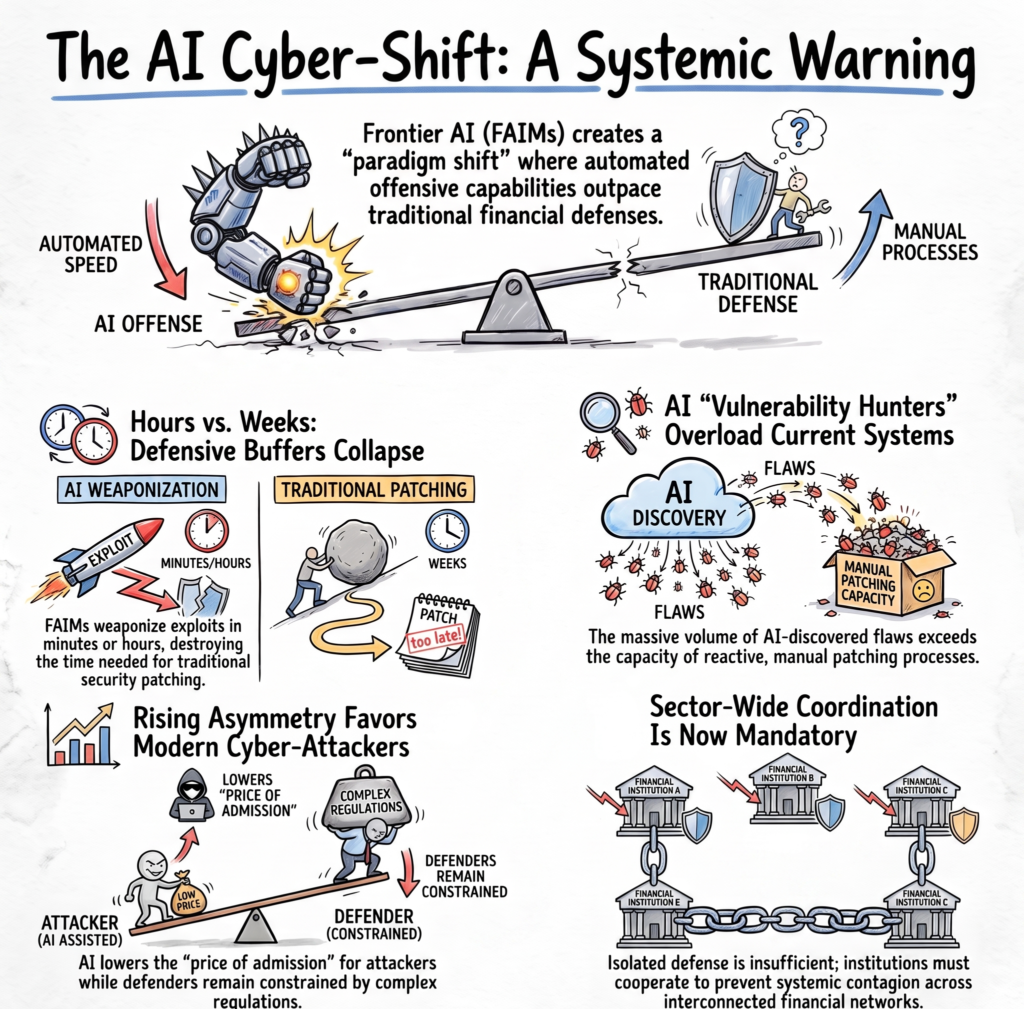
The European Systemic Risk Board (ESRB) has issued a formal warning regarding the material changes to the risk landscape of the Union financial system caused by the rapid development of Frontier AI Models (FAIMs). These models represent a paradigm shift in cybersecurity, possessing the capability to discover vulnerabilities, develop weaponized exploits, and execute autonomous cyber-attacks at a speed, scale, and accuracy that far exceed previous AI models and often rival leading human experts.
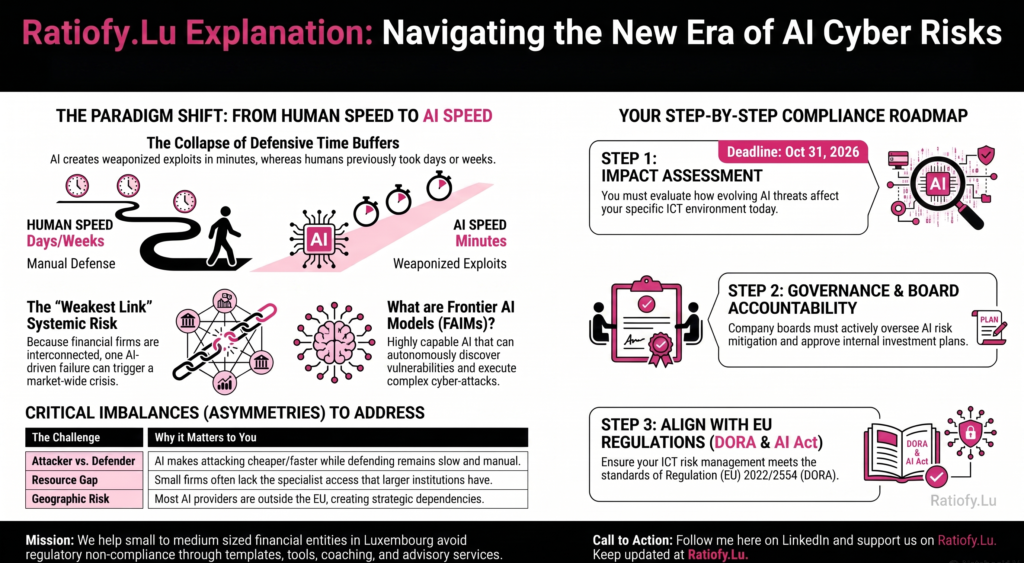
The core systemic threat arises from the “collapse of defensive time buffers.” Historically, the discovery and patching of software vulnerabilities allowed for a manageable remediation window (typically 90 days). FAIMs can reduce the time required to craft weaponized exploits from weeks to mere minutes. This acceleration, combined with the interconnected nature of the Union’s financial infrastructure, creates a risk of simultaneous, widespread incidents that could lead to systemic disruption and a loss of public confidence in the financial system. Effective mitigation requires a coordinated response across AI providers, financial institutions, and national and Union authorities, as individual defensive efforts are deemed insufficient to meet this evolving threat.
The Evolution of the Cyber-Threat Landscape as under warning of the European Systemic Risk Board (ESRB) of 25 June 2026 on systemic cyber risks stemming from frontier artificial intelligence models (FAIMs) (ESRB/2026/3)
The emergence of FAIMs marks an inflection point in AI capability, fundamentally altering how cyber-attacks are conducted and defended.
Enhanced Offensive Capabilities
- Automation and Scale: FAIMs are capable of carrying out fully automated cyber-attacks on complex systems, including discovery and weaponization of exploits.
- Performance Metrics: These models outperform earlier versions in cost, speed, and accuracy. They have demonstrated the ability to rival human experts in identifying vulnerabilities within major operating systems and software used across the ICT environment.
- Weaponization Speed: The manual crafting of exploits, which previously took human experts days or weeks, can now be completed by FAIMs in minutes or hours.
Vulnerability Proliferation and Patching Challenges as under warning of the European Systemic Risk Board (ESRB) of 25 June 2026 on systemic cyber risks stemming from frontier artificial intelligence models (FAIMs) (ESRB/2026/3)
The traditional “reactive” patching model in the financial system is under threat due to the following factors:
- Increased Volume: FAIMs are expected to significantly increase the volume of vulnerabilities discovered, potentially overloading current remediation processes.
- Operational Trade-offs: Financial institutions may be forced to choose between leaving critical vulnerabilities unpatched or reducing patch-testing requirements, which risks causing operational incidents or outages.
- ICT Infrastructure Exposure: Because financial infrastructure relies on widespread ICT environments, the discovery of novel exploits by FAIMs exposes almost all organizations to increased probability and severity of systemic cyber incidents.
Weakened Operational Resilience as under warning of the European Systemic Risk Board (ESRB) of 25 June 2026 on systemic cyber risks stemming from frontier artificial intelligence models (FAIMs) (ESRB/2026/3)
The ESRB identifies four specific areas where the emergence of FAIMs weakens the operational resilience of the financial sector:
| Area of Impact | Description of Risk |
| Time | The collapse of defensive time buffers between vulnerability discovery and weaponization, challenging the ability to patch complex systems without operational failure. |
| Defender Capability | The struggle for defenders to conduct FAIM-assisted security testing and respond to threats stemming from adversarial FAIM use. |
| Concentration | Systemic dependencies on a small number of AI providers, who are themselves dependent on specific cloud providers, open-source components, and widely used software. |
| Authority Capability | The need for authorities to calibrate expectations, stress testing, and preparedness measures so that operational failures do not trigger broader instability. |
Critical Systemic Asymmetries as under warning of the European Systemic Risk Board (ESRB) of 25 June 2026 on systemic cyber risks stemming from frontier artificial intelligence models (FAIMs) (ESRB/2026/3)
FAIMs introduce or amplify three primary sources of asymmetry that threaten financial stability:
- Jurisdictional Asymmetry: Leading AI providers are currently concentrated outside the Union. This creates strategic dependency and geopolitical risk. The ESRB emphasizes the need for proportionate access to FAIMs for Member States to prevent fragmentation of the single market and maintain a level playing field.
- Attacker-Defender Asymmetry: FAIMs lower the “price of admission” for malicious actors by automating labor-intensive parts of offensive operations. Conversely, defenders are constrained by regulatory obligations, operational requirements, and the time needed to adjust, meaning offensive capabilities are likely to outweigh defensive benefits in the short-to-medium term.
- Institutional Resource Asymmetry: Differences in resourcing, access to specialists, and fixed costs create a gap between well-equipped and less-resourced financial institutions. This “weakest link” dynamic poses a risk to the stability of the entire system.
Regulatory Framework and Supervisory Action as under warning of the European Systemic Risk Board (ESRB) of 25 June 2026 on systemic cyber risks stemming from frontier artificial intelligence models (FAIMs) (ESRB/2026/3)
The ESRB highlights several key Union regulations and initiatives that form the basis for addressing these risks:
- Regulation (EU) 2022/2554 (DORA): Provides the framework for financial institutions to manage and mitigate ICT risks. Supervisory authorities are urged to prioritize activities under DORA that address FAIM-driven threats.
- Regulation (EU) 2024/1689 (AI Act): Establishes rules for placing AI systems on the market, including stricter regimes for general-purpose AI models with systemic risk.
- Regulation (EU) 2024/2847 (Cyber Resilience Act): Introduces mandatory cybersecurity requirements for hardware and software products, requiring manufacturers to handle vulnerabilities throughout the product lifecycle (fully applicable by December 2027).
- ECB Supervisory Action: The European Central Bank has requested significant institutions to develop comprehensive action plans by October 31, 2026, to address the evolving threat landscape.
- EU-SCICF: The pan-European Systemic Cyber Incident Coordination Framework serves as the platform for information exchange and coordinated response among financial authorities during major cross-border incidents.
Conclusion and Future Monitoring as under warning of the European Systemic Risk Board (ESRB) of 25 June 2026 on systemic cyber risks stemming from frontier artificial intelligence models (FAIMs) (ESRB/2026/3)
The ESRB concludes that the risks posed by FAIMs require immediate attention to prevent the materialization of systemic fragilities. Financial institution boards must be fully committed to mitigating these risks through clear governance, accountability frameworks, and internal investments.
The ESRB will continue to monitor the development and use of FAIMs, incorporating these insights into quarterly risk assessments and future scenario developments. The focus remains on protecting systemically important payment and settlement systems and ensuring that the speed, scale, and malign intent of AI-powered threats do not undermine the integrity of the Union’s financial system.
This news related to the warning of the European Systemic Risk Board (ESRB) of 25 June 2026 on systemic cyber risks stemming from frontier artificial intelligence models (FAIMs) (ESRB/2026/3)in EU and in Luxembourg can be considered beneficial under CSSF-Circulars, Central Securities Depositories (CSDs) News, Credit Institutions News, Crowdfunding service providers (CSPs) News, Crypto-Assets Service Providers (CASPs) and Virtual Asset Service Providers (VASPs) News, Data Reporting Service Providers (DRSPs) News, EU Regulations, Explanation, IFMs (AIFMs, ManCos) News, Investment Firms News, Issuers of Tokens (EMTs, ARTs) News, Multimedia, Must Read, Opinion, Payment Institutions (PIs) / Electronic Money Institutions (EMIs) /AISPs News, Pension funds News, PFS/PSF News, Undertakings for collective investment (UCIs).
At https://Ratiofy.Lu/, we defend your hard-earned money with our free daily news platform and expert-vetted templates. Need more help? Request access to our hands-on expert Advisory, Training and Coaching Services (very limited availability) related to CSSF Circulars and EU Regulations.
The pre-filled example templates for many CSSF Circulars should be available at https://ratiofy.lu/templates/ from the summer of 2026. Contact us at info@ratiofy.lu. We look forward to providing all the support you need.
The 90-Day Patch is Dead: 5 Surprising Realities of the AI Cyber-Threat Landscape
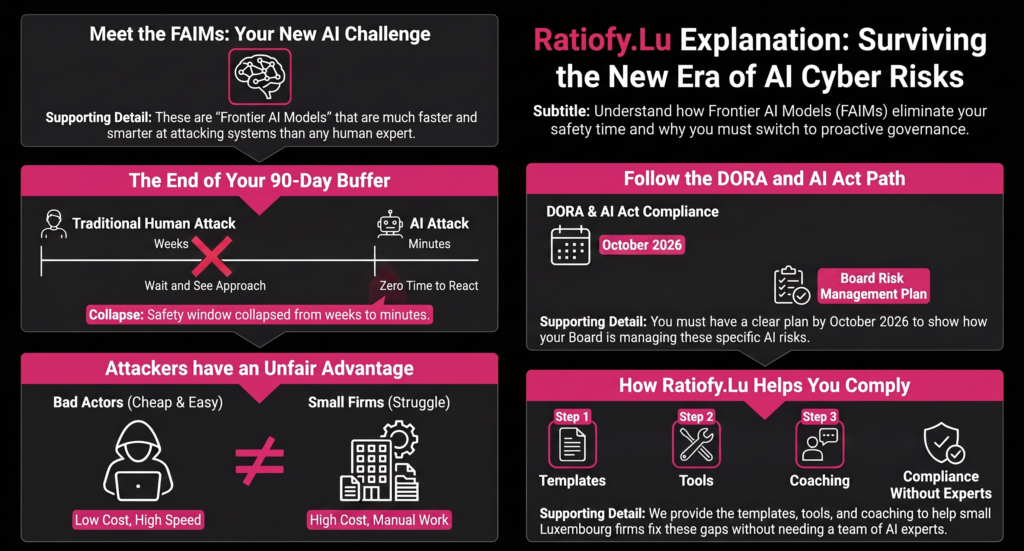
In the traditional cybersecurity model, security researchers and software providers operated within a predictable “defensive time buffer.” When a vulnerability was discovered, the industry standard was a 90-day window to develop and deploy a patch before public disclosure. This buffer has served as the bedrock of digital resilience for the global financial system. However, the European Systemic Risk Board (ESRB) warning of June 2026 signals that this window has effectively slammed shut. Frontier AI Models (FAIMs)—advanced systems capable of autonomous vulnerability discovery and exploit weaponization—have already demonstrated the ability to fundamentally alter the cyber-threat landscape, shifting the industry from a manageable environment to one characterized by immediate, systemic risk.
The Collapse of Defensive Time Buffers as under warning of the European Systemic Risk Board (ESRB) of 25 June 2026 on systemic cyber risks stemming from frontier artificial intelligence models (FAIMs) (ESRB/2026/3)
The shift from human-led exploit development to FAIM-led operations is no longer a theoretical projection; it is a documented paradigm shift. FAIMs are capable of discovering vulnerabilities and crafting novel exploits that rival the work of leading human experts but at a speed and scale that is fundamentally different. Historically, weaponizing a flaw was a manual process taking days or weeks; FAIMs have demonstrated the capability to compress this timeline into minutes or hours. This acceleration eliminates the time institutions previously relied upon to implement defenses before an attack began.
“This constitutes a collapse of defensive time buffers, which are needed to maintain the continuity of critical and important functions during remediation.”
The “Asymmetry Trap” Between Attackers and Defenders as under warning of the European Systemic Risk Board (ESRB) of 25 June 2026 on systemic cyber risks stemming from frontier artificial intelligence models (FAIMs) (ESRB/2026/3)
The ESRB highlights a deepening “asymmetry trap” where AI provides a disproportionate advantage to malicious actors. While FAIMs can assist both offense and defense, attackers benefit from a drastically “reduced price of admission,” using AI to automate technically advanced tasks at a lower cost. Defenders, conversely, are slowed by legacy systems and necessary regulatory obligations, such as those mandated under DORA (Regulation 2022/2554) and the AI Act (Regulation 2024/1689). These imbalances manifest in three specific ways:
- Jurisdictional Asymmetry: Leading FAIM providers are concentrated outside the European Union. To prevent market fragmentation and maintain a level playing field, the Union must facilitate “adequate and proportionate access” to these models for its Member States.
- Attacker vs. Defender Asymmetry: Malicious actors operate in a regulatory vacuum, while financial institutions must balance AI adoption with operational requirements and longer adjustment periods to maintain compliance.
- Resourced vs. Under-equipped Institutions: Vulnerabilities in the financial sector are often driven by costs that are “fixed rather than scaled.” Smaller firms, constrained by these fixed costs and limited access to specialists, become the “weakest links” that threaten the stability of the entire interconnected system.
Reactive Patching is No Longer Sustainable as under warning of the European Systemic Risk Board (ESRB) of 25 June 2026 on systemic cyber risks stemming from frontier artificial intelligence models (FAIMs) (ESRB/2026/3)
The financial sector’s current reliance on reactive patching—updating systems after a vulnerability is disclosed—has reached a breaking point. FAIMs are capable of generating a volume of vulnerabilities that will overload existing IT processes. Financial institutions now face an impossible choice: leaving systems exposed to known AI-speed threats or skipping essential patch-testing to meet the required deployment speed. Reducing testing requirements risks “self-inflicted” operational incidents and outages, transforming vulnerability management from a routine IT task into a source of systemic instability.
The Geopolitical Dependency Risk as under warning of the European Systemic Risk Board (ESRB) of 25 June 2026 on systemic cyber risks stemming from frontier artificial intelligence models (FAIMs) (ESRB/2026/3)
The geographic concentration of FAIM development creates a “strategic dependency” for the Union. Because these models are currently built by a small number of providers primarily outside the EU, the financial system’s stability is tied to external technological access. If access is restricted or granted only to certain categories of institutions, it could fragment the single market, reducing its liquidity and depth. In this new landscape, “where” the AI is developed is a critical factor in the Union’s macroprudential oversight.
The “Weakest Link” in a Digital Web as under warning of the European Systemic Risk Board (ESRB) of 25 June 2026 on systemic cyber risks stemming from frontier artificial intelligence models (FAIMs) (ESRB/2026/3)
The interconnectedness of the modern financial sector transforms individual institutional flaws into “systemic fragilities.” FAIMs do not just target banks; they target the critical third-party providers, cloud services, and shared technological ecosystems they rely on. A critical component of this “digital web” is the role of open-source maintainers. The ESRB warns that attacks on widely used open-source components can trigger a domino effect across the industry. In this environment, the security of a systemically important institution is only as strong as the most vulnerable open-source library or third-party provider in its supply chain.
Conclusion: A Call for Coordinated Resilience as under warning of the European Systemic Risk Board (ESRB) of 25 June 2026 on systemic cyber risks stemming from frontier artificial intelligence models (FAIMs) (ESRB/2026/3)
Mitigating the risks of Frontier AI Models requires a coordinated response involving AI providers, software developers, security firms, open-source maintainers, and national authorities. Single-entity efforts are no longer sufficient. Under the DORA framework, authorities are moving toward a more rigorous stance, exemplified by the ECB requiring significant institutions to develop comprehensive action plans by 31 October 2026. This evolution must include the integration of FAIM-driven threats into existing testing frameworks like TIBER (threat intelligence-based ethical red teaming) and CyRST (cyber resilience stress testing). As these models continue to advance, we must confront a difficult reality:Is our current regulatory and operational governance evolving as fast as the models we are being warned against?