
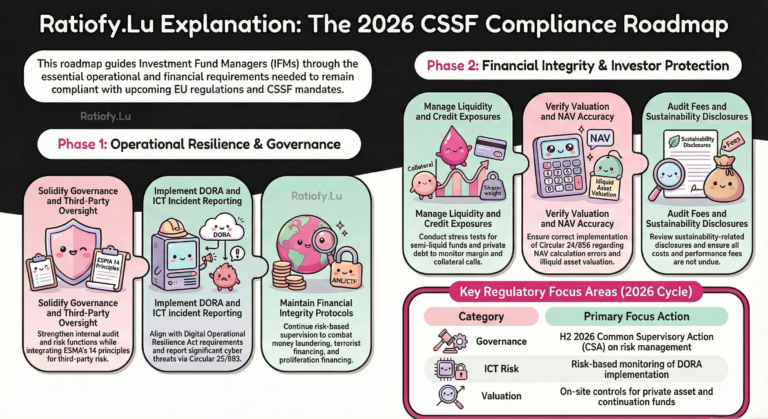
Luxembourg Financial Regulatory Advisory, Tools, Templates:
Briefing Document: CSSF’s 2026 priorities for supervising for the Investment Fund Sector
Executive Summary
The Commission de Surveillance du Secteur Financier (CSSF) has established its supervisory priorities for 2026, centering on the dual mission of ensuring financial stability and protecting investors. The 2026 agenda is shaped by a risk-based approach that integrates the current geopolitical and economic climate with international standards from ESMA and IOSCO.
Critical points for The CSSF’s 2026 priorities for supervising the investment fund sector:
- Regulatory Evolution: Heavy focus on the implementation of the Digital Operational Resilience Act (DORA) and new principles for third-party risk management.
- Operational Integrity: Intensified scrutiny of internal control functions through Common Supervisory Actions (CSAs) and reviews of risk management, internal audit, and compliance.
- Financial Stability: Heightened monitoring of liquidity mismatches in “semi-liquid” private asset funds (including ELTIFs) and the use of leverage in AIFs and UCITS.
- Asset Valuation: Continued priority on the valuation of illiquid assets and the strict application of rules regarding NAV calculation errors.
- Investor Protection: Targeted thematic reviews to identify cost/fee outliers and to verify the consistency of sustainable finance disclosures.
| Supervisory Priority | Key Risk Areas | Regulatory Framework / Reference | Specific Supervisory Actions | Compliance Requirements for IFMs |
| Governance/operational risks | Internal control functions (internal audit and compliance) | ESMA Common Supervisory Action (CSA) | Follow-up work in relation to the ESMA CSA on internal audit and compliance functions | Strengthen organisational set-up and internal control functions; ensure compliance with internal audit standards |
| Governance/operational risks | Risk management function | ESMA/NCAs coordination | Common Supervisory Action (CSA) on the risk management function | Review and document risk management processes to ensure alignment with CSSF/ESMA expectations |
| Governance/operational risks | Third-party risk and delegation | ESMA 14 principles on third-party risk; Circular CSSF 18/698 | Study among a sample of IFMs to assess compliance with third-party risk principles and delegation rules | Integrate comprehensive operational framework for third-party risk into overall risk management |
| ICT/cyber risks | Digital operational resilience; cyber threats | EU Digital Operational Resilience Act (DORA); Circular CSSF 25/893 | Risk-based monitoring of implementation; review of ICT-related risk procedures and incident reporting | Establish ICT risk management procedures; report major ICT incidents and significant cyber threats to CSSF |
| Liquidity risks and credit risks | Liquidity mismatch in open-ended/semi-liquid funds; private debt credit risk | CSSF Macroprudential Policy Considerations (10 June 2024); Circular CSSF 24/856 | Thematic sample-based reviews on liquidity and credit risk management; development of supervisory stress tests | Implement liquidity management tools (LMTs); operationalize stress tests for margin/collateral calls |
| Asset valuation risk | Valuation of illiquid assets; NAV calculation errors | Circular CSSF 24/856; CSSF Feedback Reports | On-site controls on valuation organization; thematic reviews of open-ended private assets and continuation funds | Ensure correct implementation of NAV calculation error procedures and investment rule compliance |
| Sustainable finance | Sustainability risks; greenwashing (disclosures) | SFDR; CSSF Communiqué of 2 March 2026 | Verification of sustainability risk integration; compliance/consistency reviews of disclosures and portfolio analysis | Integrate sustainability risks into organizational arrangements; ensure disclosure consistency with portfolios |
| Costs and fees | Undue costs; performance fees; transaction costs | ESMA Market Reports; Fund Self-Assessment Questionnaires | Thematic reviews to identify fund outliers in relation to overall costs and fees | Prevent undue costs; align performance fees and transaction costs with investor best interests |
| ML/TF/PF risks | Money laundering; terrorist financing; proliferation financing | IOSCO AML Network standards | Continued risk-based supervision and active contribution to international standards | Maintain robust AML/CFT/CPF control frameworks and financial integrity |
Strategic Context and Methodology under the CSSF’s 2026 priorities for supervising the investment fund sector
The CSSF’s priorities are derived from an annual risk assessment of investment funds and investment fund managers (IFMs). The 2026 program is not exhaustive and remains subject to adjustment based on emerging risks. It aligns with:
- Union Strategic Supervisory Priorities (USSPs) defined by ESMA.
- IOSCO’s 2026 Work Program.
- Geopolitical Risk Monitoring: Continuous surveillance of how global instability impacts the investment fund sector.
Governance and Operational Risks under the CSSF’s 2026 priorities for supervising the investment fund sector
The CSSF emphasizes that compliance with organizational and internal control requirements is a fundamental cornerstone of its supervision.
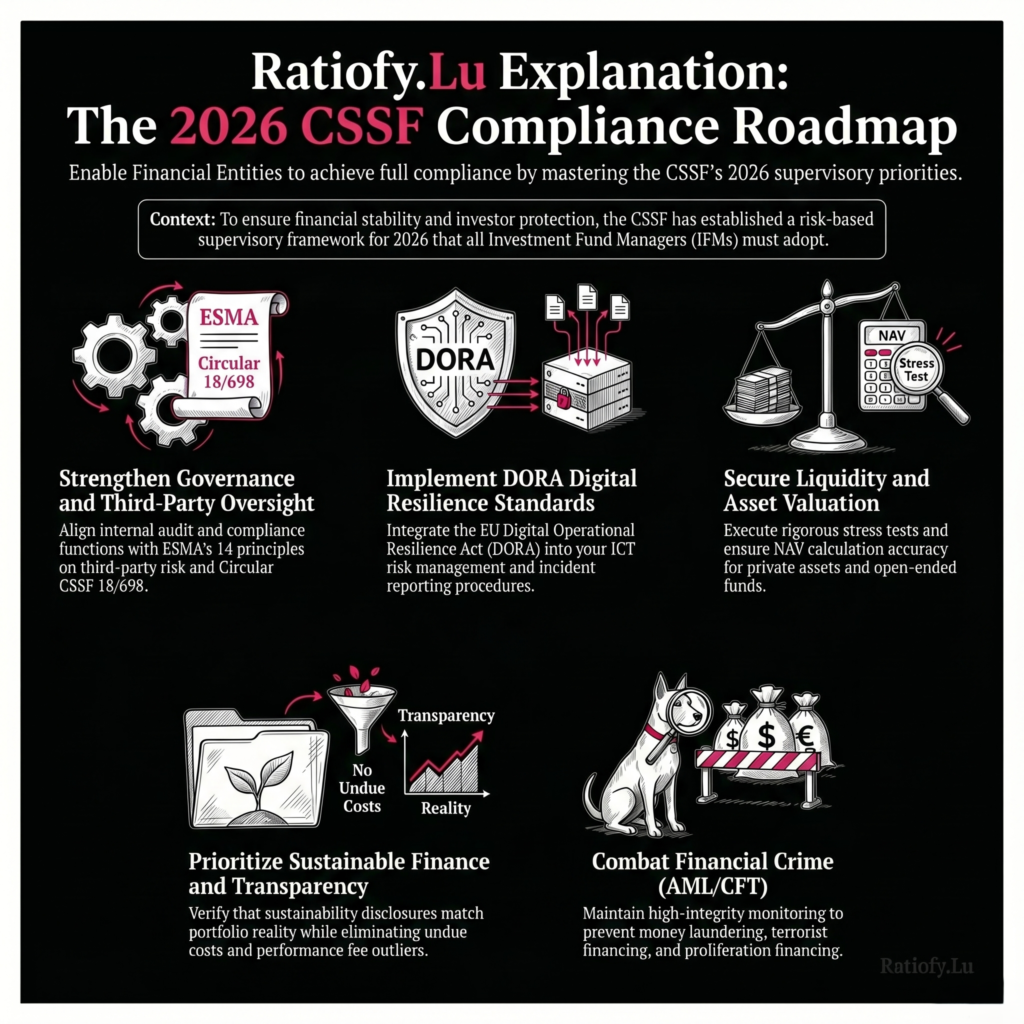
Internal Control Functions under the CSSF’s 2026 priorities for supervising the investment fund sector
- CSA Follow-up: Priority will be given to follow-up work regarding the ESMA Common Supervisory Action on internal audit and compliance functions.
- Risk Management Function: In the second half of 2026, the CSSF—in coordination with ESMA—will launch a new CSA focused specifically on the risk management function.
Third-Party Risk and Delegation under the CSSF’s 2026 priorities for supervising the investment fund sector
Following ESMA’s June 2025 publication of 14 principles on third-party risk supervision, the CSSF will launch a study in 2026. This study will:
- Assess a sample of IFMs for compliance with these 14 principles.
- Evaluate adherence to delegation requirements outlined in Circular CSSF 18/698.
- Examine the integration of third-party risk management into the overall risk management framework.
Liquidity, Credit, and Contagion Risks under the CSSF’s 2026 priorities for supervising the investment fund sector
Financial stability concerns are driven by identified vulnerabilities in open-ended funds and the increasing interconnectedness of the market.
Semi-Liquid and Private Asset Funds
The CSSF has identified “liquidity mismatch” as a primary vulnerability, particularly in open-ended private asset funds (e.g., semi-liquid funds and ELTIFs).
- Thematic Reviews: Sample-based reviews will examine liquidity risk management processes.
- Credit Risk: For funds with material exposure to private debt, reviews will extend to credit granting and management processes.
Leverage and Market Interconnectedness
- Interconnectedness: Specific risk monitoring will continue for AIFs and UCITS utilizing higher levels of leverage.
- Stress Testing: Supervisory stress tests will be further developed to monitor margin and collateral calls linked to financial derivative instruments and repurchase agreement (repo) transactions.
- LMT Implementation: Compliance with the selection and operational use of Liquidity Management Tools (LMTs) remains a focus area.
Asset Valuation and NAV Integrity under the CSSF’s 2026 priorities for supervising the investment fund sector
Valuation remains a high-priority area due to the growth of Alternative Investment Funds (AIFs) investing in illiquid assets and the impact of successive economic crises.
| Focus Area | Supervisory Action |
| Organizational Framework | On-site controls regarding the valuation organization of IFMs. |
| Private Assets | Thematic reviews of open-ended private asset funds, including continuation funds. |
| Error Correction | Monitoring the implementation of Circular CSSF 24/856 regarding NAV calculation errors and investment rule non-compliance. |
ICT and Cyber Risk (DORA) under the CSSF’s 2026 priorities for supervising the investment fund sector
As digitalisation grows, the value chain of investment funds is increasingly exposed to ICT-related risks. The primary regulatory driver for 2026 is the Digital Operational Resilience Act (DORA).
- Implementation Monitoring: Risk-based monitoring of how IFMs incorporate DORA requirements into their supervisory programs.
- Incident Reporting: Oversight of procedures and reports concerning major ICT-related incidents, as mandated by Circular CSSF 25/893.
Sustainable Finance and Investor Protection under the CSSF’s 2026 priorities for supervising the investment fund sector
The CSSF continues to integrate sustainability into its core supervisory activities, applying a risk-based approach to verify both organizational and disclosure-related compliance.
- Integration of Risks: Verification that sustainability risks are integrated into IFMs’ organizational arrangements.
- Disclosure Consistency: Portfolio analyses to ensure that sustainability-related disclosures are consistent with actual fund holdings.
- Costs and Fees: Ongoing thematic reviews to identify “outliers” regarding performance fees, transaction costs, and overall fee levels. The objective is to prevent “undue costs” and ensure IFMs act in the best interest of investors.
Financial Integrity and AML/CFT under the CSSF’s 2026 priorities for supervising the investment fund sector
The fight against Money Laundering (ML), Terrorist Financing (TF), and Proliferation Financing (PF) remains a permanent priority.
- Supervisory Convergence: Active contribution to international standards via the IOSCO AML Network.
- Risk-Based Supervision: Continuation of specialized oversight to maintain the integrity of the financial sector.
Relevant Entities and Keywords under the CSSF’s 2026 priorities for supervising the investment fund sector
The CSSF’s 2026 priorities are particularly relevant for:
- Investment Fund Managers (IFMs)
- UCITS and AIFs
- Specialised Investment Funds (SIFs)
- Investment Companies in Risk Capital (SICARs)
- Part II UCIs
Key Keywords: CSSF’s 2026 priorities, Asset Valuation, ELTIF, NAV Calculation, Stress Testing, DORA, Internal Governance, and Investor Protection.
This news related to CSSF 2026 Supervisory Priorities for the Investment Fund Sector can be considered beneficial under CSSF-Circulars, Central Securities Depositories (CSDs) News, Credit Institutions News, Crowdfunding service providers (CSPs) News, Crypto-Assets Service Providers (CASPs) and Virtual Asset Service Providers (VASPs) News, Data Reporting Service Providers (DRSPs) News, EU Regulations, Explanation, IFMs (AIFMs, ManCos) News, Investment Firms News, Issuers of Tokens (EMTs, ARTs) News, Multimedia, Must Read, Opinion, Payment Institutions (PIs) / Electronic Money Institutions (EMIs) /AISPs News, Pension funds News, PFS/PSF News, Undertakings for collective investment (UCIs).
At https://Ratiofy.Lu/, we defend your hard-earned money with our free daily news platform and expert-vetted templates. Need more help? Request access to our hands-on expert Advisory, Training and Coaching Services (very limited availability) related to CSSF Circulars and EU Regulations.
The pre-filled example templates for many CSSF Circulars should be available at https://ratiofy.lu/templates/ from the summer of 2026.