
Luxembourg Financial Regulatory Advisory, Tools, Templates:
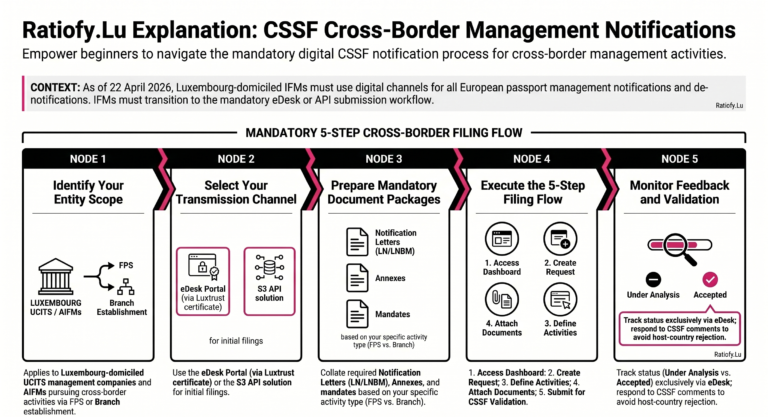
The new CSSF communication 22 April 2026: New methods of transmitting management notifications and de-notifications with a European passport for Luxembourg-domiciled IFMs outlines the official procedures for Luxembourg Investment Fund Managers regarding the management of cross-border notifications and de-notifications. This guidance applies to both UCITS management companies and Alternative Investment Fund Managers (AIFMs) that intend to operate in other Member States via a branch or the freedom to provide services. Users are instructed to submit their applications through the eDesk portal or an API solution, following specific technical formats and documentation standards. The text details mandatory requirements, such as notification letters and programs of operations, as well as conditional documents like organizational charts and forecast statements for branch establishments. By standardizing these submissions, the CSSF ensures that all regulated entities provide the necessary oversight information for international activities. The guidelines also specify that dual-authorized managers must submit separate requests for each regulatory framework they utilize.
Summary
Under the supervision of the Commission de Surveillance du Secteur Financier (CSSF), IFMs must follow standardized notification and de-notification processes when operating in other Member States via the establishment of a branch or under the freedom to provide services (FPS).
Key points include:
- Regulatory Scope: The guidelines apply to both Luxembourg-domiciled UCITS management companies and Luxembourg Alternative Investment Fund Managers (AIFMs).
- Dual Submission Requirements: Entities with dual licenses (“supermancos”) or those seeking both FPS and branch establishment in a single Member State must submit separate notifications for each activity.
- Digital-First Submission: All procedures are facilitated through the eDesk portal or via an Application Programming Interface (API), with the latter strictly reserved for initial filings.
- Strict Documentation Standards: Submissions require a specific set of mandatory and situational documents, including notification letters, organizational charts, and forecast statements, all adhering to precise naming and formatting conventions.
1. Scope and Applicability of CSSF Communication on the new methods of transmitting management notifications and de-notifications with a European passport for Luxembourg-domiciled IFMs
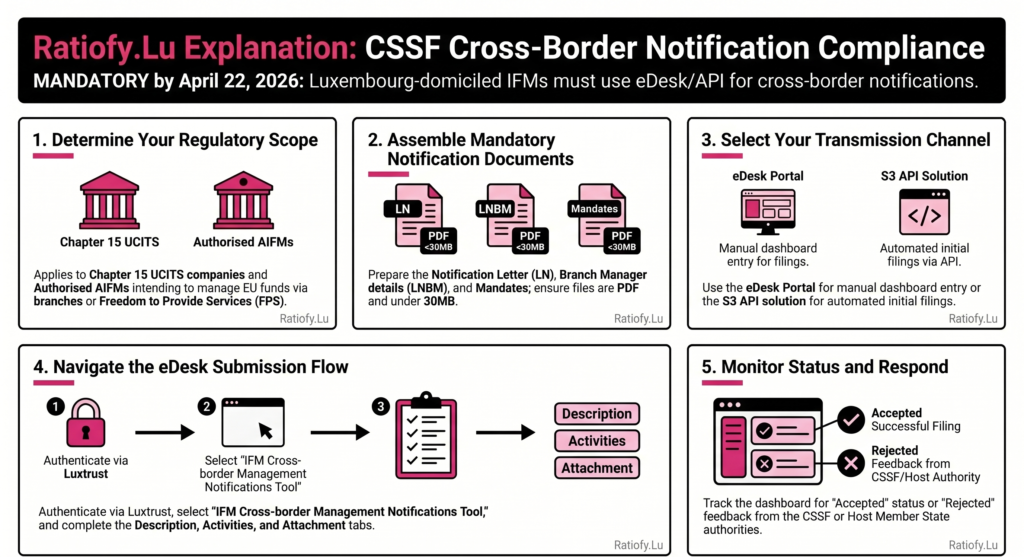
The procedures outlined in the guidelines are mandatory for specific supervised entities wishing to pursue activities cross-border:
- UCITS Management Companies: Governed by Articles 17 and 18 of Directive 2009/65/EC (UCITSD), this includes management of UCITS established in other Member States.
- Alternative Investment Fund Managers (AIFMs): Governed by Article 33 of Directive 2011/61/EU (AIFMD), covering the direct management of AIFs (regulated or not) or the provision of services under Article 6(4) of the AIFMD.
Mandatory Separation of Filings
The CSSF requires distinct notifications in the following scenarios:
- Supermancos: An IFM authorized as both a UCITS management company and an AIFM must introduce two separate notifications to pursue activities under both directives.
- FPS vs. Branch: If an IFM intends to notify both the freedom to provide services (FPS) and the establishment of a branch in the same Member State, it must submit two separate notification requests.
2. Documentation Requirements under CSSF Communication on the new methods of transmitting management notifications and de-notifications with a European passport for Luxembourg-domiciled IFMs
The notification file submitted to the CSSF must be exhaustive. While the CSSF provides an attestation of authorization automatically, the IFM is responsible for the following documents:
2.1 Mandatory Documents
| Type of Document | Abbreviation | Specifications |
| Notification letter of the IFM | LN | Identifies intended activities/services and establishment location; includes a program of operations. |
| Notification letter of person responsible | LNBM | Required specifically for branch notifications to identify the responsible individual. |
| Mandate | MT | Required only if the entity submitting the notification is not the IFM itself. |
2.2 Situational and Optional Documents
Certain documents are mandatory only for specific requests, such as establishing or terminating a branch:
- Branch-Specific: CSSF Annex (LNA), Forecast statements (FS), Branch organizational structure chart (BOC), and Manager organizational structure chart including the branch (MOC).
- Personnel: Branch manager(s) documents (BMD), including CVs and identification.
- De-notification: CSSF Annex for the termination of a branch operation (TA).
- Specific Activities: CSSF Annex for MiFID activities (MA) if such activities are being passported.
- Tied Agents: Documentation related to the use of tied agents must be submitted under the “Other” (OT) document type.
3. Submission Channels under CSSF Communication on the new methods of transmitting management notifications and de-notifications with a European passport for Luxembourg-domiciled IFMs
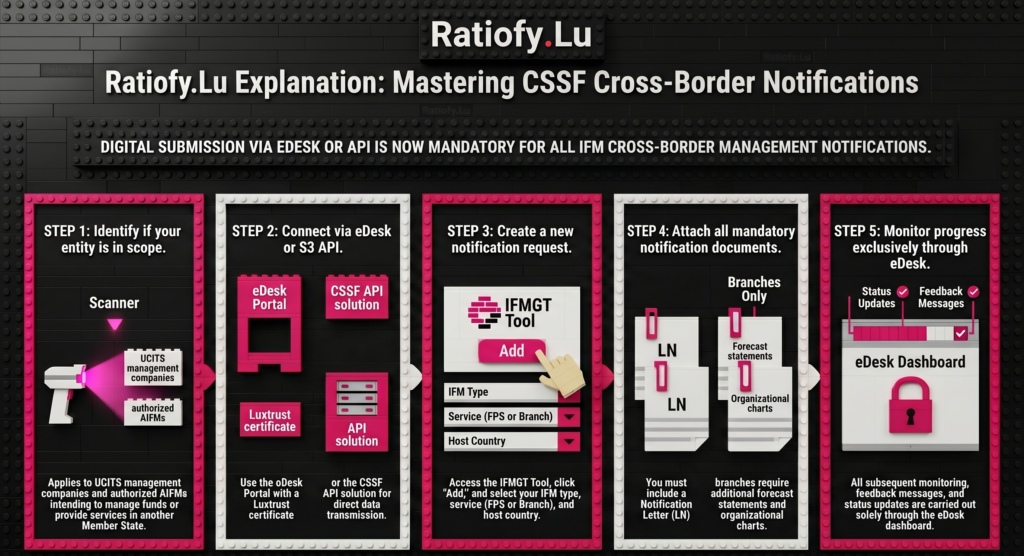
The CSSF provides two primary channels for the submission of cross-border management notifications: the eDesk portal and an API solution.
3.1 eDesk Portal Transmission
The eDesk portal is the central hub for managing the lifecycle of a notification.
- Authentication: Access requires a Luxtrust certificate.
- Dashboard Functionality: Users can monitor the status of requests (e.g., “Initialisation,” “Submitted,” “Accepted by CSSF – Sent to host,” or “Rejected by host”).
- Activity Statuses: When amending a notification, activities must be marked as “Addition,” “Removal,” or “Already notified.”
- Communication: The portal includes a commenting system for exchanges between the CSSF and the applicant. Responses to CSSF comments can only be made while the request is in “draft” mode.
3.2 API Transmission (S3 Technology)
The API channel is designed for high-volume or automated initial filings but has significant limitations:
- Initial Filings Only: The API can only be used for the first filing of a notification request. All subsequent modifications, updates, or responses to CSSF comments must be handled through the eDesk portal.
- Package Format: Submissions must be a ZIP file containing PDF documents and a JSON (report.json) data file.
- Technical Standards: Archives must use the DEFLATE compression algorithm (RFC 1951) and UTF-8 codepage. The maximum size for any file within the archive is 2 Gigabytes.
4. Processing and Host Member State Coordination under CSSF Communication on the new methods of transmitting management notifications and de-notifications with a European passport for Luxembourg-domiciled IFMs
Once a notification is submitted, it undergoes a formal verification process by the CSSF to ensure completeness and compliance with technical requirements.
- CSSF Verification: If the file is incomplete or non-compliant, the CSSF will inform the applicant via eDesk, and an amended version must be transmitted.
- Host Member State Transmission: Upon acceptance by the CSSF, the notification is transmitted to the competent authorities of the host Member State via email.
- Host Rejection: If a host Member State rejects the notification, the applicant is informed of the reasons via eDesk and must submit an amended version through the same channel.
- Monitoring: The “Host follow-up” section in eDesk allows IFMs to track the status of their application within the host country’s regulatory framework.
This news related to new methods of transmitting management notifications and de-notifications with a European passport for Luxembourg-domiciled IFMs can be considered beneficial under CSSF-Circulars, EU Regulations, Explanation, IFMs (AIFMs, ManCos) News, Undertakings for collective investment (UCIs).
At https://Ratiofy.Lu/, we defend your hard-earned money with our free daily news platform and expert-vetted templates. Need more help? Request access to our hands-on expert Advisory, Training and Coaching Services (very limited availability) related to CSSF Circulars and EU Regulations.
The pre-filled example templates for many CSSF Circulars should be available at https://ratiofy.lu/templates/ from the summer of 2026.
Expanding Your Fund Across Borders: 5 Surprising Rules from Luxembourg’s New Guidelines
Many fund managers operating in Luxembourg view cross-border expansion as a victory lap – the logical next step after a successful launch. However, I’ve seen seasoned teams fall into the “easy expansion” trap, assuming that moving into a new European market is merely a matter of checking a box on a standard form.
In reality, the regulatory landscape is shifting from paper-shuffling to high-precision digital data management. The Commission de Surveillance du Secteur Financier (CSSF) recently published updated guidelines (dated April 22, 2026) that serve as a “digital roadmap” for cross-border management notifications. While these rules aim for efficiency, they contain several non-obvious technical requirements that can derail your distribution strategy if you aren’t prepared for the “Digital Gatekeeper.”
1. The “Double Notification” Rule for Dual-Licensed Managers
In Luxembourg, it is common to operate as a “Supermanco” – a single legal entity authorized as both a UCITS management company and an Alternative Investment Fund Manager (AIFM).
The surprise for many business professionals is that while you are one company, you do not have one “passport.” Because you operate under two distinct legal frameworks, the regulator views your activities through two different lenses. As the CSSF guidelines explicitly state:
“A supermanco (i.e. an IFM authorised as UCITS management company and as an AIFM) must introduce two separate notifications (one under the UCITSD and one under the AIFMD) if it wants to pursue in another Member State the activities for which it has been authorised.”
Tip: Don’t let your legal structure fool you into thinking you have a streamlined filing. If you plan to manage both UCITS and AIFs in a new country, you must submit two distinct notification files.
2. Why One Notification for One Country Isn’t Always Enough
When entering a new market, you generally choose between two modes: the Freedom to Provide Services (FPS), which allows you to manage funds from Luxembourg, or establishing a branch locally.
A frequent executive-level pitfall is the assumption that a single “country entry” filing covers the territory. However, if your firm decides to provide services directly while also setting up a physical branch in the same Member State, the CSSF requires you to submit two separate notifications. There is no “blanket” country filing; the regulator demands a hard distinction between these two operational methods to ensure the host country knows exactly how you are interacting with their market.
3. The Digital Gatekeeper: eDesk and the API Hybrid Workflow
The CSSF has fully committed to a digital-first environment, utilizing the eDesk portal and a high-tech Application Programming Interface (API) solution based on S3 technology (an Amazon-compatible cloud storage protocol).
While the API is excellent for large-scale automation, it creates a hybrid workflow that catches many teams off guard. The API channel can only be used for the initial filing. Once that initial package is uploaded, the automation stops. Any subsequent updates, modifications, or replies to CSSF comments must be handled manually through the eDesk portal.
Furthermore, this digital gatekeeper is unforgiving. Access requires a Luxtrust certificate, which is often the primary bottleneck for international teams—I recommend securing yours weeks before you intend to file.
The Automated Rejection Risk: Because the system is digital, it utilizes “Formal Verification Rules” (found in Annex 4). If your document naming conventions do not strictly follow the codes in Annex 2, the “Digital Gatekeeper” will automatically reject the filing before a human regulator even sees it. Precision in your tech setup is now just as important as your legal reasoning.
4. The “Hands-Off” Benefit: The CSSF Attestation
It’s not all bureaucratic hurdles; the 2026 guidelines include a genuine administrative “win” for managers. Historically, proving your authorization to a host-country regulator involved a tedious request for certificates.
Under Section 3.3, this burden is gone. Once you submit your file, the CSSF handles the “proof” internally. The guidelines state:
“The CSSF will enclose the statement attesting that the IFM concerned is authorised by the CSSF. No action from the IFM is required.”
This automated attestation is a seamless bridge to the host Member State, provided you have cleared the initial digital hurdles.
5. Tied Agents: The “Compliance Landmine”
If you plan to use a “tied agent” to provide services in a host country, beware: there is no “Tied Agent” button in the portal. This is a manual entry requirement that is easily overlooked, making it a significant compliance landmine.
Per the guidelines, you must manually type the agent’s details into the “Description” field of your request. Additionally, any supporting documentation for that agent cannot be uploaded to a dedicated slot; it must be attached as a document type labeled “Other.”
If your team misses these hidden manual requirements, the filing is technically incomplete. In a world of automated validation, “Other” is a specific label the system looks for to process your agent’s credentials.
Conclusion: the Digital Frontier
The April 2026 guidelines signal a new era for Luxembourgish fund managers. We are moving away from “best effort” filings toward a highly structured, automated, and digital-first environment. While this eventually leads to faster approvals, the burden of technical preparation has never been higher. Success in cross-border expansion now depends as much on your document naming conventions and portal mastery as it does on your underlying financial strategy. As regulators move toward fully digital systems, ask yourself: Is your compliance team ready to be as much “tech-savvy” as they are “law-savvy”?