
Luxembourg Financial Regulatory Advisory, Tools, Templates:
The April 2026 CSSF Newsletter No 303 from the Commission de Surveillance du Secteur Financier (CSSF) serves as a comprehensive update on the Luxembourg financial scene. It highlights critical security warnings regarding fraudulent websites and provides detailed regulatory circulars concerning crypto-assets and liquidity management. Extensive statistical data for early 2026 illustrates the performance and structural breakdown of various investment vehicles, including UCITS and specialized funds. The document also tracks institutional changes, such as executive appointments and the removal of specific funds from official registries. Furthermore, it outlines supervisory priorities for the upcoming year while documenting global market trends and technical supply chain alerts. Through these updates, the CSSF ensures transparency and oversight for credit institutions and investment professionals operating within the jurisdiction.
Summary of April 2026 CSSF Newsletter No 303
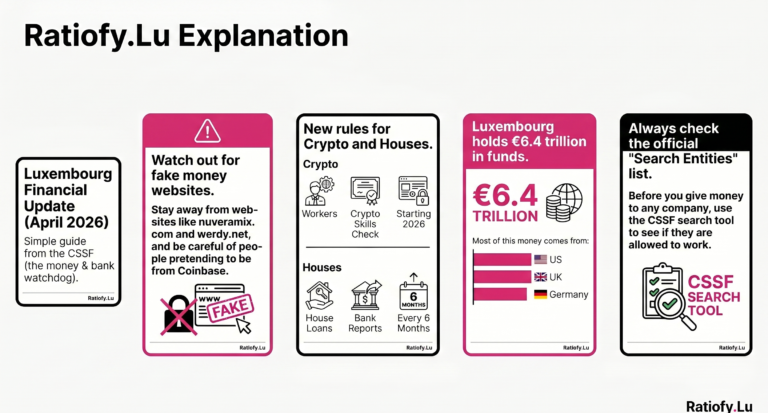
The financial environment in early 2026 is marked by a mix of steady growth in investment funds and increasing caution due to global events. While the Luxembourg investment fund market remains huge—managing over €6.4 trillion—regulators are introducing stricter rules to protect investors. These new rules focus on three main areas: the growing crypto-asset market, the safety of real estate lending, and making sure investment funds have enough cash available for their clients.
A major theme in the April 2026 CSSF Newsletter is the impact of the war in the Middle East, which has created new uncertainties for the economy. Despite this, European banks are currently in a strong position with good levels of savings and high-quality assets. Locally, the Commission de Surveillance du Secteur Financier (CSSF) is actively warning the public about fraudulent websites and is tightening reporting requirements for banks to ensure the system remains stable.
1. Investor Protection and Fraud Alerts under April 2026 CSSF Newsletter No 303
The CSSF has issued several warnings to protect the public from dishonest activities. The main goal is to prevent people from losing money to fake companies or websites.
- Fraudulent Websites: The public is warned to avoid the following websites, which are not authorized to provide financial services:
- www.nuveramix.com
- www.afitaustin.com
- www.werdy.net
- Identity Theft: There are reports of people wrongly using the name of Coinbase Luxembourg S.A. to trick customers.
- Safety Advice: Before doing business with any financial company, individuals should use the “Search Entities” tool on the CSSF website. Warning signs of a scam include:
- Foreign or strange phone numbers.
- Incorrect office addresses.
- Spelling mistakes on the website.
2. New National Regulations and Reporting under April 2026 CSSF Newsletter No 303
Luxembourg is introducing several new circulars (official rulebooks) to improve how financial data is collected and how staff are trained as per April 2026 CSSF Newsletter.
Real Estate and Loans
- Circular CSSF 26/908: Banks must now report details about their home loans (residential real estate) twice a year, in April and October. This helps the regulator see if there are risks in the housing market.
Crypto-Assets and Training
- Circular CSSF 26/909: This rule relates to the “Markets in Crypto-Assets” (MiCA) regulation. Starting July 28, 2026, staff who give advice or information about crypto-assets must meet high standards for knowledge and experience. They must also receive ongoing training to protect clients.
Investment Fund Management
- Circular CSSF 26/910: This requires managers of investment funds to have “Liquidity Management Tools.” These are plans to make sure that if many investors want to take their money out at once, the fund can handle it without harming the remaining investors.
Bank Safety Buffers and Deposits
- Countercyclical Buffer: The rate is set at 0.50% for the second quarter of 2026. This is an extra amount of money banks must keep aside to stay strong during difficult times.
- Deposit Survey: Banks must report the total amount of “covered deposits” they held as of March 31, 2026. Generally, deposits are protected up to €100,000 per person.
3. The Luxembourg Investment Fund Market under April 2026 CSSF Newsletter No 303
As of February 28, 2026, the investment sector in Luxembourg remains a global leader, though there are slight changes in its makeup as per April 2026 CSSF Newsletter.
Key Market Figures
- Total Assets: €6,436.135 billion (over €6.4 trillion).
- Number of Funds: 3,005 individual investment entities.
- Main Fund Type: The “SICAV” (an investment company with variable money) is the most popular, making up about 58% of all funds and nearly 82% of the total money managed.
Who is Investing?
The “initiators” (the companies that start these funds) come from all over the world:
- United States: 19.5% of total assets.
- United Kingdom: 16.5%.
- Germany: 14.4%.
- France: 13.2%.
- Switzerland: 11.6%.
Currency Breakdown as per April 2026 CSSF Newsletter
Most of the money in these funds is held in two main currencies:
- Euro (EUR): 53.7%
- US Dollar (USD): 39.9%
4. European and International Developments under April 2026 CSSF Newsletter No 303
Geopolitical Risks and the Economy
The war in the Middle East, which began in late February 2026, is a major concern for European regulators.
- ECB Interest Rates: The European Central Bank decided to keep interest rates the same. They want to keep inflation (the rising cost of goods) at a steady 2% target.
- Economic Outlook: The war has made the future harder to predict. It might cause prices to go up and the economy to grow more slowly. However, the European economy was very strong in 2025, which provides a good “cushion.”
Changes in Leadership and Oversight as per April 2026 CSSF Newsletter
- New EBA Chair: François-Louis Michaud will become the Chair of the European Banking Authority on April 16, 2026.
- Digital Euro: The European Central Bank is moving forward with a plan for a “Digital Euro.” They view this as a way for banks to modernize and for central bank money to remain a stable “anchor” for the economy.
- US Reporting Relief: The US Securities and Exchange Commission (SEC) decided that directors of European companies no longer have to follow certain strict US reporting rules. This is because European rules are already very similar and provide enough protection.
5. CSSF Internal Updates under April 2026 CSSF Newsletter No 303
The CSSF continues to grow its team to handle these new regulations.
- Staffing: The organization now has 1,021 employees (566 men and 455 women).
- Recent Hires: Six new people were hired recently to work in areas like IT, banking supervision, and the audit profession.
- New Director: Mr. Davy Reinard was recently sworn in as the “Director Resolution,” a key role for managing banks under such scope.
- Variable-Yield Transferable Securities | Net assets (in bn €): 2,261.155 | Number of fund units: 4,056
- Mixed Transferable Securities | Net assets (in bn €): 1,149.708 | Number of fund units: 2,960
- Money Market Instruments | Net assets (in bn €): 674.869 | Number of fund units: 172
- Real Estate | Net assets (in bn €): 126.315 | Number of fund units: 271
- Private Equity | Net assets (in bn €): 116.831 | Number of fund units: 286
This news related to April 2026 CSSF Newsletter No 303 can be considered beneficial under CSSF-Circulars, Central Securities Depositories (CSDs) News, Credit Institutions News, Crowdfunding service providers (CSPs) News, Crypto-Assets Service Providers (CASPs) and Virtual Asset Service Providers (VASPs) News, Data Reporting Service Providers (DRSPs) News, EU Regulations, Explanation, IFMs (AIFMs, ManCos) News, Investment Firms News, Issuers of Tokens (EMTs, ARTs) News, Multimedia, Must Read, Opinion, Payment Institutions (PIs) / Electronic Money Institutions (EMIs) /AISPs News, Pension funds News, PFS/PSF News, Undertakings for collective investment (UCIs).
At https://Ratiofy.Lu/, we defend your hard-earned money with our free daily news platform and expert-vetted templates. Need more help? Request access to our hands-on expert Advisory, Training and Coaching Services (very limited availability) related to CSSF Circulars and EU Regulations.
The pre-filled example templates for many CSSF Circulars should be available at https://ratiofy.lu/templates/ from the summer of 2026.
5 Things You Should Know About the Future of Finance: Lessons from April 2026 CSSF Newsletter No 303 in Luxembourg
You might think a regulatory report such as April 2026 CSSF Newsletter, from a small country like Luxembourg doesn’t affect your daily life, but here is the truth: Luxembourg is one of the world’s most vital financial hubs. The standards set by its regulators often become the “gold standard” for banking safety across all of Europe. When the people watching over these trillions of euros speak, it provides a direct look at how your own money—and the banks you trust—will be handled in the coming years.
The April 2026 update from the Commission de Surveillance du Secteur Financier (CSSF) is a wake-up call. It reveals a world of finance that is moving faster than ever, where your safety depends on a mix of stricter laws, better-trained experts, and your own digital awareness. Here are the five most important lessons to help you navigate this landscape.
1. Beware of “Look-alike” Scams and Fake Websites as per April 2026 CSSF Newsletter No 303 in Luxembourg
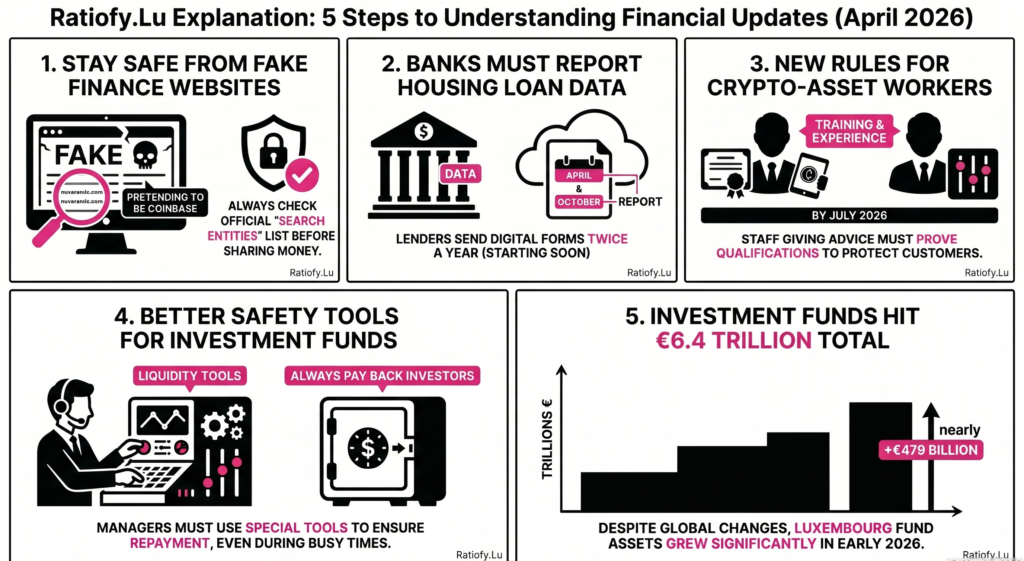
Scammers have moved beyond simple “prince” emails. They are now building high-tech, professional websites that look nearly identical to the banks you use every day. You might be surprised to learn that even household names like Coinbase are being used as bait; the CSSF recently issued a specific warning about fraudsters pretending to be “Coinbase Luxembourg S.A.”
As per April 2026 CSSF Newsletter, to keep your money safe, the CSSF and global regulators have flagged several specific websites you must avoid:
- nuveramix.com
- afitaustin.com
- werdy.net
Your Protection Checklist: Before you ever enter your password or send money, look for these red flags:
- Wrong addresses: Does the physical address on the site match the official registry?
- Spelling mistakes: Professional banks rarely have typos in their main web addresses.
- Suspicious contact info: Be on high alert if you see unusual or foreign phone numbers listed for a local service.
“The CSSF recommends verifying whether the entity with which you would like to do business is supervised by the CSSF by using the application ‘Search Entities’. In case of doubt, please visit the CSSF website and contact the CSSF.”
2. Your Crypto Advisor is Going Back to School as per April 2026 CSSF Newsletter No 303 in Luxembourg
For years, the crypto market felt like the “Wild West”—an unregulated frontier where anyone with an internet connection could claim to be an expert. That era is officially ending. Under the new Markets in Crypto Assets Regulation (MiCA), the rules are shifting toward “Professionalized Advice.”
Starting July 28, 2026, if someone at a crypto firm gives you advice or information, they must have real, legal proof of their knowledge. This isn’t just a suggestion; it’s a legal requirement. These advisors must prove they have the qualifications, real-world experience, and ongoing training to understand the risks they are asking you to take.
Why this matters to you: This shift is entirely about client protection. By forcing crypto staff to “know their stuff” by law, regulators are trying to ensure you don’t lose your savings to bad advice from an unqualified “expert.”
3. The Massive Scale of the Money Industry as per April 2026 CSSF Newsletter No 303 in Luxembourg
To understand why these rules are so strict, you have to see the sheer volume of money involved. As of February 28, 2026, the total net assets managed in Luxembourg’s investment funds reached a staggering €6.4 trillion (€6,436.135 billion) as per April 2026 CSSF Newsletter.
This isn’t just local money—it’s a global engine fueled by people and companies from every corner of the world. Here are the top three leaders that start and manage these funds:
- United States: 19.5%
- United Kingdom: 16.5%
- Germany: 14.4%
When you realize that nearly 20% of this massive pot comes from the U.S. alone, you can see why Luxembourg’s safety rules act as a shield for the global economy.
4. A Stronger Safety Net for Your Savings as per April 2026 CSSF Newsletter No 303 in Luxembourg
When you put your hard-earned money into a bank, you deserve to know it’s safe. Regulators have recently strengthened two major systems to protect you:
- The €100,000 Guarantee: Your “covered deposits” (like your standard savings and checking accounts) are protected up to €100,000 per person, per bank. This means if your bank fails, the system is designed to pay you back. Note: This protection generally applies to euro-denominated accounts and typically excludes specialized “omnibus” accounts.
- The “Rainy Day” Requirement: The CSSF has set a Countercyclical Buffer of 0.50% for the second quarter of 2026. Think of this as a mandatory savings account for the banks themselves. Regulators require banks to set aside this extra capital during good times so they remain strong enough to keep your money safe when the economy gets rocky.
5. How Global Conflicts Reach Your Wallet as per April 2026 CSSF Newsletter No 303 in Luxembourg
Security in 2026 is now a two-front battle: your wallet and your web browser. Experts at the European Central Bank (ECB) are watching closely as the war in the Middle East—which began on February 28, 2026—creates a cloud of “uncertainty” over the economy.
This conflict puts our recent progress at risk. In 2025, the economy was remarkably resilient, growing at 1.5% and easily beating the 0.9% growth that experts had originally projected. However, this new war creates “upside risks for inflation” (prices going up) and “downside risks for growth” (the economy slowing down).
While the war threatens the economy, technology has also become a battlefield. A recent “supply chain attack” on Axios NPM reminded us that scammers and hackers are now targeting the very software that runs our financial systems. In this new world, staying safe means being as careful with your digital security as you are with your spending.
Conclusion: Looking Ahead with Confidence as per April 2026 CSSF Newsletter No 303 in Luxembourg
The world of money is becoming more digital and more complicated, but your “safety systems” are also being reinforced. From the guaranteed protection of your savings to the new laws making sure your crypto advisor is actually an expert, the rules are evolving to keep pace with the risks.