
Luxembourg Financial Regulatory Advisory, Tools, Templates:
The article details the Commission de Surveillance du Secteur Financier (CSSF) announcement regarding a new Luxembourg law enacted on May 5, 2026. This legislation integrates European Union directives, specifically CRD VI, to modernize the oversight of credit institutions and investment firms. Key updates include stricter internal governance standards, enhanced fit-and-proper assessments for leadership, and new frameworks for managing ESG and crypto-asset risks. Furthermore, the law establishes a harmonized regulatory system for third-country branches operating within the region. Existing circulars and procedures will remain active but are subject to future revisions to maintain alignment with evolving European Banking Authority guidelines.
| Law Date | Legal Reference | Primary Directives Transposed | Target Entities | Key Provisions and Changes | Effective Dates and Deadlines | Regulatory Circulars Affected |
| 5 May 2026 | Memorial A n° 227 | Directive (EU) 2024/1619 (CRD VI) and Directive (EU) 2024/2994 | Credit institutions (CRR institutions), third-country branches, and investment firms | Bolsters internal governance; ESG and crypto-asset risk management; enhanced prudential powers for mergers and transfers; harmonised framework for third-country branches; tightened fit-and-proper (FAP) criteria; updated administrative penalties. | Published 6 May 2026. Third-country branch provisions and banking services regime apply from 11 January 2027. | Circular CSSF 12/552 (to be updated following EBA guidelines expected Q3 2026) |
Publication of the Law of 5 May 2026 transposing Directive (EU) 2024/1619 (CRD VI) and Directive (EU) 2024/2994 – CSSF
Analysis: The Law of 5 May 2026 and Transposition of CRD VI
The Law of 5 May 2026 marks a significant evolution in the Luxembourgish regulatory landscape, transposing key European directives aimed at strengthening the prudential supervision of credit institutions and investment firms. Published in the Journal Officiel du Grand-Duché de Luxembourg on 6 May 2026, this legislation integrates Directive (EU) 2024/1619 (CRD VI) and Directive (EU) 2024/2994 into national law, specifically amending the Law of 5 April 1993 on the financial sector (LFS).
Executive Summary
The Law of 5 May 2026 introduces a modernized framework for internal governance, risk management, and supervisory oversight within the financial sector. Central to this legislation is the transposition of CRD VI, which enhances the powers of the Commission de Surveillance du Secteur Financier (CSSF) regarding material operations like mergers and asset transfers. Furthermore, the law establishes new requirements for managing environmental, social, and governance (ESG) risks and crypto-asset exposures.
Key takeaways for supervised entities include:
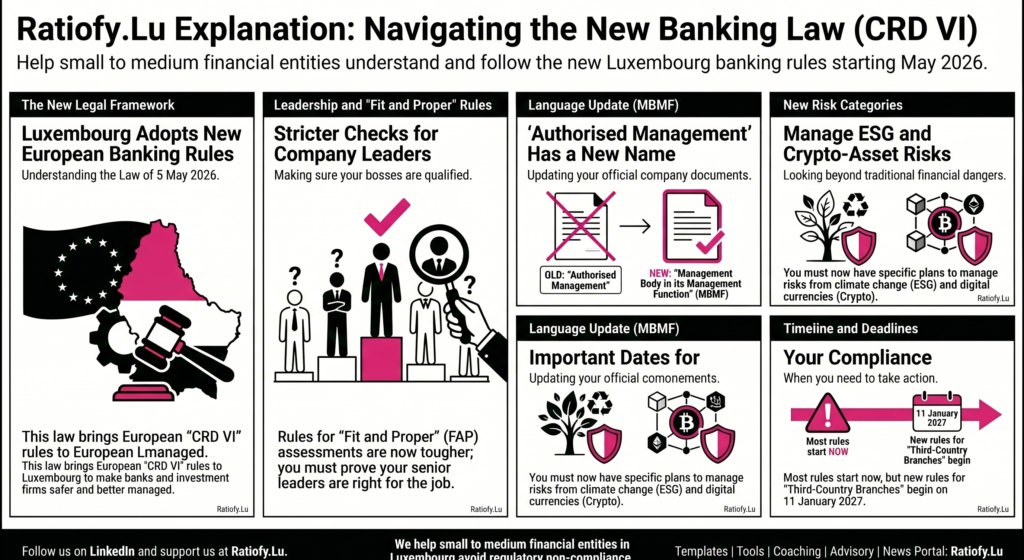
- Harmonized Third-Country Regime: A new prudential framework for third-country branches will apply starting 11 January 2027.
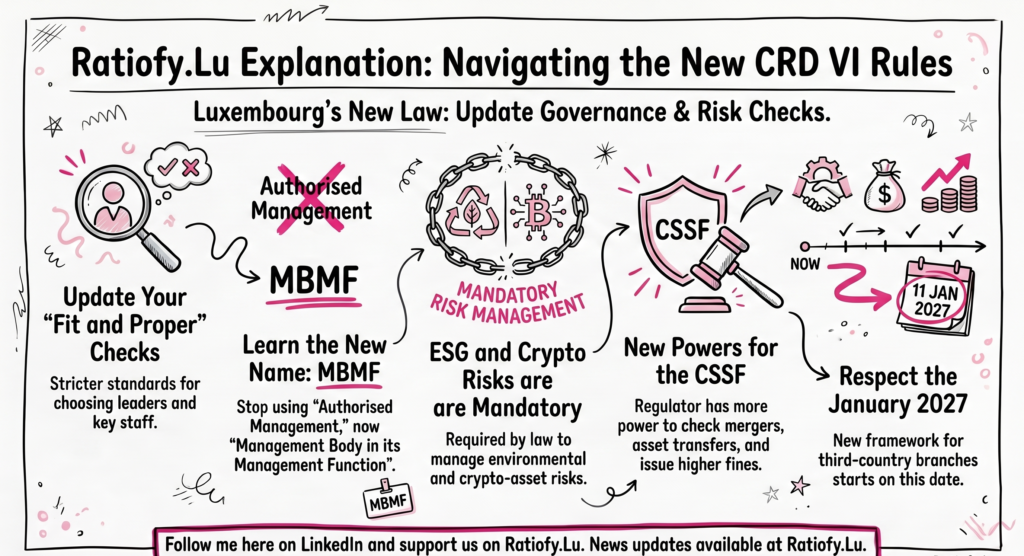
- Governance Terminology: The term “authorised management” is replaced by “Management Body in its Management Function” (MBMF).
- Tightened Fit and Proper (FAP) Criteria: Standards for assessing members of management bodies and key function holders have been increased.
- Regulatory Continuity: Circular CSSF 12/552 remains in force until updated in late 2026, except where the Law explicitly overrides current provisions.
Scope of the New Legislative Framework under Publication of the Law of 5 May 2026 transposing Directive (EU) 2024/1619 (CRD VI) and Directive (EU) 2024/2994 in Luxembourg
The Law of 5 May 2026 transposes two primary European directives that impact the operational and risk-management structures of CRR institutions and investment firms.
Directive (EU) 2024/1619 (CRD VI)
This directive focuses on the qualitative aspects of supervision, including:
- Supervisory Powers: Enhanced authority for the CSSF to oversee material operations, such as mergers and the transfer of assets.
- Risk Management: Introduction of specific requirements for managing ESG risks and risks associated with crypto-assets.
- Sanctions: A strengthening of the rules governing administrative penalties and measures.
- Authority Independence: Aspects regarding the independence of competent authorities and their staff are being handled under a separate legislative track (draft law no 8705).
Directive (EU) 2024/2994
This directive addresses technical risks within the financial system, specifically:
- Concentration Risk: Treatment of exposures toward central counterparties (CCPs).
- Counterparty Risk: Management of risks in centrally cleared derivative transactions.
Internal Governance and the “Fit and Proper” Procedure under Publication of the Law of 5 May 2026 transposing Directive (EU) 2024/1619 (CRD VI) and Directive (EU) 2024/2994 in Luxembourg
The CSSF has signaled a shift in how internal governance will be assessed and regulated following the enactment of the Law.
Updated Terminology and Circulars
- Circular CSSF 12/552: This circular, which governs central administration, internal governance, and risk management, will remain applicable in its current form until the European Banking Authority (EBA) completes its revision of internal governance guidelines (expected Q3 2026).
- MBMF Transition: Supervised entities must now interpret all references to “authorised management” in existing CSSF publications as “Management Body in its Management Function” (MBMF) to align with European terminology.
Enhanced Suitability Assessments under Publication of the Law of 5 May 2026 transposing Directive (EU) 2024/1619 (CRD VI) and Directive (EU) 2024/2994 in Luxembourg
The Law tightens the “Fit and Proper” (FAP) criteria used to assess the suitability of members of the management body and holders of key functions. The CSSF intends to adapt its prudential procedures to reflect these stricter standards and the forthcoming EBA guidelines.
Third-Country Branch Framework under Publication of the Law of 5 May 2026 transposing Directive (EU) 2024/1619 (CRD VI) and Directive (EU) 2024/2994 in Luxembourg
The Law introduces a new harmonized prudential framework specifically for third-country branches. This regime aims to create consistency in how banking services from outside the European Union are provided and supervised within Luxembourg.
- Application Date: Provisions relating to the third-country regime and branches will take effect on 11 January 2027.
- Transitional Period: A period of transition is provided to allow entities to align with the new requirements before the 2027 deadline.
Regulatory Timelines and Deadlines under Publication of the Law of 5 May 2026 transposing Directive (EU) 2024/1619 (CRD VI) and Directive (EU) 2024/2994 in Luxembourg
Supervised entities (CRR institutions and third-country branches) must monitor several key milestones throughout 2026 and 2027.
| Milestone | Expected Date |
| Publication of the Law of 5 May 2026 | 6 May 2026 |
| Publication of revised EBA guidelines (Governance/FAP) | End of Q3 2026 |
| Update to Circular CSSF 12/552 | Following EBA guidelines publication |
| Application of Third-Country Branch regime | 11 January 2027 |
Transparency and Data Management under Publication of the Law of 5 May 2026 transposing Directive (EU) 2024/1619 (CRD VI) and Directive (EU) 2024/2994 in Luxembourg
In conjunction with these regulatory updates, the CSSF maintains specific protocols for digital interaction and data transparency through its web platforms.
Communication Channels under Publication of the Law of 5 May 2026 transposing Directive (EU) 2024/1619 (CRD VI) and Directive (EU) 2024/2994 in Luxembourg
Supervised entities are directed to the CSSF website and the eDesk portal for official communications, prudential procedures, and updates to circulars. Direct inquiries regarding the Law of 5 May 2026 are handled by specific supervisory teams or the dedicated email address: banque@cssf.lu.
This news related to under Publication of the Law of 5 May 2026 transposing Directive (EU) 2024/1619 (CRD VI) and Directive (EU) 2024/2994 in Luxembourg can be considered beneficial under Credit Institutions News, EU Regulations, Explanation, Investment Firms News, Must Read, Opinion.
At https://Ratiofy.Lu/, we defend your hard-earned money with our free daily news platform and expert-vetted templates. Need more help? Request access to our hands-on expert Advisory, Training and Coaching Services (very limited availability) related to CSSF Circulars and EU Regulations.
The pre-filled example templates for many CSSF Circulars should be available at https://ratiofy.lu/templates/ from the summer of 2026.
New Era of Banking Oversight: 5 Takeaways from Luxembourg’s CRD VI Transposition
1. Introduction: The Quiet Revolution in Financial Stability under Publication of the Law of 5 May 2026 transposing Directive (EU) 2024/1619 (CRD VI) and Directive (EU) 2024/2994 in Luxembourg
While banking laws are often dismissed as dry technicalities, the Law of 5 May 2026 represents a fundamental shift in the global financial architecture. Published in the Journal Officiel (Memorial A n° 227) on 6 May 2026, this legislation does more than just transpose Directive (EU) 2024/1619 (CRD VI); it also integrates Directive (EU) 2024/2994, targeting concentration and counterparty risks in centrally cleared transactions. This is a necessary evolution for a digital-first and climate-conscious era, moving beyond traditional capital metrics to address the governance of modern risk. The CSSF’s communiqué, released on 12 May 2026, signals that we have entered a period of heightened scrutiny. Here are the top five takeaways for credit institutions and investment firms navigating this new landscape.
2. ESG and Crypto Move from the Margins to the Core under Publication of the Law of 5 May 2026 transposing Directive (EU) 2024/1619 (CRD VI) and Directive (EU) 2024/2994 in Luxembourg
Under the new framework, Environmental, Social, and Governance (ESG) risks and crypto-asset risks have officially moved from the regulatory periphery to the absolute center of the prudential framework. Once considered “alternative” risks primarily relegated to disclosure reports, these are now strictly codified as core safety and soundness concerns.
The significance here is operational: regulators now have the explicit power to intervene in an institution’s internal governance specifically to address ESG and crypto exposures. We are moving from a “comply or explain” disclosure model to active prudential oversight.
“CRD VI bolsters the internal governance framework of credit institutions, introduces new requirements relating to the management of ESG and crypto-asset risks, and grants enhanced prudential powers to supervisory authorities with respect to material operations, such as mergers or transfers of assets.”
3. The End of the “Authorised Management” Era under Publication of the Law of 5 May 2026 transposing Directive (EU) 2024/1619 (CRD VI) and Directive (EU) 2024/2994 in Luxembourg
Alignment with European Accountability
The Law introduces a pivotal shift in terminology that serves as a “compliance trap” for the unwary. The traditional Luxembourgish concept of “authorised management” is being replaced by the “Management Body in its Management Function” (MBMF). This is not a mere semantic update; it is a deliberate alignment with European terminology to ensure that every member of the management body in their executive role is held directly accountable under a unified EU standard.
From a consultant’s perspective, the most critical detail is the immediate applicability: the CSSF has clarified that any reference to “authorised management” in any existing regulatory publication – including the current Circular CSSF 12/552 – must now be read and understood as referring to the MBMF. Institutions must immediately re-interpret their internal charters and governance manuals through this lens.
4. Tightening the “Fit and Proper” Screws under Publication of the Law of 5 May 2026 transposing Directive (EU) 2024/1619 (CRD VI) and Directive (EU) 2024/2994 in Luxembourg
The “Fit and Proper” (FAP) assessment for management members and key function holders has been significantly tightened. This simultaneous move by the Luxembourgish legislature and the European Banking Authority (EBA) signals a zero-tolerance approach to governance failures.
Market participants should be prepared for a period of “regulatory flux.” The CSSF will adapt its prudential procedures following the EBA’s revised guidelines, which are expected in Q3 2026. This means institutions are currently operating in a window where the Law has raised the bar, but the final supervisory manual is still being written. Strategic hires and board appointments made today must be future-proofed against these impending, more rigorous standards.
5. A Unified Gateway for Third-Country Branches under Publication of the Law of 5 May 2026 transposing Directive (EU) 2024/1619 (CRD VI) and Directive (EU) 2024/2994 in Luxembourg
The Harmonized Prudential Framework
The Law of 5 May 2026 effectively ends the era of fragmented national regimes for non-EU banks by introducing a harmonized prudential framework for third-country branches (TCBs). This “unified gateway” ensures that branches of banks from outside the Union are subject to oversight comparable to their EU-headquartered peers.
The critical milestone is 11 January 2027. This is the hard deadline for the new TCB regime and the third-country banking services framework to become fully applicable. Non-EU entities must utilize this transitional window to reassess their Luxembourg footprint, as the path to compliance will involve significantly more administrative and prudential friction than in years past.
6. Enhanced Supervisory Teeth for Material Operations under Publication of the Law of 5 May 2026 transposing Directive (EU) 2024/1619 (CRD VI) and Directive (EU) 2024/2994 in Luxembourg
The CSSF has been granted enhanced prudential powers regarding “material operations,” such as mergers or asset transfers. This transforms the regulator from a reactive observer into a proactive gatekeeper. By granting the CSSF what effectively amounts to “veto-like” early intervention powers, the Law allows authorities to scrutinize corporate restructuring through a systemic risk lens before the ink is dry. For institutions planning M&A activity or significant asset shifts, regulatory engagement must now happen much earlier in the deal lifecycle.
7. Conclusion: The Road to 2027 and Beyond under Publication of the Law of 5 May 2026 transposing Directive (EU) 2024/1619 (CRD VI) and Directive (EU) 2024/2994 in Luxembourg
The publication of this Law is only one piece of the puzzle. The legislative roadmap includes Draft Law 8705, which will address the independence of competent authorities, and the highly anticipated update to Circular CSSF 12/552. Crucially, the CSSF has signaled that the update to this cornerstone circular will be conducted in collaboration with the ABBL, ensuring the industry has a voice in the technical implementation.
However, a vital compliance warning remains: while Circular 12/552 remains in force, any provisions directly amended by the Law apply immediately. As we look toward the EBA’s Q3 2026 guidelines and the 2027 TCB deadline, a fundamental question remains: Will these stricter governance and ESG mandates lead to a truly more resilient financial sector, or will the mounting complexity of these mandates create a new species of systemic risk?