
Luxembourg Financial Regulatory Advisory, Tools, Templates:
The article explains the Luxembourgish law of May 5, 2026, which establishes a comprehensive legal framework to ensure high-level cybersecurity across the nation. Transposing the European NIS 2 Directive, the legislation identifies essential and important entities across critical sectors such as energy, health, and digital infrastructure that must implement rigorous risk management and incident reporting protocols. It designates the Luxembourg Institute of Regulation (ILR) and the CSSF as primary supervisory authorities, while tasking the High Commission for National Protection with managing major crises and cross-border cooperation. The law mandates that organizational leadership take responsibility for digital security through mandatory training and oversight of technical safeguards. To ensure compliance, the text details a strict supervision and enforcement regime, including the power to conduct audits and impose significant administrative fines for security failures. Finally, it integrates these requirements with existing national strategies to bolster the resilience of critical infrastructure against evolving cyber threats.
| Sector | Entity Type | Classification (Inferred) |
| Energy | Electricity undertakings (supply function) | Highly Critical |
| Energy | Distribution system operators | Highly Critical |
| Energy | Transmission system operators | Highly Critical |
| Energy | Producers | Highly Critical |
| Energy | Operators of oil pipelines | Highly Critical |
| Energy | Natural gas undertakings | Highly Critical |
| Transport | Air carriers (commercial) | Highly Critical |
| Banking | Credit institutions | Highly Critical |
| Health | Healthcare providers | Highly Critical |
| Digital Infrastructure | Cloud computing service providers | Highly Critical |
| Public Administration | Public administration entities | Highly Critical |
| Manufacturing | Manufacturers of medical devices | Other Critical |
| Waste Management | Waste management undertakings | Other Critical |
| Digital Providers | Online marketplace providers | Other Critical |
| Research | Research organizations | Other Critical |
Summary of NIS2 in Luxembourg under Law of 5 May 2026 concerning measures to ensure a high level of cybersecurity in Luxembourg
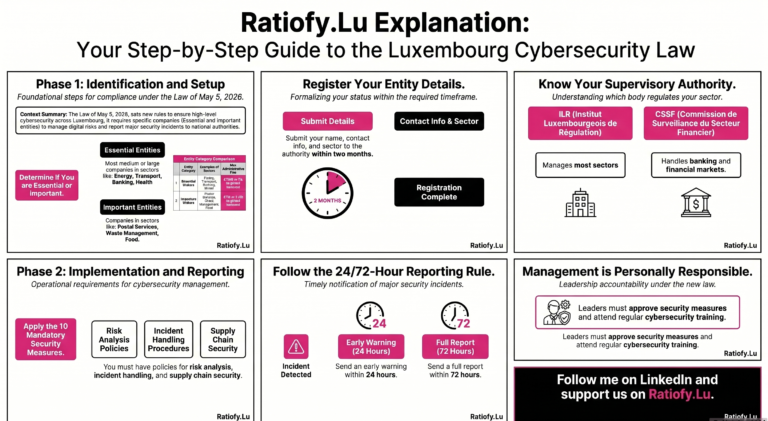
The Law of May 5, 2026, establishes a rigorous legal framework to ensure a high common level of cybersecurity across the Grand Duchy of Luxembourg, transposing European Union Directive 2022/2555 (NIS 2). The legislation applies to public and private entities operating in highly critical sectors—such as energy, transport, banking, and health—as well as other critical digital and industrial sectors.
Critical points to know under NIS2 in Luxembourg under Law of 5 May 2026 concerning measures to ensure a high level of cybersecurity in Luxembourg:
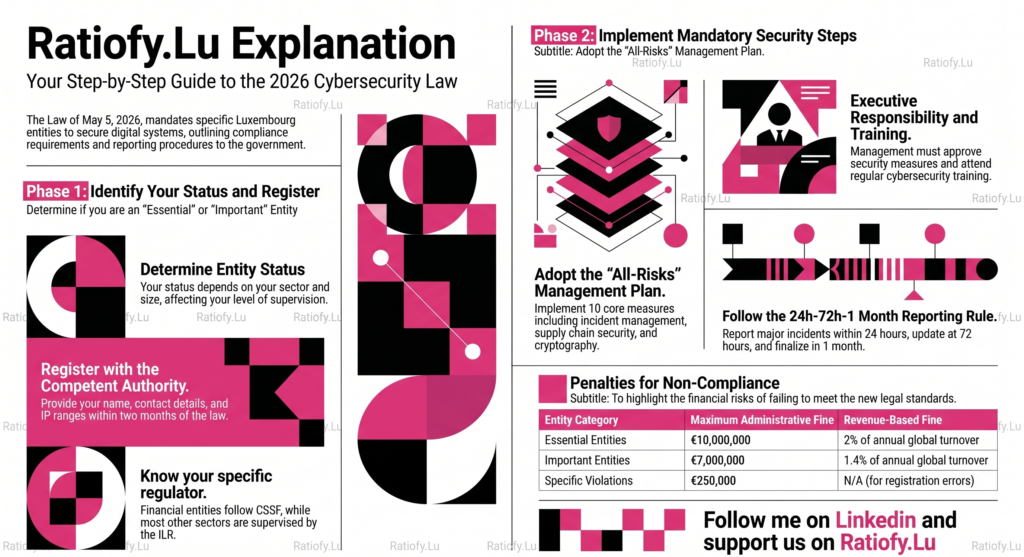
- Dual-Tier Entity Classification: Entities are categorized as “Essential” or “Important” based on their size, sector, and societal impact. Essential entities face stricter supervision and higher penalties.
- Regulatory Oversight: The Luxembourg Institute of Regulation (ILR) serves as the primary competent authority, while the Financial Sector Supervisory Commission (CSSF) oversees banking and financial market infrastructures.
- Mandatory Risk Management: Organizations must adopt an “all-hazards” approach to cybersecurity, including supply chain security, encryption, and incident response.
- Strict Reporting Timelines: Significant incidents must be reported via a phased approach, starting with an initial notification within 24 hours of discovery.
- Leadership Accountability: Management bodies are legally responsible for approving and supervising cybersecurity measures and must undergo mandatory training.
- Substantial Penalties: Non-compliance can result in administrative fines reaching up to €10,000,000 or 2% of total worldwide annual turnover for essential entities.
Scope and Applicability under NIS2 in Luxembourg under Law of 5 May 2026 concerning measures to ensure a high level of cybersecurity in Luxembourg
The law applies to entities that exceed the thresholds for medium-sized enterprises or are specifically identified due to their critical nature, regardless of size.
Targeted Entities
- Size-Based: Public or private entities classified as medium-sized enterprises (under Recommendation 2003/361/CE) or larger.
- Criticality-Based (Regardless of Size):
- Providers of public electronic communications networks/services.
- Trust service providers.
- DNS (Domain Name System) service providers and TLD (Top-Level Domain) name registries.
- Entities that are the sole providers of services essential for critical societal or economic activities in Luxembourg.
- Entities where service disruption could significantly impact public safety, security, or health, or induce systemic risks.
- Public administration entities.
- Entities identified as “critical” under the Law of May 5, 2026, on the resilience of critical entities.
Exemptions under NIS2 in Luxembourg under Law of 5 May 2026 concerning measures to ensure a high level of cybersecurity in Luxembourg
The law does not apply to:
- Entities excluded from the scope of Regulation (EU) 2022/2554 (DORA) for the financial sector.
- The State Intelligence Service, the Ministry of Defense, and the Luxembourg Army.
- Systems handling classified information under the Law of June 15, 2004.
Institutional Framework under NIS2 in Luxembourg under Law of 5 May 2026 concerning measures to ensure a high level of cybersecurity in Luxembourg
The law designates specific authorities to oversee cybersecurity and manage crises.
Competent Authorities
| Authority | Jurisdiction |
| Luxembourg Institute of Regulation (ILR) | General competent authority for sectors in Annex I and II and critical entities. |
| Financial Sector Supervisory Commission (CSSF) | Competent authority for banking, financial market infrastructures, and related digital/ICT services under its supervision. |
| High Commission for National Protection (HCPN) | Serves as the Single Point of Contact (SPOC) for cross-border and inter-sectoral cooperation. |
Crisis and Response Management under NIS2 in Luxembourg under Law of 5 May 2026 concerning measures to ensure a high level of cybersecurity in Luxembourg
- Authority for Cyber Crisis Management: The HCPN represents Luxembourg in the EU-CyCLONe network and manages major cybersecurity incidents.
- CSIRTs (Computer Incident Response Centers):
- GOVCERT.LU: Serves state administrations, public establishments, and critical entities.
- CIRCL: Serves all other entities and acts as the national coordinator for “coordinated vulnerability disclosure.”
Obligations for Essential and Important Entities under NIS2 in Luxembourg under Law of 5 May 2026 concerning measures to ensure a high level of cybersecurity in Luxembourg
Risk Management (Article 12)
Entities must implement technical, operational, and organizational measures based on an “all-hazards” approach. Minimum requirements include:
- Policies: Information system security and risk analysis.
- Incident Handling: Procedures for detection, response, and recovery.
- Business Continuity: Backup management and crisis recovery plans.
- Supply Chain Security: Evaluating the quality and cybersecurity practices of direct suppliers and service providers.
- Cyber Hygiene: Basic practices and staff training.
- Cryptography: Policies regarding the use of encryption.
- Authentication: Use of multi-factor or continuous authentication solutions.
Governance and Training (Article 13)
- Management Responsibility: Management bodies must approve and supervise the implementation of cybersecurity measures. They are held liable for violations.
- Mandatory Education: Members of management bodies must follow regular training to identify risks and evaluate management practices. Similar training must be offered to all staff.
Incident Notification (Article 14)
Entities must notify the competent authority of “significant incidents”—those causing serious operational disruption, financial loss, or damage to others.
The Phased Reporting Timeline under NIS2 in Luxembourg under Law of 5 May 2026 concerning measures to ensure a high level of cybersecurity in Luxembourg:
- Preliminary Notification: Within 24 hours (24h for trust services) of becoming aware of the incident.
- Incident Notification: Within 72 hours, providing an initial assessment of severity and impact.
- Final Report: Within one month of the incident notification, providing a detailed description and the root cause.
Supervision and Enforcement under NIS2 in Luxembourg under Law of 5 May 2026 concerning measures to ensure a high level of cybersecurity in Luxembourg
Authorities have extensive powers to ensure compliance, with a distinction between the supervision of “Essential” and “Important” entities.
Supervisory Powers
- Essential Entities: Subject to proactive supervision, including on-site inspections, regular security audits by independent bodies, and security scans.
- Important Entities: Subject to ex post supervision (after the fact) triggered by evidence or indications of non-compliance.
Administrative Sanctions and Fines under NIS2 in Luxembourg under Law of 5 May 2026 concerning measures to ensure a high level of cybersecurity in Luxembourg
Authorities may issue warnings, formal instructions, or binding injunctions. Financial penalties are categorized by entity type:
| Entity Type | Maximum Fine | Percentage of Turnover (if higher) |
| Essential Entities | €10,000,000 | 2% of total worldwide annual turnover |
| Important Entities | €7,000,000 | 1.4% of total worldwide annual turnover |
Other Enforcement Actions under NIS2 in Luxembourg under Law of 5 May 2026 concerning measures to ensure a high level of cybersecurity in Luxembourg:
- Management Bans: Authorities may request the temporary suspension of a director’s right to exercise management functions in cases of persistent non-compliance.
- Publicity: Entities may be ordered to make violations public.
- Daily Fines (Astreintes): Up to €1,250 per day (capped at €25,000 total) to compel compliance with an order.
National Cybersecurity Strategy and DNS Management under NIS2 in Luxembourg under Law of 5 May 2026 concerning measures to ensure a high level of cybersecurity in Luxembourg
National Strategy
The HCPN is tasked with adopting a National Cybersecurity Strategy that includes:
- A framework for identifying relevant assets and assessing risks.
- Policies for supply chain security and vulnerability management.
- Measures to improve citizen awareness and “cyber-hygiene” for SMEs.
- A National Response Plan for major cyber crises.
DNS and Domain Registration (Article 18)
TLD (Top-Level Domain) registries and registration service providers must:
- Maintain a database of accurate and complete registration data (names, emails, phone numbers).
- Implement verification procedures.
- Publicly disclose non-personal registration data.
- Respond to legitimate access requests within 72 hours.
Sectoral Classifications (Annex I & II) under NIS2 in Luxembourg under Law of 5 May 2026 concerning measures to ensure a high level of cybersecurity in Luxembourg
The law identifies two tiers of sectors based on their criticality to the state and economy.
Annex I: Highly Critical Sectors under NIS2 in Luxembourg under Law of 5 May 2026 concerning measures to ensure a high level of cybersecurity in Luxembourg
- Energy: Electricity, district heating/cooling, oil, gas, and hydrogen.
- Transport: Air, rail, water, and road.
- Banking and Financial Market Infrastructures.
- Health: Healthcare providers, laboratories, and pharmaceutical manufacturing.
- Water: Drinking water supply and distribution; waste water management.
- Digital Infrastructure: IXPs, DNS, TLDs, Cloud computing, data centers, CDNs, and Trust services.
- ICT Service Management (B2B).
- Public Administration.
- Space.
Annex II: Other Critical Sectors under NIS2 in Luxembourg under Law of 5 May 2026 concerning measures to ensure a high level of cybersecurity in Luxembourg
- Postal and Courier Services.
- Waste Management.
- Chemicals: Manufacture, production, and distribution.
- Food: Production, processing, and distribution.
- Manufacturing: Medical devices, electronics, electrical equipment, machinery, and motor vehicles.
- Digital Providers: Online marketplaces, search engines, and social networking platforms.
- Research Organizations.
As the situation is still developing, there could be updates on the official link.
This news related to under NIS2 in Luxembourg under Law of 5 May 2026 concerning measures to ensure a high level of cybersecurity in Luxembourg can be considered beneficial under CSSF-Circulars, Central Securities Depositories (CSDs) News, Credit Institutions News, Crowdfunding service providers (CSPs) News, Crypto-Assets Service Providers (CASPs) and Virtual Asset Service Providers (VASPs) News, Data Reporting Service Providers (DRSPs) News, EU Regulations, Explanation, IFMs (AIFMs, ManCos) News, Investment Firms News, Issuers of Tokens (EMTs, ARTs) News, Multimedia, Must Read, Opinion, Payment Institutions (PIs) / Electronic Money Institutions (EMIs) /AISPs News, Pension funds News, PFS/PSF News, Undertakings for collective investment (UCIs).
At https://Ratiofy.Lu/, we defend your hard-earned money with our free daily news platform and expert-vetted templates. Need more help? Request access to our hands-on expert Advisory, Training and Coaching Services (very limited availability) related to CSSF Circulars and EU Regulations.
The pre-filled example templates for many CSSF Circulars should be available at https://ratiofy.lu/templates/ from the summer of 2026.
Foundation of Cybersecurity Oversight: A Guide to the Law of May 5, 2026: under NIS2 in Luxembourg under Law of 5 May 2026 concerning measures to ensure a high level of cybersecurity in Luxembourg
1. Introduction: The Purpose of Legal Oversight under NIS2 in Luxembourg under Law of 5 May 2026 concerning measures to ensure a high level of cybersecurity in Luxembourg
The Law of May 5, 2026, marks a definitive shift in the Grand Duchy’s approach to digital sovereignty and resilience. This legislation is not a mere bureaucratic exercise; its core objective is to mandate a “high common level of cybersecurity” across the national infrastructure. By transposing the European NIS2 framework into national law, the state recognizes that in a hyper-connected economy, the security posture of a single entity is no longer a private internal matter, but a pillar of national security.
The “So What?” for the Reader Modern resilience is built on the strength of the weakest link. Because our societal functions—ranging from energy distribution to financial stability—depend on a complex web of interconnected providers, a single failure can trigger a systemic collapse or a cross-border crisis. This law ensures that every critical actor operates under a rigorous, harmonized protective standard, safeguarding not only individual business continuity but the collective stability of the nation and the European Union.
Having established this legislative intent, organizations must now determine their specific classification and obligations under the Act’s two-tier oversight model.
2. Identifying Regulated Entities: Essential vs. Important under NIS2 in Luxembourg under Law of 5 May 2026 concerning measures to ensure a high level of cybersecurity in Luxembourg
The law utilizes a risk-based categorization to ensure that oversight is proportionate to an organization’s impact on society. While size (staff and turnover) is a primary factor, the law also accounts for the critical nature of specific services regardless of the provider’s scale.
Entity Classification
| Essential Entities (High Oversight) | Important Entities (Standard Oversight) |
| Large Enterprises: Operating in “Highly Critical” sectors (Annex I) that exceed the thresholds for medium enterprises. | Medium Enterprises: Operating in Annex I or Annex II sectors that do not meet the “Essential” threshold. |
| Specific Infrastructure: DNS service providers, TLD registries, and Qualified Trust Service Providers (regardless of size). | Discretionary Designation: Entities identified as “Important” due to regional or sectoral impact. |
| Systemic Risk Actors: Any entity—regardless of size—identified by authorities as a sole provider, a source of potential systemic risk, or of specific regional importance (Art. 11.1.5). | Standard Scope: Any entity in a regulated sector that is not explicitly classified as “Essential.” |
| Public Administration: All State administration and public services (Art. 1.2.6). |
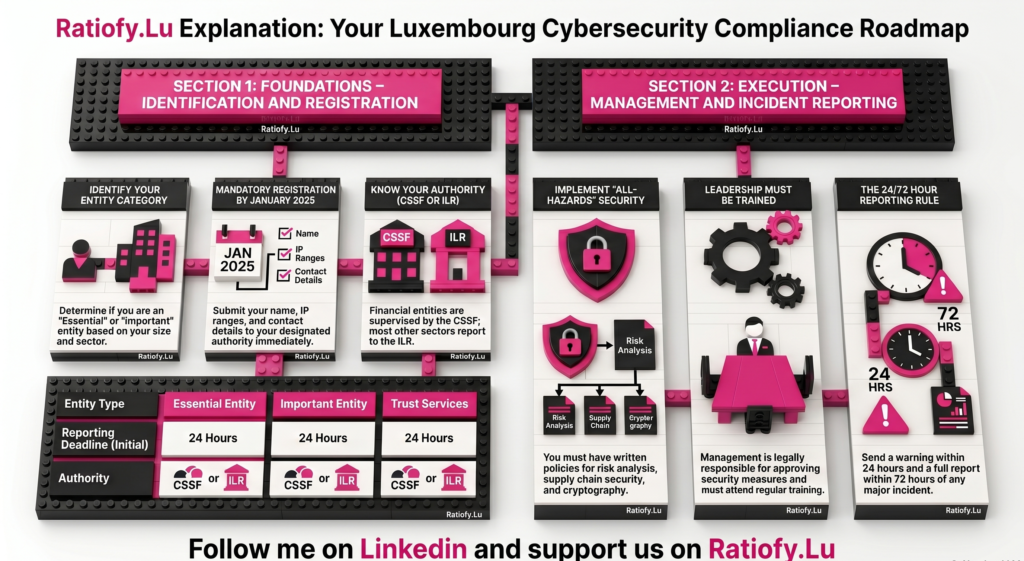
Compliance Deadline: Under Article 11(4), all regulated entities must register their identity, IP ranges, and relevant sectors with the competent authorities within two months of the law’s entry into force.
Scope of Sectors Covered
- Highly Critical Sectors (Annex I): Energy (Electricity, Oil, Gas, Hydrogen, District Heating), Transport (Air, Rail, Water, Road), Banking and Financial Markets, Health, Drinking Water and Waste Water, Digital Infrastructure (IXPs, Cloud, Data Centers, Trust Services), ICT Service Management (Managed Service/Security Providers), Public Administration, and Space.
- Other Critical Sectors (Annex II): Postal and Courier Services, Waste Management, Chemical Production/Distribution, Food Production/Transformation, Manufacturing (Medical Devices, Electronics, Electrical Equipment, Machinery, Vehicles), Digital Providers (Online Marketplaces, Search Engines, Social Networks), and Research Organizations.
Once classification is determined, entities must pivot immediately toward implementing the mandatory risk management framework.
3. The Pillars of Data Protection: Risk Management Duties under NIS2 in Luxembourg under Law of 5 May 2026 concerning measures to ensure a high level of cybersecurity in Luxembourg
Article 12 mandates an “all-hazards” approach. This requires entities to move beyond traditional IT security and protect their entire operational environment from both cyber and physical threats through ten mandatory measures:
- Risk Analysis & Security Policies
- Primary Benefit: Provides a strategic baseline for identifying and prioritizing high-impact vulnerabilities before exploitation.
- Incident Management
- Primary Benefit: Minimizes operational downtime by establishing clear protocols for detection, containment, and remediation.
- Business Continuity & Crisis Management
- Primary Benefit: Ensures the survival of essential services through robust backup management and disaster recovery strategies.
- Supply Chain Security
- Primary Benefit: Mitigates “backdoor” risks by forcing a security-first evaluation of all third-party vendors and service providers.
- Network/System Security & Vulnerability Handling
- Primary Benefit: Hardens the digital perimeter through proactive patching and secure development lifecycles.
- Efficiency Assessment Procedures
- Primary Benefit: Validates the actual effectiveness of security investments through regular, evidence-based testing.
- Cyber Hygiene & Training
- Primary Benefit: Addresses the most common attack vector—the human element—by fostering a culture of security awareness.
- Cryptography & Encryption
- Primary Benefit: Safeguards the confidentiality and integrity of data, rendering it useless to unauthorized interceptors.
- Human Resources & Access Control
- Primary Benefit: Enforces the principle of least privilege, preventing unauthorized internal or external lateral movement.
- Multi-factor Authentication (MFA) & Secure Communications
- Primary Benefit: Establishes a redundant layer of identity verification for all access points and critical internal exchanges.
While these internal protections are the primary line of defense, the law demands absolute transparency through a structured reporting regime when a breach occurs.
4. Incident Reporting: The Critical Timeline under NIS2 in Luxembourg under Law of 5 May 2026 concerning measures to ensure a high level of cybersecurity in Luxembourg
Organizations are legally required to notify authorities of any “significant incident.” The reporting window is narrow, emphasizing the need for immediate situational awareness.
Incident Notification Milestones
- T+24 Hours: Preliminary Notification. An initial “early warning” indicating if the incident is malicious or likely to have a cross-border impact.
- T+72 Hours: Intermediate Update. A detailed assessment of severity and impact, including available “indicators of compromise.”
- T+1 Month: Final Detailed Report. A comprehensive post-mortem detailing the root cause, mitigation steps, and transborder consequences.
Defining a “Significant Incident”
Under Article 14(3), an incident is significant if it:
- Causes severe operational disruption or substantial financial loss for the entity.
- Causes considerable material, bodily, or moral damage to other natural or legal persons.
While rapid technical reporting is vital, the ultimate legal responsibility for an organization’s readiness rests with its top leadership.
5. Leadership Accountability and Training under NIS2 in Luxembourg under Law of 5 May 2026 concerning measures to ensure a high level of cybersecurity in Luxembourg
The Law of May 5, 2026, removes the “IT silo” excuse. Article 13 places the burden of compliance squarely on the “management organs” of the organization.
- Approval & Supervision: Leadership must formally approve all cybersecurity measures and are legally liable for overseeing their implementation (Art. 13.1).
- Personal Liability: Management can be held personally responsible for failures to ensure the entity complies with the law (Art. 22.6).
- Mandatory Training: Management members must undergo regular, specialized training to evaluate cyber risks and their impact on the services they lead.
Failure by leadership to prioritize these duties can lead to direct intervention by national supervisory authorities.
6. Consequences of Non-Compliance: Supervision and Penalties under NIS2 in Luxembourg under Law of 5 May 2026 concerning measures to ensure a high level of cybersecurity in Luxembourg
The law is enforced by specialized authorities: the CSSF governs the banking and financial markets, while the ILR supervises all other regulated sectors.
Supervisory Powers
Authorities have the mandate to verify compliance through:
- Inspections: On-site visits and remote monitoring.
- Audits: Mandatory security audits conducted by independent professionals.
- Proactive Scanning: CSIRTs (GOVCERT.LU/CIRCL) may perform non-intrusive scans of publicly accessible systems to detect vulnerabilities (Art. 8).
Administrative Fines (Art. 26)
Fines are calculated based on global turnover, ensuring they are “effective, proportionate, and dissuasive.”
| Entity Type | Maximum Administrative Fine |
| Essential Entities | Up to €10,000,000 or 2% of total global turnover (whichever is higher). |
| Important Entities | Up to €7,000,000 or 1.4% of total global turnover (whichever is higher). |
Management Penalties
Beyond financial levies, Article 22 grants authorities the power to:
- Request the temporary suspension of service certifications.
- Prohibit individuals (including CEOs and legal representatives) from exercising management functions until compliance is achieved.
As a Summary: A Collaborative Framework under NIS2 in Luxembourg under Law of 5 May 2026 concerning measures to ensure a high level of cybersecurity in Luxembourg
While the penalties are severe, the law also provides robust support mechanisms. The CIRCL acts as a trusted intermediary through the Coordinated Disclosure of Vulnerabilities (CVD) process (Art. 9), facilitating communication between security researchers and companies. Furthermore, the government provides proactive scanning tools to help entities identify flaws before they are exploited. This balance of strict accountability and state-level support ensures that Luxembourg remains a resilient and trusted digital hub.
The GDPR of Cybersecurity? 5 Surprising Realities of Luxembourg’s New Cyber Law: NIS2 in Luxembourg under Law of 5 May 2026 concerning measures to ensure a high level of cybersecurity in Luxembourg
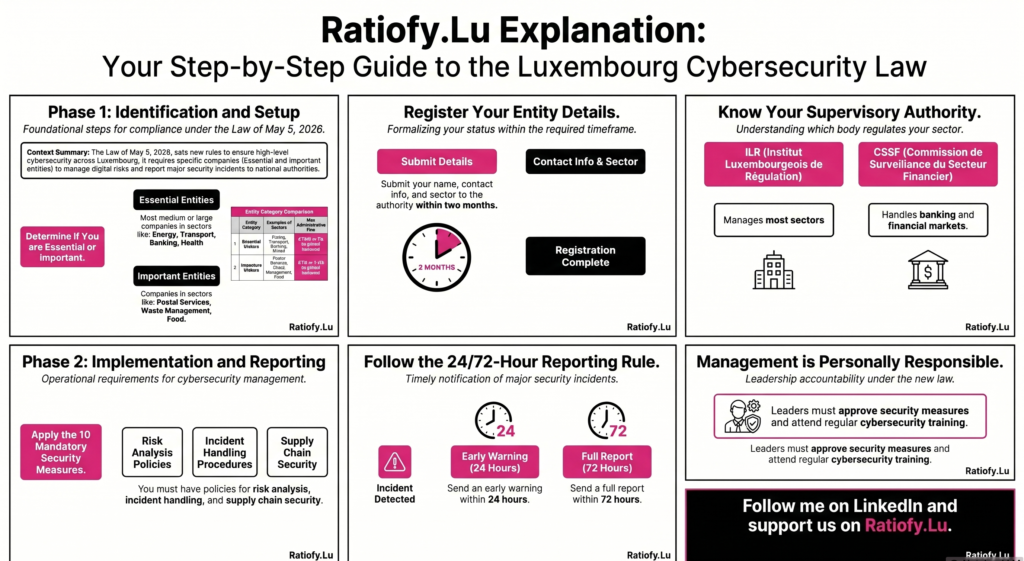
For years, cybersecurity was often relegated to the “IT problem” pile—a technical hurdle to be cleared by specialists in windowless server rooms. But as ransomware cripples local economies and state-sponsored threats become a boardroom reality, the Grand Duchy has signaled that digital resilience is no longer a technical preference. It is a legal mandate.
With the passage of the Loi du 5 mai 2026, Luxembourg has officially ended the era of voluntary “best practices.” This landmark legislation transforms cybersecurity from a vague insurance requirement into a rigorous regulatory framework. For business leaders, the message is clear: the server room has met the courtroom.
Here are five surprising realities of Luxembourg’s new cyber law that every director, manager, and citizen needs to understand.
1. The CEO is on the Hook: Personal Liability for Management under NIS2 in Luxembourg under Law of 5 May 2026 concerning measures to ensure a high level of cybersecurity in Luxembourg
The Loi du 5 mai 2026 effectively drags cybersecurity out of the basement and places it squarely on the mahogany desk of the CEO. Under Article 13, cybersecurity is codified as a governance issue. Management bodies are now legally required to approve risk-management measures and, more importantly, supervise their implementation.
The law creates a high-stakes distinction between Essential and Important entities (defined in Article 11). Essential entities face “Ex-ante” supervision—meaning the state won’t wait for a breach to check your homework; they can perform proactive audits and inspections (Art. 22). Important entities are subject to “Ex-post” supervision, meaning the regulator’s hammer usually falls after an incident occurs (Art. 23). Regardless of the category, management can no longer plead technical ignorance.
“Management bodies of essential and important entities approve the cybersecurity risk-management measures taken by those entities to comply with Article 12, supervise their implementation and may be held liable for the infringement of the said Article by those entities.” — Art. 13(1)
To prevent “willful ignorance,” the law mandates that leadership teams undergo regular training to identify risks and assess the impact of security practices on their services. In short: if your organization fails, the regulator will ask what you personally did to prevent it.
2. Beyond Big Tech: The Legal Deputization of the Supply Chain under NIS2 in Luxembourg under Law of 5 May 2026 concerning measures to ensure a high level of cybersecurity in Luxembourg
One of the most profound shifts in this law is its reach. While many assume these regulations target only banks or telecom giants, Annex I and II reveal a massive scope that includes the “hidden” infrastructure of society.
The law recognizes the radical interconnectedness of modern life. If a waste management firm’s logistics are paralyzed, a city stops. If a food distributor’s inventory is wiped, shelves go empty. Under Annex II, the law explicitly covers:
- Waste Management: Companies executing waste management operations (Annex II, 2).
- Food Production and Distribution: Industrial processing and wholesale distribution (Annex II, 4).
- Postal and Courier Services: Including shipping and delivery providers (Annex II, 1).
- Chemicals: Manufacturing and distribution of chemical substances (Annex II, 3).
Perhaps more surprising is the Supply Chain Mandate (Art. 12(2)(4°)). The law now legally requires these entities to account for the “cyber-hygiene” of their vendors. You are now legally responsible for the security of your suppliers. This effectively “deputizes” every large organization in Luxembourg to audit the security of their smaller partners, creating a trickle-down effect of compliance that will touch nearly every business in the country.
3. The 24-Hour Dash: A Brutal New Reporting Standard under NIS2 in Luxembourg under Law of 5 May 2026 concerning measures to ensure a high level of cybersecurity in Luxembourg
When a crisis hits, the first 24 hours are usually spent in a state of forensic triage—trying to keep the lights on while identifying the source of the breach. The Loi du 5 mai 2026 complicates this by demanding a “preliminary notification” within a window that will feel impossibly tight during a live attack.
Article 14 establishes a tiered notification marathon:
- 24-Hour Preliminary Notification: A high-pressure “first look” at the incident.
- 72-Hour Incident Notification: An initial assessment of severity and cross-border impact.
- 1-Month Final Report: A deep-dive description of the root cause and mitigation measures.
“Without undue delay and in any event within twenty-four hours after having become aware of the significant incident, [entities shall submit] a preliminary notification which, where applicable, indicates whether the significant incident is suspected of being caused by unlawful or malicious acts or could have a cross-border impact.” — Art. 14(4)(1°)
This is not just a technical challenge; it is a logistical nightmare. Imagine a ransomware attack discovered at 5:00 PM on a Friday. Your legal, PR, and technical teams must now coordinate, assess, and report to the state before Saturday evening. Failure to do so isn’t just a lapse in protocol—it’s a violation of the law.
4. The Price of Negligence: Fines That Rival GDPR under NIS2 in Luxembourg under Law of 5 May 2026 concerning measures to ensure a high level of cybersecurity in Luxembourg
The state has ensured that the cost of compliance is significantly lower than the cost of a fine. The administrative sanctions outlined in Article 26 are designed to be “effective, proportionate, and dissuasive,” mirroring the heavy-handed nature of the GDPR.
The maximum fines depend on the entity’s designation and are calculated against global scale:
- Essential Entities: Up to €10,000,000 or 2% of the total worldwide annual turnover of the preceding financial year, whichever is higher.
- Important Entities: Up to €7,000,000 or 1.4% of the total worldwide annual turnover of the preceding financial year, whichever is higher.
By tying fines to worldwide turnover rather than local revenue, Luxembourg is signaling that cybersecurity is a fundamental risk to the national economy and public safety.
5. The “Watchmen” Are Scanning: Proactive State Patrols under NIS2 in Luxembourg under Law of 5 May 2026 concerning measures to ensure a high level of cybersecurity in Luxembourg
Perhaps the most “surprising reality” is that the state is no longer waiting for you to call them for help. Under Article 8, Luxembourg’s Computer Incident Response Centers (CSIRTs), such as CIRCL or GOVCERT.LU, have been granted the power to actively patrol the nation’s digital perimeter.
The law authorizes these CSIRTs to perform “proactive, non-intrusive scans” of publicly accessible networks and information systems. Crucially, they do not need your prior request or permission to do this. They are essentially digital health inspectors, scanning for unlocked doors and unpatched vulnerabilities in the nation’s infrastructure.
If the CSIRTs find a weakness, they will inform the entity. This marks a paradigm shift from reactive defense to a state-monitored “cyber-hygiene” culture. The state is no longer just the fire department arriving after the blaze; it is now the building inspector checking your wiring while you’re still at work.
Conclusion: A New Era of Digital Trust under NIS2 in Luxembourg under Law of 5 May 2026 concerning measures to ensure a high level of cybersecurity in Luxembourg
The Loi du 5 mai 2026 represents a definitive transition for Luxembourg. Cybersecurity has graduated from a list of technical “best practices” to a regulated pillar of national security. By mandating board-level liability, enforcing aggressive reporting windows, and legalizing proactive state scanning, the law treats our digital infrastructure with the same gravity as our water and electricity.
As organizations scramble to align with these requirements, one question remains for every business leader: “In a world where digital infrastructure is as vital as the air we breathe, is your organization ready to treat cybersecurity as a fundamental legal obligation rather than just an insurance policy?”